
Midol is a brand of over-the-counter menstrual relief products, and whether you can take it while breastfeeding depends on which specific formulation you use. Midol Long Lasting Relief contains only acetaminophen, which the National Institutes of Health classifies as an L1 (safest) lactation category. However, Midol Complete contains pyrilamine maleate, an antihistamine rated L3 that may reduce milk supply, and Midol Bloat Relief contains pamabrom, a diuretic that can affect hydration and lactation. Your safest approach is choosing a single-ingredient pain reliever and consulting your healthcare provider.
Key takeaways
When your period returns after pregnancy — which can happen anywhere from two months to over a year postpartum — you may reach for the same menstrual relief you relied on before. But if you are breastfeeding, the question becomes more complicated. Every medication you take has the potential to pass into your breast milk, and what was perfectly safe before pregnancy now requires a second look.
Midol is one of the most recognized over-the-counter brands for period symptom relief. What many mothers do not realize is that Midol is not a single product — it is a family of six different formulations, each with a distinct combination of active ingredients. Some of those ingredients are fully compatible with breastfeeding. Others carry real concerns. This guide breaks down every current Midol product ingredient by ingredient, maps each to its lactation safety rating, and offers evidence-based alternatives so you can manage your period pain without putting your baby or your milk supply at risk.
Can you safely take Midol while breastfeeding?
Whether Midol is safe while breastfeeding depends entirely on which Midol product you are taking, because different formulations contain different active ingredients with different lactation risk profiles. Midol Long Lasting Relief, which contains only extended-release acetaminophen, is generally considered compatible with breastfeeding. Midol Complete, which adds caffeine and the antihistamine pyrilamine maleate, requires more caution. And Midol Bloat Relief, which contains the diuretic pamabrom, is best avoided while nursing.
This is not a simple yes-or-no question — it is a formulation-by-formulation question. The sections below walk through each product and each ingredient so you can make an informed decision with your healthcare provider.
What active ingredients are in each Midol product?
Midol is a brand name covering six distinct over-the-counter products manufactured by Bayer, each formulated for different period symptoms. Many online resources treat “Midol” as a single medication, which leads to inaccurate safety advice. Here is the current Midol lineup and what each product contains, verified from the manufacturer’s official product pages and FDA drug label data (DailyMed):
Midol Complete and Midol Complete On-the-Go contain acetaminophen 500 mg (pain reliever), caffeine 60 mg (alertness aid and pain enhancer), and pyrilamine maleate 15 mg (antihistamine for bloating and irritability). Midol Complete Caffeine Free contains acetaminophen 500 mg and pyrilamine maleate 15 mg without caffeine. Midol Long Lasting Relief contains only extended-release acetaminophen 650 mg. Midol Bloat Relief contains only pamabrom 50 mg, a mild diuretic. Midol Heat Vibes is a drug-free adhesive warming patch.
How safe is each Midol ingredient during breastfeeding?
Hale’s Lactation Risk Categories classify medications on a scale from L1 (safest, with extensive human data supporting safety) through L5 (contraindicated). The Drugs and Lactation Database (LactMed), maintained by the National Library of Medicine, provides peer-reviewed summaries of each substance’s transfer into breast milk. Here is what these sources say about each active ingredient found in Midol products:
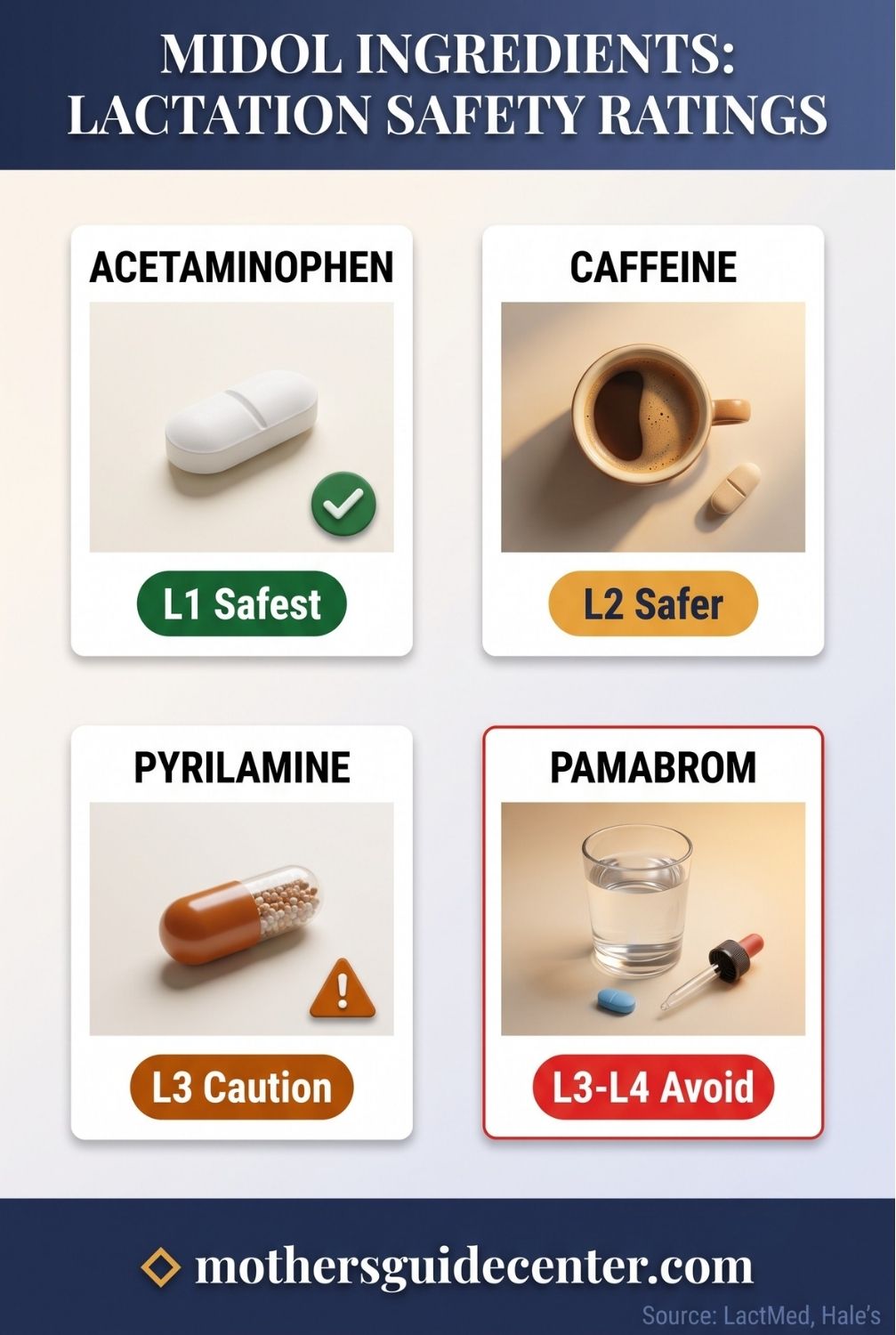
Acetaminophen (Hale’s L1 — Safest). Acetaminophen is one of the preferred analgesics for breastfeeding mothers. According to LactMed, only small amounts transfer into breast milk — far below pediatric therapeutic doses. The American Academy of Pediatrics rates it compatible with breastfeeding. It does not affect milk supply.
Caffeine (Hale’s L2 — Safer). Midol Complete contains 60 mg of caffeine per caplet — roughly equivalent to half a standard cup of coffee. According to LactMed, caffeine transfers into breast milk, and most experts recommend keeping total daily intake under 300 mg while breastfeeding. At 60 mg per dose, a single Midol Complete is unlikely to cause issues for most infants, but newborns metabolize caffeine more slowly and may show irritability or disrupted sleep.
Pyrilamine maleate (Hale’s L3 — Probably Compatible). Pyrilamine is an older, first-generation antihistamine included in Midol Complete for its mild sedative and bloating-relief effects. According to Drugs.com’s LactMed summary, antihistamines given in relatively high doses by injection can decrease basal serum prolactin — the hormone that drives milk production. While lower oral doses have not been conclusively shown to reduce supply, the InfantRisk Center recommends that breastfeeding mothers prefer newer nonsedating antihistamines (such as cetirizine or loratadine) over first-generation options when antihistamines are needed. Pyrilamine may also cause drowsiness in both the mother and the nursing infant.
Pamabrom (Hale’s L3-L4 — Probably Compatible to Possibly Hazardous). Pamabrom is a mild diuretic used in Midol Bloat Relief to reduce water retention. It works by increasing urine output, which raises a direct concern for breastfeeding mothers: adequate hydration is essential for maintaining milk production. Pamabrom also contains bromide compounds, which some lactation references note are not considered compatible with breastfeeding. For these reasons, most lactation experts recommend avoiding pamabrom-containing products while nursing.
Which Midol product is safest while breastfeeding?
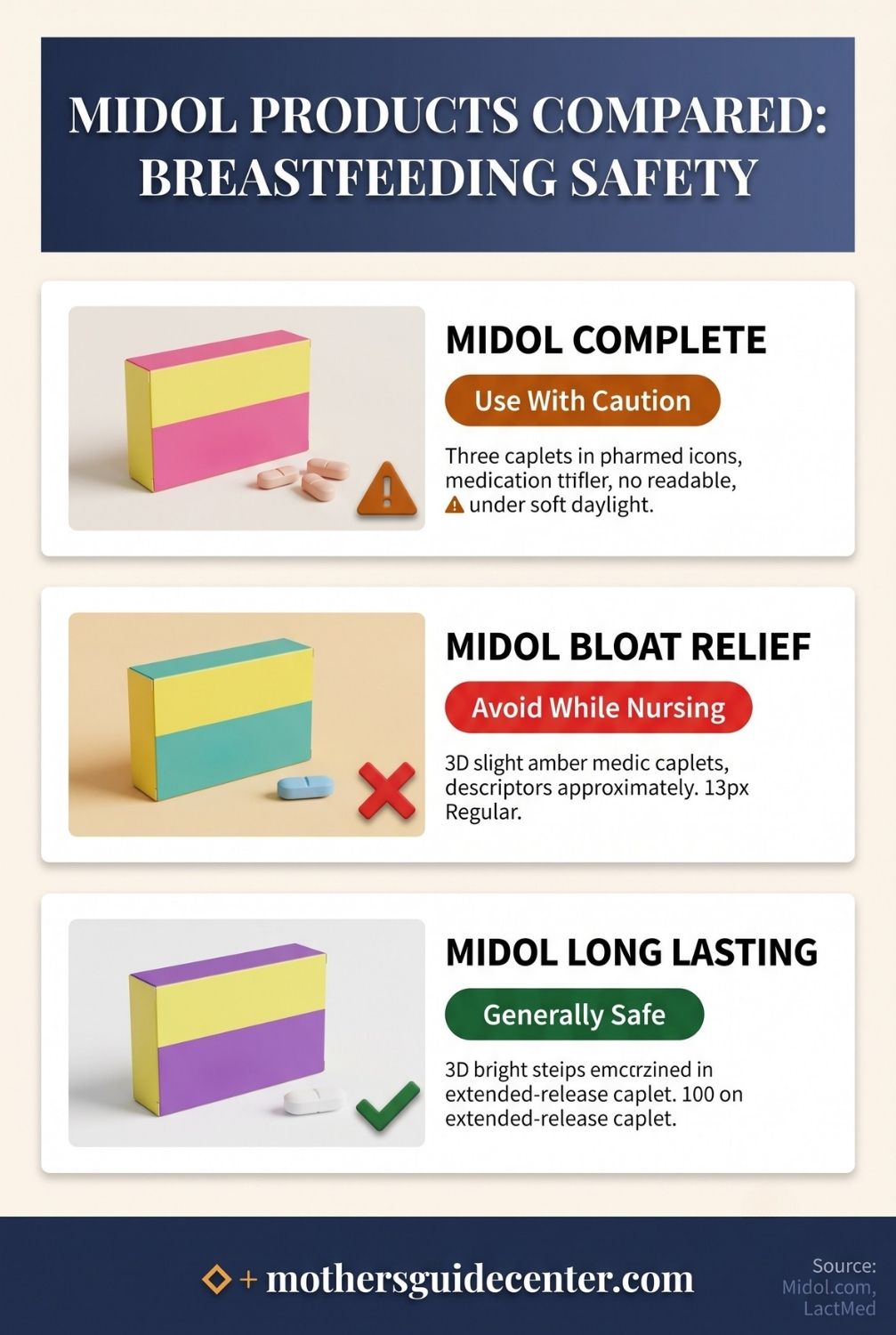
Among current Midol products, Midol Long Lasting Relief and Midol Heat Vibes carry the lowest breastfeeding risk because they either contain only acetaminophen (L1) or no medication at all. The comparison table below summarizes the breastfeeding safety profile of every current Midol formulation:
| Product | Active Ingredients | Hale’s Rating | BF Verdict |
|---|---|---|---|
| Midol Complete | Acetaminophen 500 mg, Caffeine 60 mg, Pyrilamine 15 mg | L1 / L2 / L3 | ⚠️ Caution — short-term only |
| Midol Complete Caffeine Free | Acetaminophen 500 mg, Pyrilamine 15 mg | L1 / L3 | ⚠️ Caution — antihistamine concern |
| Midol Long Lasting Relief | Acetaminophen 650 mg (extended-release) | L1 | ✅ Generally safe |
| Midol Bloat Relief | Pamabrom 50 mg | L3-L4 | ❌ Avoid while nursing |
| Midol Heat Vibes | None (adhesive heat patch) | N/A | ✅ Drug-free, safe |
| Midol Complete On-the-Go | Same as Midol Complete | L1 / L2 / L3 | ⚠️ Same as Complete |
Does Midol affect your milk supply?
Milk supply can be affected by two Midol ingredients: pyrilamine maleate and pamabrom — though through different mechanisms. Acetaminophen and caffeine (at the doses found in Midol) have not been shown to impact milk production.
Pyrilamine maleate is a first-generation antihistamine. According to research summarized in LactMed, antihistamines given at relatively high doses can decrease basal serum prolactin in postpartum women. Prolactin is the primary hormone driving milk production. While the lower oral doses found in Midol Complete (15 mg) have not been conclusively shown to reduce supply, the theoretical risk exists — particularly with repeated or prolonged use. If you are already struggling with low supply, this is an ingredient worth avoiding.
Pamabrom works as a diuretic, increasing urine output to reduce bloating. Breastfeeding mothers need adequate hydration to maintain milk production — any substance that promotes fluid loss works against that goal. If you take Midol Bloat Relief, you may notice a temporary dip in output, especially if you are not compensating with extra fluid intake.
What is the safest way to take Midol while breastfeeding?
If you and your healthcare provider decide that a Midol product is appropriate for your situation, the following timing and dosing strategies can help minimize your baby’s exposure:
Choose the simplest formulation. Midol Long Lasting Relief (acetaminophen only) or Midol Heat Vibes (drug-free) pose the lowest risk. Every additional active ingredient adds a variable — and combination products expose your baby to substances that may not have been necessary.
Take it right after breastfeeding. Most medications reach peak blood levels within one to two hours after ingestion. By taking your dose immediately after a nursing session, you allow time for blood levels to decline before the next feeding.
Use the lowest effective dose for the shortest time. One or two doses during the worst day of your period is very different from taking the maximum dose for several days straight. Short-term, occasional use carries the least risk.
Monitor your baby. Watch for unusual drowsiness, fussiness, poor feeding, or changes in sleep patterns after you take any medication. If you notice any of these, stop the medication and contact your pediatrician.
What are safer alternatives to Midol for period pain while breastfeeding?
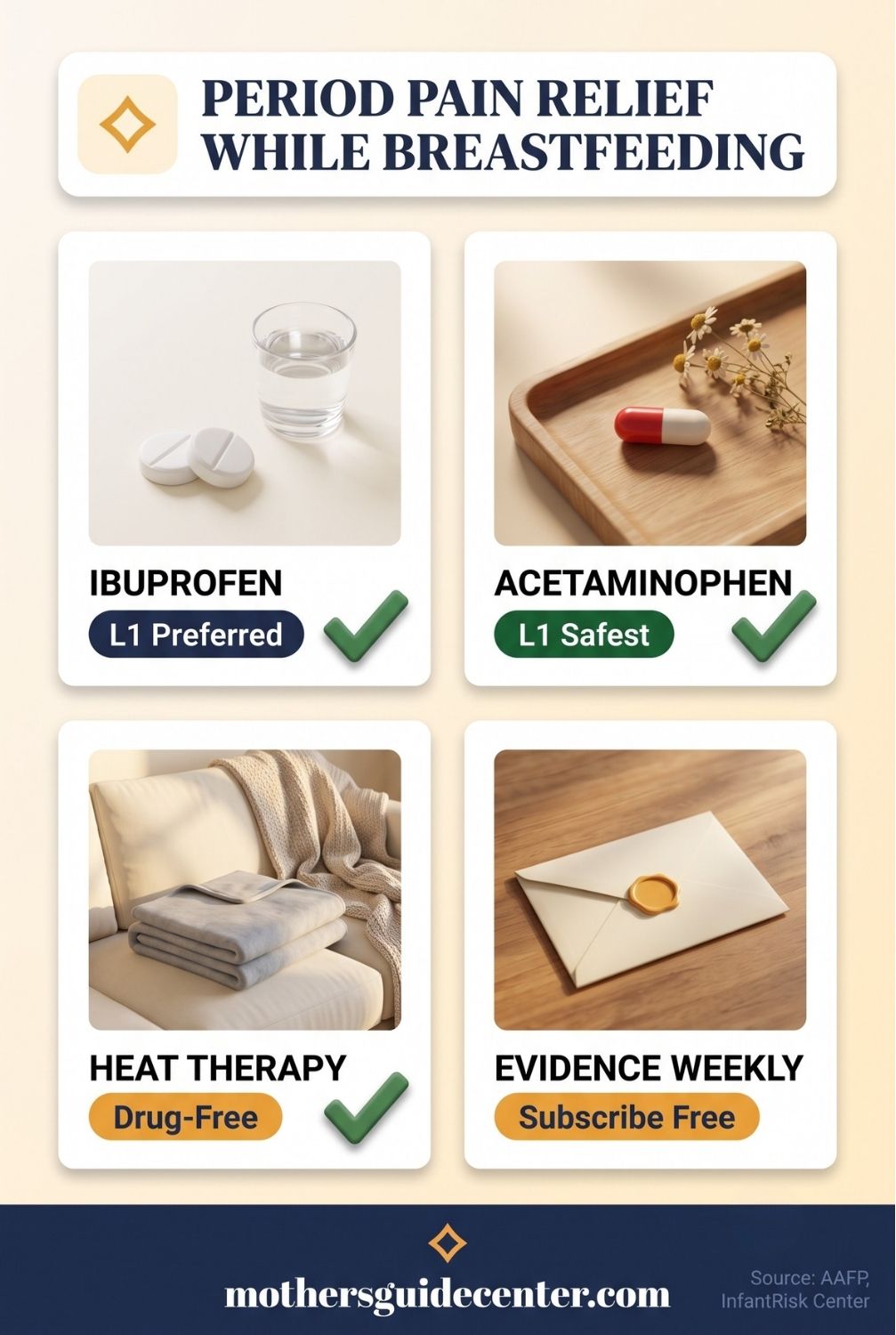
Ibuprofen and plain acetaminophen are the preferred pain relievers during breastfeeding, according to both the American Academy of Family Physicians (AAFP) and the InfantRisk Center at Texas Tech University. These single-ingredient options give you control over exactly what enters your breast milk — without the antihistamines, caffeine, or diuretics found in combination products.
Ibuprofen (Advil, Motrin). Classified as Hale’s L1 for breastfeeding. Studies show extremely low transfer into breast milk, a short half-life, and it is safe to give directly to infants. It is also a nonsteroidal anti-inflammatory drug (NSAID), meaning it targets the prostaglandins that cause menstrual cramps — making it specifically effective for period pain. Standard dosing is 200-400 mg every 4-6 hours as needed, not exceeding 1,200 mg in 24 hours for OTC use.
Acetaminophen alone (Tylenol). Also Hale’s L1. Effective for pain and fever but does not have anti-inflammatory properties. If cramps are your main symptom, ibuprofen may be more effective. Acetaminophen and ibuprofen can be alternated safely on different schedules if one alone is not providing adequate relief — ask your provider about this approach.
Non-medication approaches. Heat therapy (a heating pad or warm compress on the lower abdomen) has been shown to reduce period pain with no side effects. Gentle exercise, stretching, and adequate hydration can also help. These approaches carry zero risk to your baby and can complement medication when needed.
When does your period return while breastfeeding?
The timing of menstrual return after childbirth varies widely and is influenced by how frequently and exclusively you breastfeed. Exclusive, round-the-clock breastfeeding suppresses ovulation through a process called lactational amenorrhea. For some mothers, periods may not return until they significantly reduce nursing frequency or wean entirely — which can be 12 months or longer. For others, particularly those who supplement with formula or begin solid foods early, menstruation can return as soon as six to eight weeks postpartum.
When your period does return, you may find that cramps feel different than before pregnancy — some mothers report lighter periods and less pain, while others experience temporarily heavier or more painful cycles as hormones recalibrate. Having a plan for safe pain management while breastfeeding means you will not be caught off guard when that first postpartum period arrives. For more on navigating the physical changes after childbirth, see our postpartum recovery guide.
Frequently asked questions
Is caffeine in Midol safe for a breastfed baby?
Caffeine at the dose found in Midol Complete (60 mg per caplet) is generally considered compatible with breastfeeding when total daily caffeine intake stays under 300 mg. However, newborns metabolize caffeine more slowly than older infants, so they may be more sensitive. If your baby shows signs of irritability or disrupted sleep after you take Midol Complete, the caffeine content may be a contributing factor.
Can I take Midol for period cramps while breastfeeding?
You can, but a single-ingredient option is preferable. Plain ibuprofen or acetaminophen are both Hale’s L1 (safest) and more specifically targeted for cramp relief than combination products. If you choose Midol, Midol Long Lasting Relief (acetaminophen only) is the safest formulation for breastfeeding mothers.
How long does Midol stay in breast milk?
Acetaminophen reaches peak breast milk levels approximately one to two hours after ingestion and has a half-life of about two to three hours. Caffeine has a longer half-life in breast milk — around three to seven hours in adults, and potentially much longer in newborns. Pyrilamine’s milk transfer data is limited, but first-generation antihistamines are generally detectable in milk for several hours after dosing.
Is Pamabrom safe while breastfeeding?
Pamabrom is a mild diuretic found in Midol Bloat Relief. It carries a Hale’s rating of approximately L3-L4, and lactation experts generally advise against it during breastfeeding. Its diuretic effect promotes fluid loss, which can reduce milk production, and its bromide content has been flagged as a concern in some lactation references. If bloating is your primary complaint, increasing water intake and reducing sodium are safer first-line strategies.
Can I take ibuprofen instead of Midol while breastfeeding?
Ibuprofen is widely considered one of the safest OTC pain relievers for breastfeeding mothers. It is classified as Hale’s L1, transfers into breast milk in very low amounts, and is routinely given directly to infants. For menstrual cramps specifically, ibuprofen may be more effective than acetaminophen because it reduces prostaglandin production — the chemical mediators of uterine cramping.
Should I pump and dump after taking Midol?
Pumping and dumping is generally not necessary after taking Midol at standard doses. The active ingredients in Midol transfer into breast milk at levels that are typically very low. If you are concerned, the most practical approach is to take your dose immediately after breastfeeding and wait two to three hours before the next feeding. This allows blood levels — and therefore milk levels — to decline. Consult your healthcare provider if you have specific concerns.
When to contact your healthcare provider
Contact your provider or seek immediate care if you experience any of the following after taking Midol while breastfeeding:
This article is for educational purposes only and does not replace medical advice from a qualified healthcare provider. If you have questions about specific medications during breastfeeding, contact the InfantRisk Center hotline at 1-806-352-2519.
Sources
- National Library of Medicine. (2026). Acetaminophen — Drugs and Lactation Database (LactMed). NCBI Bookshelf.
- National Library of Medicine. (2026). Caffeine — Drugs and Lactation Database (LactMed). NCBI Bookshelf.
- Drugs.com / LactMed. (2026). Pyrilamine use while Breastfeeding. Drugs.com.
- Hale, T.W. et al. (2025). Hale’s Medications and Mothers’ Milk 2025-2026: A Manual of Lactational Pharmacology, 21st edition. Springer.
- Spencer, J. et al. (2022). Medication Safety in Breastfeeding. American Family Physician.
- InfantRisk Center. (2024). Safely Managing Pain During Lactation. Texas Tech University Health Sciences Center.
- Mayo Clinic. (2025). Breastfeeding and medications: What’s safe? Mayo Clinic.
- FDA / DailyMed (NLM). (2025). Midol Bloat Relief — Drug Label Information. DailyMed.
- Midol (Bayer). (2026). Midol Products. Midol.com.
- Franciscan Health. (2025). Safe Medications While Breastfeeding. Franciscan Health.
Midol is a brand of over-the-counter menstrual relief products, and whether you can take it while breastfeeding depends on which specific formulation you use. Midol Long Lasting Relief contains only acetaminophen, which the National Institutes of Health classifies as an L1 (safest) lactation category. However, Midol Complete contains pyrilamine maleate, an antihistamine rated L3 that may reduce milk supply, and Midol Bloat Relief contains pamabrom, a diuretic that can affect hydration and lactation. Your safest approach is choosing a single-ingredient pain reliever and consulting your healthcare provider.
Key takeaways
When your period returns after pregnancy — which can happen anywhere from two months to over a year postpartum — you may reach for the same menstrual relief you relied on before. But if you are breastfeeding, the question becomes more complicated. Every medication you take has the potential to pass into your breast milk, and what was perfectly safe before pregnancy now requires a second look.
Midol is one of the most recognized over-the-counter brands for period symptom relief. What many mothers do not realize is that Midol is not a single product — it is a family of six different formulations, each with a distinct combination of active ingredients. Some of those ingredients are fully compatible with breastfeeding. Others carry real concerns. This guide breaks down every current Midol product ingredient by ingredient, maps each to its lactation safety rating, and offers evidence-based alternatives so you can manage your period pain without putting your baby or your milk supply at risk.
Can you safely take Midol while breastfeeding?
Whether Midol is safe while breastfeeding depends entirely on which Midol product you are taking, because different formulations contain different active ingredients with different lactation risk profiles. Midol Long Lasting Relief, which contains only extended-release acetaminophen, is generally considered compatible with breastfeeding. Midol Complete, which adds caffeine and the antihistamine pyrilamine maleate, requires more caution. And Midol Bloat Relief, which contains the diuretic pamabrom, is best avoided while nursing.
This is not a simple yes-or-no question — it is a formulation-by-formulation question. The sections below walk through each product and each ingredient so you can make an informed decision with your healthcare provider.
What active ingredients are in each Midol product?
Midol is a brand name covering six distinct over-the-counter products manufactured by Bayer, each formulated for different period symptoms. Many online resources treat “Midol” as a single medication, which leads to inaccurate safety advice. Here is the current Midol lineup and what each product contains, verified from the manufacturer’s official product pages and FDA drug label data (DailyMed):
Midol Complete and Midol Complete On-the-Go contain acetaminophen 500 mg (pain reliever), caffeine 60 mg (alertness aid and pain enhancer), and pyrilamine maleate 15 mg (antihistamine for bloating and irritability). Midol Complete Caffeine Free contains acetaminophen 500 mg and pyrilamine maleate 15 mg without caffeine. Midol Long Lasting Relief contains only extended-release acetaminophen 650 mg. Midol Bloat Relief contains only pamabrom 50 mg, a mild diuretic. Midol Heat Vibes is a drug-free adhesive warming patch.
How safe is each Midol ingredient during breastfeeding?
Hale’s Lactation Risk Categories classify medications on a scale from L1 (safest, with extensive human data supporting safety) through L5 (contraindicated). The Drugs and Lactation Database (LactMed), maintained by the National Library of Medicine, provides peer-reviewed summaries of each substance’s transfer into breast milk. Here is what these sources say about each active ingredient found in Midol products:
Acetaminophen (Hale’s L1 — Safest). Acetaminophen is one of the preferred analgesics for breastfeeding mothers. According to LactMed, only small amounts transfer into breast milk — far below pediatric therapeutic doses. The American Academy of Pediatrics rates it compatible with breastfeeding. It does not affect milk supply.
Caffeine (Hale’s L2 — Safer). Midol Complete contains 60 mg of caffeine per caplet — roughly equivalent to half a standard cup of coffee. According to LactMed, caffeine transfers into breast milk, and most experts recommend keeping total daily intake under 300 mg while breastfeeding. At 60 mg per dose, a single Midol Complete is unlikely to cause issues for most infants, but newborns metabolize caffeine more slowly and may show irritability or disrupted sleep.
Pyrilamine maleate (Hale’s L3 — Probably Compatible). Pyrilamine is an older, first-generation antihistamine included in Midol Complete for its mild sedative and bloating-relief effects. According to Drugs.com’s LactMed summary, antihistamines given in relatively high doses by injection can decrease basal serum prolactin — the hormone that drives milk production. While lower oral doses have not been conclusively shown to reduce supply, the InfantRisk Center recommends that breastfeeding mothers prefer newer nonsedating antihistamines (such as cetirizine or loratadine) over first-generation options when antihistamines are needed. Pyrilamine may also cause drowsiness in both the mother and the nursing infant.
Pamabrom (Hale’s L3-L4 — Probably Compatible to Possibly Hazardous). Pamabrom is a mild diuretic used in Midol Bloat Relief to reduce water retention. It works by increasing urine output, which raises a direct concern for breastfeeding mothers: adequate hydration is essential for maintaining milk production. Pamabrom also contains bromide compounds, which some lactation references note are not considered compatible with breastfeeding. For these reasons, most lactation experts recommend avoiding pamabrom-containing products while nursing.
Which Midol product is safest while breastfeeding?
Among current Midol products, Midol Long Lasting Relief and Midol Heat Vibes carry the lowest breastfeeding risk because they either contain only acetaminophen (L1) or no medication at all. The comparison table below summarizes the breastfeeding safety profile of every current Midol formulation:
| Product | Active Ingredients | Hale’s Rating | BF Verdict |
|---|---|---|---|
| Midol Complete | Acetaminophen 500 mg, Caffeine 60 mg, Pyrilamine 15 mg | L1 / L2 / L3 | ⚠️ Caution — short-term only |
| Midol Complete Caffeine Free | Acetaminophen 500 mg, Pyrilamine 15 mg | L1 / L3 | ⚠️ Caution — antihistamine concern |
| Midol Long Lasting Relief | Acetaminophen 650 mg (extended-release) | L1 | ✅ Generally safe |
| Midol Bloat Relief | Pamabrom 50 mg | L3-L4 | ❌ Avoid while nursing |
| Midol Heat Vibes | None (adhesive heat patch) | N/A | ✅ Drug-free, safe |
| Midol Complete On-the-Go | Same as Midol Complete | L1 / L2 / L3 | ⚠️ Same as Complete |
Does Midol affect your milk supply?
Milk supply can be affected by two Midol ingredients: pyrilamine maleate and pamabrom — though through different mechanisms. Acetaminophen and caffeine (at the doses found in Midol) have not been shown to impact milk production.
Pyrilamine maleate is a first-generation antihistamine. According to research summarized in LactMed, antihistamines given at relatively high doses can decrease basal serum prolactin in postpartum women. Prolactin is the primary hormone driving milk production. While the lower oral doses found in Midol Complete (15 mg) have not been conclusively shown to reduce supply, the theoretical risk exists — particularly with repeated or prolonged use. If you are already struggling with low supply, this is an ingredient worth avoiding.
Pamabrom works as a diuretic, increasing urine output to reduce bloating. Breastfeeding mothers need adequate hydration to maintain milk production — any substance that promotes fluid loss works against that goal. If you take Midol Bloat Relief, you may notice a temporary dip in output, especially if you are not compensating with extra fluid intake.
What is the safest way to take Midol while breastfeeding?
If you and your healthcare provider decide that a Midol product is appropriate for your situation, the following timing and dosing strategies can help minimize your baby’s exposure:
Choose the simplest formulation. Midol Long Lasting Relief (acetaminophen only) or Midol Heat Vibes (drug-free) pose the lowest risk. Every additional active ingredient adds a variable — and combination products expose your baby to substances that may not have been necessary.
Take it right after breastfeeding. Most medications reach peak blood levels within one to two hours after ingestion. By taking your dose immediately after a nursing session, you allow time for blood levels to decline before the next feeding.
Use the lowest effective dose for the shortest time. One or two doses during the worst day of your period is very different from taking the maximum dose for several days straight. Short-term, occasional use carries the least risk.
Monitor your baby. Watch for unusual drowsiness, fussiness, poor feeding, or changes in sleep patterns after you take any medication. If you notice any of these, stop the medication and contact your pediatrician.
What are safer alternatives to Midol for period pain while breastfeeding?
Ibuprofen and plain acetaminophen are the preferred pain relievers during breastfeeding, according to both the American Academy of Family Physicians (AAFP) and the InfantRisk Center at Texas Tech University. These single-ingredient options give you control over exactly what enters your breast milk — without the antihistamines, caffeine, or diuretics found in combination products.
Ibuprofen (Advil, Motrin). Classified as Hale’s L1 for breastfeeding. Studies show extremely low transfer into breast milk, a short half-life, and it is safe to give directly to infants. It is also a nonsteroidal anti-inflammatory drug (NSAID), meaning it targets the prostaglandins that cause menstrual cramps — making it specifically effective for period pain. Standard dosing is 200-400 mg every 4-6 hours as needed, not exceeding 1,200 mg in 24 hours for OTC use.
Acetaminophen alone (Tylenol). Also Hale’s L1. Effective for pain and fever but does not have anti-inflammatory properties. If cramps are your main symptom, ibuprofen may be more effective. Acetaminophen and ibuprofen can be alternated safely on different schedules if one alone is not providing adequate relief — ask your provider about this approach.
Non-medication approaches. Heat therapy (a heating pad or warm compress on the lower abdomen) has been shown to reduce period pain with no side effects. Gentle exercise, stretching, and adequate hydration can also help. These approaches carry zero risk to your baby and can complement medication when needed.
When does your period return while breastfeeding?
The timing of menstrual return after childbirth varies widely and is influenced by how frequently and exclusively you breastfeed. Exclusive, round-the-clock breastfeeding suppresses ovulation through a process called lactational amenorrhea. For some mothers, periods may not return until they significantly reduce nursing frequency or wean entirely — which can be 12 months or longer. For others, particularly those who supplement with formula or begin solid foods early, menstruation can return as soon as six to eight weeks postpartum.
When your period does return, you may find that cramps feel different than before pregnancy — some mothers report lighter periods and less pain, while others experience temporarily heavier or more painful cycles as hormones recalibrate. Having a plan for safe pain management while breastfeeding means you will not be caught off guard when that first postpartum period arrives. For more on navigating the physical changes after childbirth, see our postpartum recovery guide.
Frequently asked questions
Is caffeine in Midol safe for a breastfed baby?
Caffeine at the dose found in Midol Complete (60 mg per caplet) is generally considered compatible with breastfeeding when total daily caffeine intake stays under 300 mg. However, newborns metabolize caffeine more slowly than older infants, so they may be more sensitive. If your baby shows signs of irritability or disrupted sleep after you take Midol Complete, the caffeine content may be a contributing factor.
Can I take Midol for period cramps while breastfeeding?
You can, but a single-ingredient option is preferable. Plain ibuprofen or acetaminophen are both Hale’s L1 (safest) and more specifically targeted for cramp relief than combination products. If you choose Midol, Midol Long Lasting Relief (acetaminophen only) is the safest formulation for breastfeeding mothers.
How long does Midol stay in breast milk?
Acetaminophen reaches peak breast milk levels approximately one to two hours after ingestion and has a half-life of about two to three hours. Caffeine has a longer half-life in breast milk — around three to seven hours in adults, and potentially much longer in newborns. Pyrilamine’s milk transfer data is limited, but first-generation antihistamines are generally detectable in milk for several hours after dosing.
Is Pamabrom safe while breastfeeding?
Pamabrom is a mild diuretic found in Midol Bloat Relief. It carries a Hale’s rating of approximately L3-L4, and lactation experts generally advise against it during breastfeeding. Its diuretic effect promotes fluid loss, which can reduce milk production, and its bromide content has been flagged as a concern in some lactation references. If bloating is your primary complaint, increasing water intake and reducing sodium are safer first-line strategies.
Can I take ibuprofen instead of Midol while breastfeeding?
Ibuprofen is widely considered one of the safest OTC pain relievers for breastfeeding mothers. It is classified as Hale’s L1, transfers into breast milk in very low amounts, and is routinely given directly to infants. For menstrual cramps specifically, ibuprofen may be more effective than acetaminophen because it reduces prostaglandin production — the chemical mediators of uterine cramping.
Should I pump and dump after taking Midol?
Pumping and dumping is generally not necessary after taking Midol at standard doses. The active ingredients in Midol transfer into breast milk at levels that are typically very low. If you are concerned, the most practical approach is to take your dose immediately after breastfeeding and wait two to three hours before the next feeding. This allows blood levels — and therefore milk levels — to decline. Consult your healthcare provider if you have specific concerns.
When to contact your healthcare provider
Contact your provider or seek immediate care if you experience any of the following after taking Midol while breastfeeding:
This article is for educational purposes only and does not replace medical advice from a qualified healthcare provider. If you have questions about specific medications during breastfeeding, contact the InfantRisk Center hotline at 1-806-352-2519.
Sources
- National Library of Medicine. (2026). Acetaminophen — Drugs and Lactation Database (LactMed). NCBI Bookshelf.
- National Library of Medicine. (2026). Caffeine — Drugs and Lactation Database (LactMed). NCBI Bookshelf.
- Drugs.com / LactMed. (2026). Pyrilamine use while Breastfeeding. Drugs.com.
- Hale, T.W. et al. (2025). Hale’s Medications and Mothers’ Milk 2025-2026: A Manual of Lactational Pharmacology, 21st edition. Springer.
- Spencer, J. et al. (2022). Medication Safety in Breastfeeding. American Family Physician.
- InfantRisk Center. (2024). Safely Managing Pain During Lactation. Texas Tech University Health Sciences Center.
- Mayo Clinic. (2025). Breastfeeding and medications: What’s safe? Mayo Clinic.
- FDA / DailyMed (NLM). (2025). Midol Bloat Relief — Drug Label Information. DailyMed.
- Midol (Bayer). (2026). Midol Products. Midol.com.
- Franciscan Health. (2025). Safe Medications While Breastfeeding. Franciscan Health.