
Newborn care is the set of evidence-based practices that support a baby’s health, growth, and safety during the first 12 weeks of life — a period defined by rapid neurological development, frequent feeding cycles, and vulnerability to infection. According to the American Academy of Pediatrics, newborns require feeding every 2 to 3 hours, 14 to 17 hours of sleep per day, and close monitoring for warning signs such as fever, jaundice, and feeding difficulties.
Key takeaways
- ✓Newborns sleep 14 to 17 hours per day in short cycles — no newborn sleeps through the night, and that is normal.
- ✓Feed on demand: breastfed newborns eat every 2 to 3 hours, formula-fed every 3 to 4 hours.
- ✓AAP safe sleep: always on the back, firm flat surface, nothing in the crib, room-share for at least 6 months.
- ✓Any fever (100.4°F or higher) in a baby under 3 months is a medical emergency — call your pediatrician immediately.
- ✓The umbilical cord stump falls off within 1 to 3 weeks — keep it dry and fold the diaper below it.
- ✓Well-baby visits are scheduled at 3 to 5 days, 2 weeks, 1 month, and 2 months — each includes growth checks and vaccinations.
- ✓Tummy time starts from day one — begin with 3 to 5 minutes several times a day to build neck and shoulder strength.
The first 12 weeks with a newborn are simultaneously overwhelming and profoundly important — your baby’s brain is forming over one million neural connections per second, their immune system is encountering the world for the first time, and their feeding and sleep patterns are establishing the foundation for healthy growth. According to the American Academy of Pediatrics, the newborn period is the single most vulnerable window for preventable illness, making informed care decisions critical from day one.
This guide covers every essential aspect of newborn care — sleep, feeding, safety, skin care, bathing, milestones, and when to seek medical attention — drawing on current guidelines from the AAP, CDC, Mayo Clinic, and Cleveland Clinic. Whether you are a first-time parent or returning to the newborn stage, the goal is the same: give you the evidence-based information you need so you can focus less on worry and more on your baby.
What do newborns need in the first 12 weeks?
Newborn needs in the first 12 weeks center on five core requirements: frequent feeding, safe sleep, temperature regulation, infection prevention, and responsive caregiving — all supported by the AAP’s Bright Futures guidelines as the foundation of healthy infant development.
Feeding: Whether breastfed or formula-fed, newborns need to eat every 2 to 4 hours, including overnight. The AAP recommends exclusive breastfeeding for the first 6 months when possible, with formula as a safe and complete alternative. Watch for hunger cues — rooting, hand-to-mouth movements, fussing — rather than strict clock-based schedules.
Sleep: Newborns sleep 14 to 17 hours per day, but in cycles of 2 to 4 hours. There is no expectation for a newborn to sleep through the night. Safe sleep practices — back sleeping, firm flat surface, empty crib — reduce the risk of sudden infant death syndrome (SIDS) by more than 50 percent, according to the AAP’s safe sleep guidelines.
Skin-to-skin contact: Also called kangaroo care, skin-to-skin holding is recommended by both the AAP and WHO as one of the most effective interventions for newborn thermoregulation, bonding, and breastfeeding initiation. It stabilizes heart rate and blood sugar and reduces infant stress hormones.
How much should a newborn sleep?
Newborn sleep is a physiological pattern of 14 to 17 hours of total sleep per day, distributed across multiple short cycles of 2 to 4 hours each, driven by the baby’s immature circadian rhythm and frequent need to feed. This pattern is biologically normal and does not indicate a sleep problem.
According to the Mayo Clinic, most newborns do not distinguish between day and night for the first 6 to 8 weeks. Day-night confusion gradually resolves as the baby’s circadian system matures, typically between 8 and 12 weeks. Parents can support this transition by keeping daytime feeds bright and interactive and nighttime feeds dim and quiet.
By 3 months, many babies begin consolidating sleep into longer nighttime stretches of 4 to 6 hours, though waking for feeds remains normal and expected through at least the first 6 months.
How often should you feed a newborn?
Newborn feeding frequency is guided by the baby’s hunger cues rather than a fixed schedule, with breastfed babies typically eating every 2 to 3 hours (8 to 12 times per day) and formula-fed babies every 3 to 4 hours (6 to 8 times per day), according to AAP guidelines.
Signs of adequate intake: After the first 5 days, a well-fed newborn produces at least 6 wet diapers and 3 to 4 bowel movements per day, gains weight steadily (regaining birth weight by 10 to 14 days), and appears satisfied after feeds. If your baby is not meeting these markers, contact your pediatrician or a lactation consultant.
Breastfeeding support: The AAP and WHO recommend exclusive breastfeeding for the first 6 months. Common early challenges — latching difficulty, nipple pain, engorgement — typically resolve within the first 2 to 3 weeks with support. An IBCLC-certified lactation consultant can help troubleshoot. For a comprehensive breastfeeding guide, see our Feeding pillar.
What is the safest sleep position for newborns?
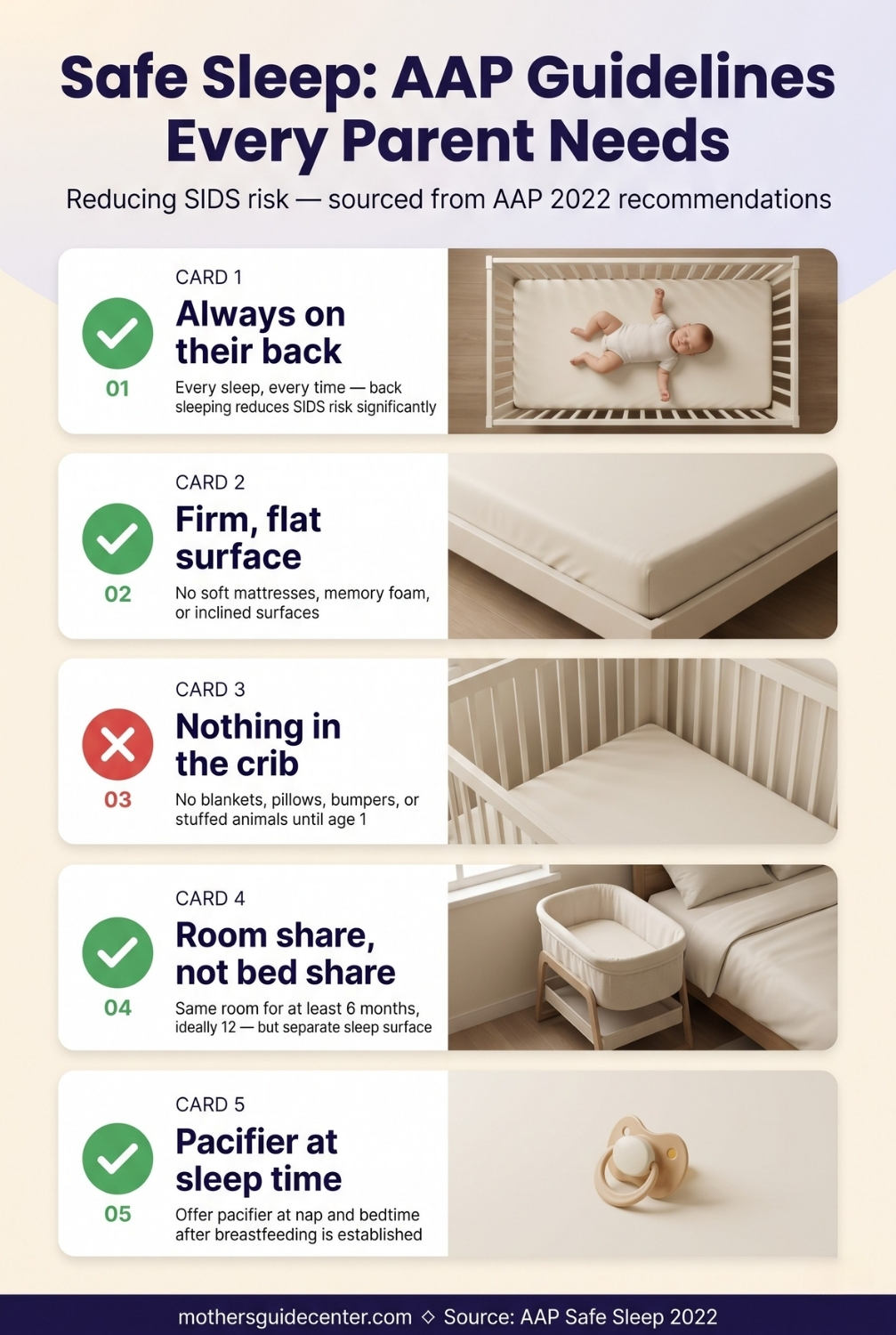
The safest sleep position for newborns is on their back, on a firm flat surface, with nothing else in the crib — a recommendation from the AAP that has reduced SIDS rates by over 50 percent since its introduction in 1994 as the Back to Sleep campaign.
The AAP’s 2022 updated safe sleep guidelines include the following core recommendations: place your baby on their back for every sleep (naps and nighttime); use a firm, flat sleep surface (crib, bassinet, or play yard that meets CPSC safety standards); keep the sleep area free of blankets, pillows, bumper pads, and stuffed animals; share a room with your baby for at least the first 6 months (but not the same bed); and offer a pacifier at sleep time once breastfeeding is established.
Common misconceptions: side sleeping is not a safe alternative — it is an unstable position that increases the risk of rolling to the stomach. Swaddling is safe only when the baby is on their back and must stop as soon as the baby shows signs of rolling (typically around 2 months).
How do you care for the umbilical cord stump?
Umbilical cord stump care is the practice of keeping the remaining cord tissue clean and dry until it naturally separates from the baby’s navel, which typically occurs within 1 to 3 weeks after birth.
The AAP recommends a “dry care” approach: leave the stump exposed to air as much as possible, fold the front of the diaper below the stump to prevent irritation, and give sponge baths rather than tub baths until the stump falls off. Do not pull or twist the stump, even if it appears loose. Alcohol swabs, which were previously recommended, are no longer advised — research shows that dry care leads to faster separation without increased infection risk.
Contact your pediatrician if you notice redness spreading around the base, pus or foul-smelling discharge, active bleeding (more than a few drops), or the stump has not separated after 3 weeks.
What does normal newborn skin look like?
Normal newborn skin undergoes several visible changes in the first weeks of life that are almost always benign and self-resolving — understanding these patterns prevents unnecessary worry and unnecessary medical visits.
Erythema toxicum: Red blotchy patches with small white or yellow bumps, appearing in the first 2 to 5 days. Affects up to 50 percent of newborns, per the Cleveland Clinic. Resolves on its own within 1 to 2 weeks. No treatment needed.
Milia: Tiny white bumps on the nose, cheeks, or chin caused by trapped keratin. Present in up to 40 percent of newborns. Resolve within a few weeks without treatment.
Newborn acne: Small red or white bumps on the face, typically appearing at 2 to 4 weeks. Caused by maternal hormones still circulating. Clears within 3 to 4 months. Do not apply acne products — gentle cleansing with water only.
Cradle cap: Yellowish, scaly patches on the scalp. Common and harmless. Gentle brushing with a soft brush and regular shampooing help manage it. If it spreads or becomes inflamed, consult your pediatrician.
Jaundice: Yellowing of the skin and whites of the eyes, caused by elevated bilirubin. Mild physiological jaundice is common and peaks around day 3 to 5. If jaundice spreads to the arms, legs, or abdomen, or if the baby is excessively sleepy or feeding poorly, seek evaluation — untreated severe jaundice can cause brain damage.
How do you bathe a newborn safely?
Newborn bathing is a gentle cleansing routine that changes as the baby develops — sponge baths until the cord stump falls off, then tub baths 2 to 3 times per week, using only warm water and mild fragrance-free cleanser.
The Mayo Clinic recommends: water temperature 98 to 100°F (37 to 38°C), tested with your wrist or elbow; never leave the baby unattended in water, even for a second; support the baby’s head and neck at all times; and wash from cleanest to dirtiest areas (face first, diaper area last).
Daily baths are unnecessary and can dry out newborn skin. Spot-cleaning the face, neck folds, and diaper area between baths is sufficient.
What are the key developmental milestones from 0 to 3 months?
Developmental milestones from 0 to 3 months are the observable skills and behaviors that emerge as a newborn’s neurological, motor, and social systems mature — tracked by pediatricians at every well-child visit using the CDC’s milestone checklist.
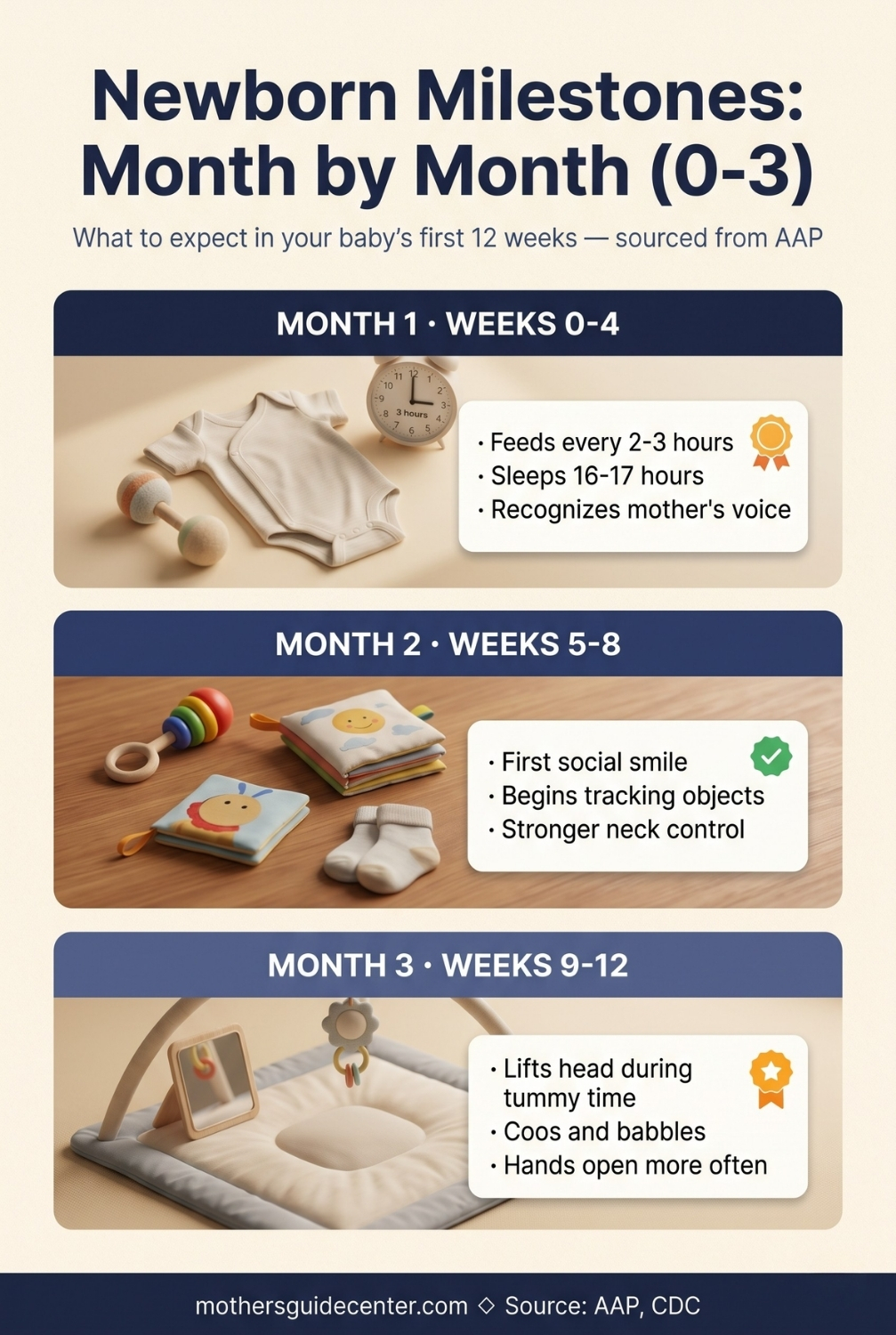
Month 1: Recognizes parent’s voice. Turns head toward sounds. Moves arms and legs in uncoordinated bursts. Brief eye contact. Strong grasp reflex. Focuses on objects 8 to 12 inches away (the distance to a parent’s face during feeding).
Month 2: First social smile (distinct from reflexive newborn smile). Begins tracking moving objects with eyes. Coos and makes vowel sounds. Lifts head briefly during tummy time. Shows increasing interest in faces and high-contrast patterns.
Month 3: Holds head steady when supported upright. Opens and closes hands. Bats at hanging objects. Recognizes familiar faces from a distance. Babbles and laughs. Begins to bear weight on legs when held standing.
Milestones have ranges, not deadlines. If your baby is not meeting multiple milestones or has lost a skill previously achieved, discuss this with your pediatrician.
When should you call your pediatrician?
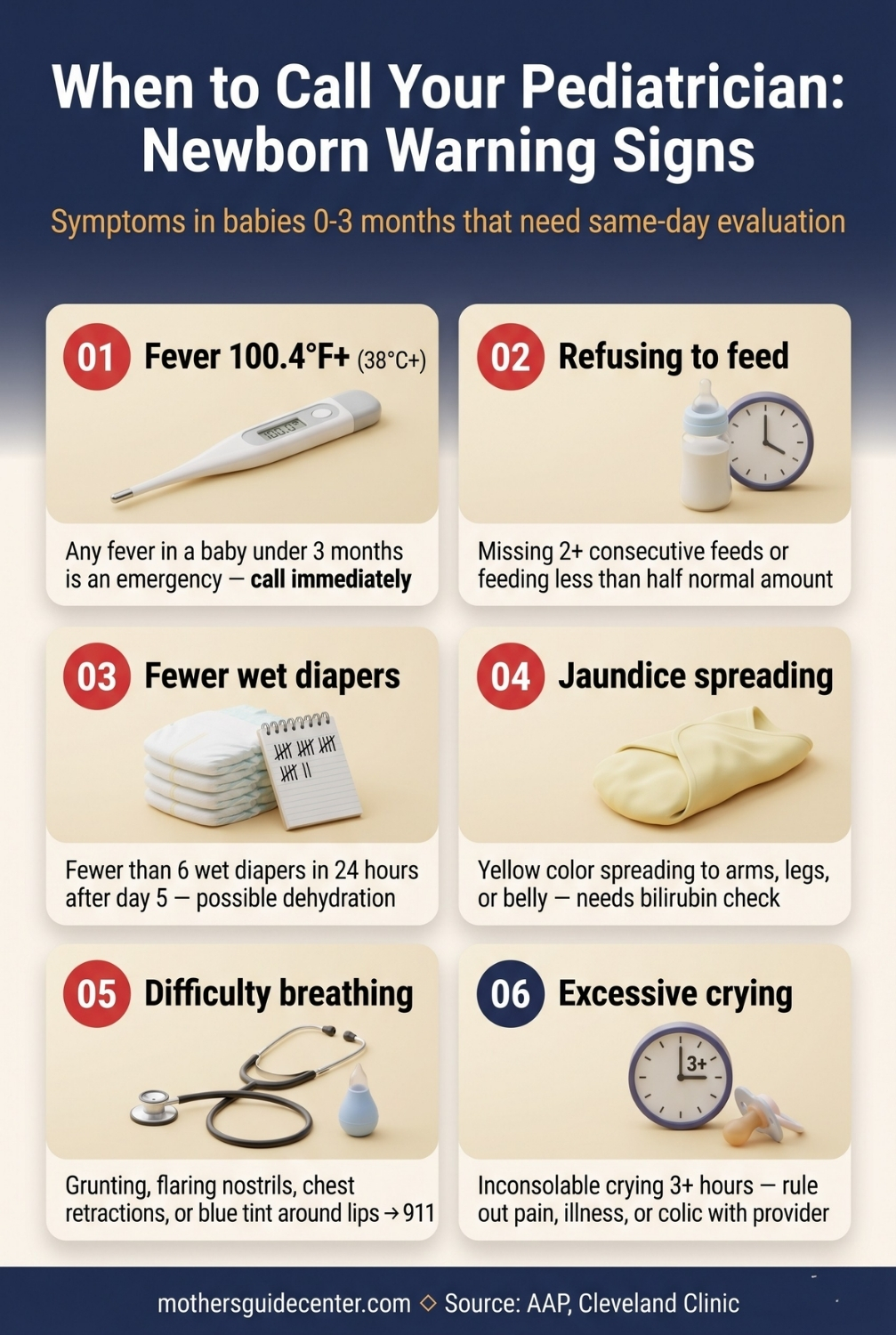
Newborn warning signs are specific symptoms that indicate a potentially serious condition requiring same-day or emergency evaluation — distinguishable from the normal variations of early infant life by their severity, persistence, or combination.
The most critical rule: any fever of 100.4°F (38°C) or higher in a baby under 3 months old is a medical emergency. Unlike older children, newborns cannot localize or fight infections effectively. A fever may be the only sign of a serious bacterial infection including meningitis. Do not give fever-reducing medication — call your pediatrician or go to the emergency room immediately.
What newborn care appointments are needed in the first 3 months?
Well-baby visits are the structured series of pediatric checkups recommended by the AAP to monitor growth, development, feeding adequacy, and vaccination status during the first year of life — with the highest frequency occurring in the first 3 months.
3 to 5 days: Weight check (ensuring baby has not lost more than 7 to 10 percent of birth weight), jaundice assessment, feeding evaluation, umbilical cord check. This visit often happens before hospital discharge or within 48 hours of going home.
2 weeks: Weight gain confirmation (should be back to birth weight), breastfeeding assessment, newborn screening results review, parental wellbeing check.
1 month: Growth measurements (weight, length, head circumference), developmental milestone check, feeding pattern review, discussion of tummy time and safe sleep practices.
2 months: First major vaccination visit (DTaP, IPV, Hib, PCV13, rotavirus, Hepatitis B second dose). Growth and development assessment. This is often the first time parents see their baby’s social smile documented.
What should you expect the first week home with a newborn?
The first week home with a newborn is a period of intense adjustment for the entire family — defined by round-the-clock feeding, sleep disruption, and a steep learning curve that is completely normal and temporary.
Expect your baby to feed every 2 to 3 hours, sleep in short bursts, and cry 1 to 4 hours per day — all within normal range per the AAP. Your baby may lose up to 7 to 10 percent of birth weight in the first few days; this is expected and typically recovers by day 10 to 14. The pediatrician will confirm weight gain at the 3-to-5-day visit.
Practical priorities for week one: establish a safe sleep setup before the baby arrives, keep visitors limited to reduce infection exposure, accept help with meals and household tasks, and sleep when the baby sleeps — this advice is repeated often because it works. Your primary job in week one is feeding, diaper changes, and skin-to-skin bonding. Everything else can wait.
Many parents feel overwhelmed during the first week — this does not mean you are failing. If feelings of sadness, anxiety, or inability to cope persist beyond two weeks, contact your provider or the National Maternal Mental Health Hotline (1-833-TLC-MAMA) for support.
How do you know if your baby is getting enough milk?
Adequate milk intake in a newborn is measured by output indicators — wet diapers, bowel movements, and weight gain — rather than by watching the clock or counting ounces, according to the AAP.
Reassuring signs your baby is getting enough: At least 6 wet diapers per day after day 5. Three or more bowel movements per day in the first month (breastfed babies may stool with every feed). Steady weight gain — your baby should regain birth weight by 10 to 14 days and then gain approximately 5 to 7 ounces per week. Baby appears satisfied and relaxed after feeds. You can hear swallowing during breastfeeding.
Warning signs of inadequate intake: Fewer than 6 wet diapers after day 5. Baby has not regained birth weight by 2 weeks. Feeds consistently last longer than 45 minutes with visible frustration. Baby is excessively sleepy and difficult to wake for feeds. Dark urine or brick-red spots in diaper (urate crystals — can indicate dehydration in the first few days). Contact your pediatrician or a lactation consultant immediately if you notice these signs.
Frequently asked questions
How long do newborns sleep at a time?
Newborns sleep in cycles of 2 to 4 hours, with total daily sleep averaging 14 to 17 hours. They do not distinguish between day and night for the first 6 to 8 weeks. By 3 months, many babies begin sleeping longer stretches of 4 to 6 hours at night, though continued nighttime waking for feeds is normal and expected.
How many wet diapers should a newborn have per day?
A well-hydrated newborn produces at least 6 wet diapers per day after the first 5 days of life. In the first few days, expect 1 wet diaper per day of age (1 on day 1, 2 on day 2, etc.) as milk production increases. Fewer than 6 wet diapers after day 5 may indicate dehydration and warrants a call to your pediatrician.
When should I start tummy time?
Tummy time can begin on the first day home from the hospital. The AAP recommends starting with 3 to 5 minute sessions, 2 to 3 times per day, on a firm flat surface while the baby is awake and supervised. Gradually increase duration as the baby builds neck and shoulder strength. By 3 months, aim for a total of 30 to 60 minutes of tummy time spread throughout the day.
Is it normal for newborns to sneeze a lot?
Frequent sneezing in newborns is a normal reflex mechanism used to clear nasal passages of mucus, dust, and amniotic fluid residue — it does not indicate illness or allergy. Newborn nasal passages are very narrow, making sneezing an efficient self-cleaning tool. Sneezing accompanied by fever, thick nasal discharge, or difficulty breathing, however, warrants evaluation.
Can you overfeed a breastfed newborn?
Overfeeding a breastfed newborn is extremely rare because breastfeeding is a self-regulating system — the baby controls the flow and stops when satiated. Frequent feeding (sometimes called cluster feeding) is normal, especially during growth spurts around 2 to 3 weeks, 6 weeks, and 3 months. If your baby is gaining weight excessively, consult your pediatrician rather than restricting feeds.
When can newborns go outside?
Newborns can go outside from the first days of life as long as they are dressed appropriately for the weather and kept away from crowds and sick individuals. The AAP does not recommend isolating newborns indoors. Avoid direct sunlight (newborn skin burns easily) and crowded enclosed spaces where respiratory viruses circulate, especially during the first 2 months before initial vaccinations.
When do newborns start smiling?
A newborn’s first true social smile — distinct from the reflexive smiles seen in the first few weeks — typically appears between 6 and 8 weeks of age. This milestone indicates that your baby’s social brain is developing and they are beginning to recognize and respond to familiar faces. If your baby is not smiling by 3 months, mention this at your next well-child visit.
How do you care for an uncircumcised newborn?
Caring for an uncircumcised newborn requires only gentle external cleaning with warm water during diaper changes and baths — the foreskin should never be forcibly retracted. According to the AAP, the foreskin is naturally fused to the glans at birth and separates gradually over months to years. Forced retraction can cause pain, bleeding, and scarring. Simply wipe the outside clean; no special care is needed beyond standard hygiene.
When to call your pediatrician or go to the emergency room
Contact your baby’s pediatrician or seek emergency care immediately if your newborn has any of the following:
- ⚠️Fever of 100.4°F (38°C) or higher — any fever under 3 months is an emergency
- ⚠️Refusing to feed for 2 or more consecutive sessions
- ⚠️Fewer than 6 wet diapers in 24 hours (after day 5) — possible dehydration
- ⚠️Difficulty breathing — grunting, flaring nostrils, chest retractions, or blue/gray skin → call 911
- ⚠️Jaundice spreading to arms, legs, or abdomen
- ⚠️Inconsolable crying for 3+ hours — rule out pain or illness
- ⚠️Excessive sleepiness or difficulty waking for feeds
This article is for educational purposes only and does not replace medical advice from a qualified healthcare provider.
Sources
- American Academy of Pediatrics. (2022). Safe Sleep Guidelines. AAP.org.
- American Academy of Pediatrics. (2024). Caring for Your Baby and Young Child: Birth to Age 5. HealthyChildren.org.
- Centers for Disease Control and Prevention. (2024). Developmental Milestones. CDC.gov.
- Mayo Clinic. (2025). Newborn Sleep: Understanding Your Baby’s Patterns. MayoClinic.org.
- Mayo Clinic. (2025). How to Bathe Your Newborn. MayoClinic.org.
- Cleveland Clinic. (2024). Erythema Toxicum Neonatorum. ClevelandClinic.org.
- World Health Organization. (2024). Newborn Health. WHO.int.
- Stanford Medicine Children’s Health. (2024). The Growing Child: Newborn. StanfordChildrens.org.
- National Institutes of Health. (2024). Safe to Sleep Campaign. NICHD.NIH.gov.
- American Academy of Pediatrics. (2024). Umbilical Cord Care. HealthyChildren.org.