
Infant developmental milestones are specific skills and behaviors that most children can do by a certain age, spanning four domains: motor, language, cognitive, and social-emotional development. According to the CDC’s revised 2022 guidelines, these milestones are tracked at 11 age checkpoints from 2 months through 5 years and represent what 75% of children achieve by each age — not the earliest or the average.
Key takeaways
-
✓
Developmental milestones span four domains: motor, language, cognitive, and social-emotional. -
✓
The CDC revised its milestone checklists in 2022 to reflect what most (75%) children can do. -
✓
Every baby develops at their own pace — milestones are guideposts, not deadlines. -
✓
The AAP recommends formal developmental screening at 9, 18, and 30 months. -
✓
Early intervention for developmental delays is most effective when started before age 3. -
✓
Talk to your pediatrician if your baby loses skills they once had or misses multiple milestones.
Watching your baby grow is one of the most extraordinary experiences of early parenthood — and also one of the most anxious. Is she lifting her head enough? Should he be babbling by now? When will she start crawling? These questions are natural, and they’re exactly why developmental milestones exist: to give you a reliable, evidence-based framework for understanding your child’s growth.
This guide walks you through the major infant developmental milestones from birth to 36 months, organized by age and covering all four developmental domains. Every milestone referenced here is sourced from Tier 1 medical authorities — the CDC, AAP, NIH, and Mayo Clinic — and reflects the CDC’s revised 2022 milestone checklists. Whether you’re tracking your first baby’s progress or noticing something different with your second, this is designed to inform and reassure, not to alarm.
What Are Infant Developmental Milestones?
Infant developmental milestones are specific skills and behaviors — such as smiling, rolling over, babbling, and taking first steps — that most children achieve by a certain age. According to the CDC’s Learn the Signs. Act Early. program, these milestones are organized across four key developmental domains and tracked at 11 age checkpoints from 2 months through 5 years.
It’s important to understand what milestones represent. In February 2022, the CDC updated its milestone checklists for the first time in decades, shifting from the 50th percentile (what half of children can do) to the 75th percentile (what most children can do). This change, as Zero to Three explains, was designed to make it clearer when a child might need extra support — if most children can do something by a certain age and your child cannot, it’s worth discussing with your pediatrician.
Milestones are guideposts, not deadlines. Every child develops at their own pace, influenced by genetics, environment, nutrition, and opportunities for practice. A baby who walks at 14 months is just as healthy as one who walks at 10 months. What matters most is the overall pattern of development — steady progress across all four domains — rather than hitting any single milestone at a precise age.
What Are the 4 Types of Developmental Milestones?
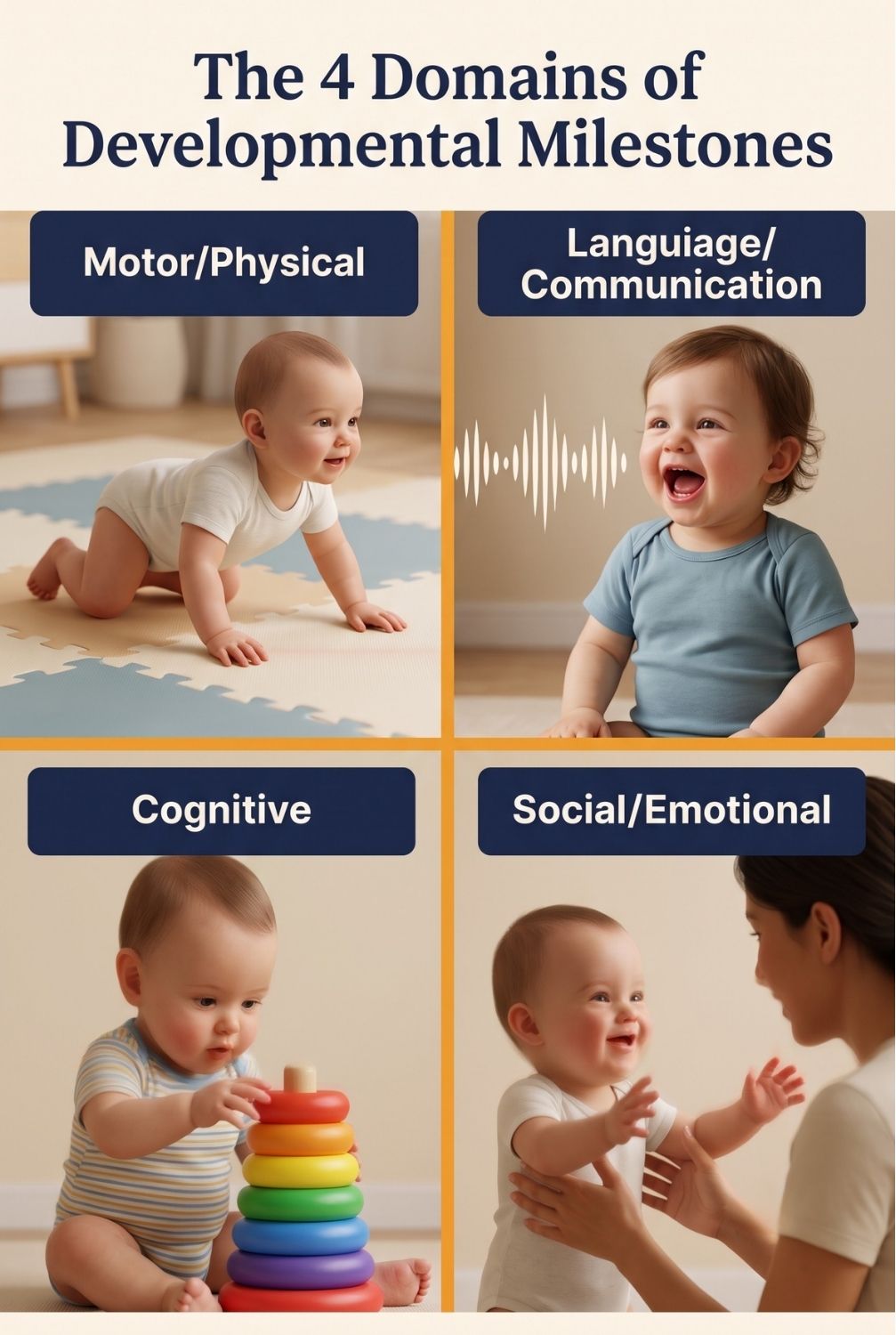
The four types of developmental milestones are motor (movement and physical), language and communication, cognitive (learning and thinking), and social-emotional development. According to the National Institute of Child Health and Human Development (NICHD), these domains develop simultaneously and influence each other — for example, a baby who can sit up independently gains new cognitive opportunities because both hands are free to explore objects.
Motor development includes both gross motor skills (large movements like rolling, sitting, crawling, and walking) and fine motor skills (smaller movements like grasping, pinching, and stacking). Language and communication covers everything from a newborn’s cries to a toddler’s first sentences, including pre-verbal skills like gesturing and pointing. Cognitive development involves how your baby learns, solves problems, and understands the world — from tracking a moving object with their eyes to figuring out that a toy hidden under a blanket still exists. Social-emotional development includes bonding, showing emotions, responding to others’ feelings, and beginning to play with peers.
When pediatricians assess your baby’s development, they look across all four domains — not just the most visible one. A child who walks early but shows limited eye contact and no pointing by 12 months would warrant the same attention as a child who isn’t walking by 15 months. The complete picture matters.
What Should Your Baby Do From Birth to 3 Months?
From birth to 3 months, your baby is building the foundational skills that all later development depends on — head control, visual tracking, social smiling, and early vocalization. According to Mayo Clinic, this period is one of rapid neurological growth as your baby adapts from the womb to the outside world.
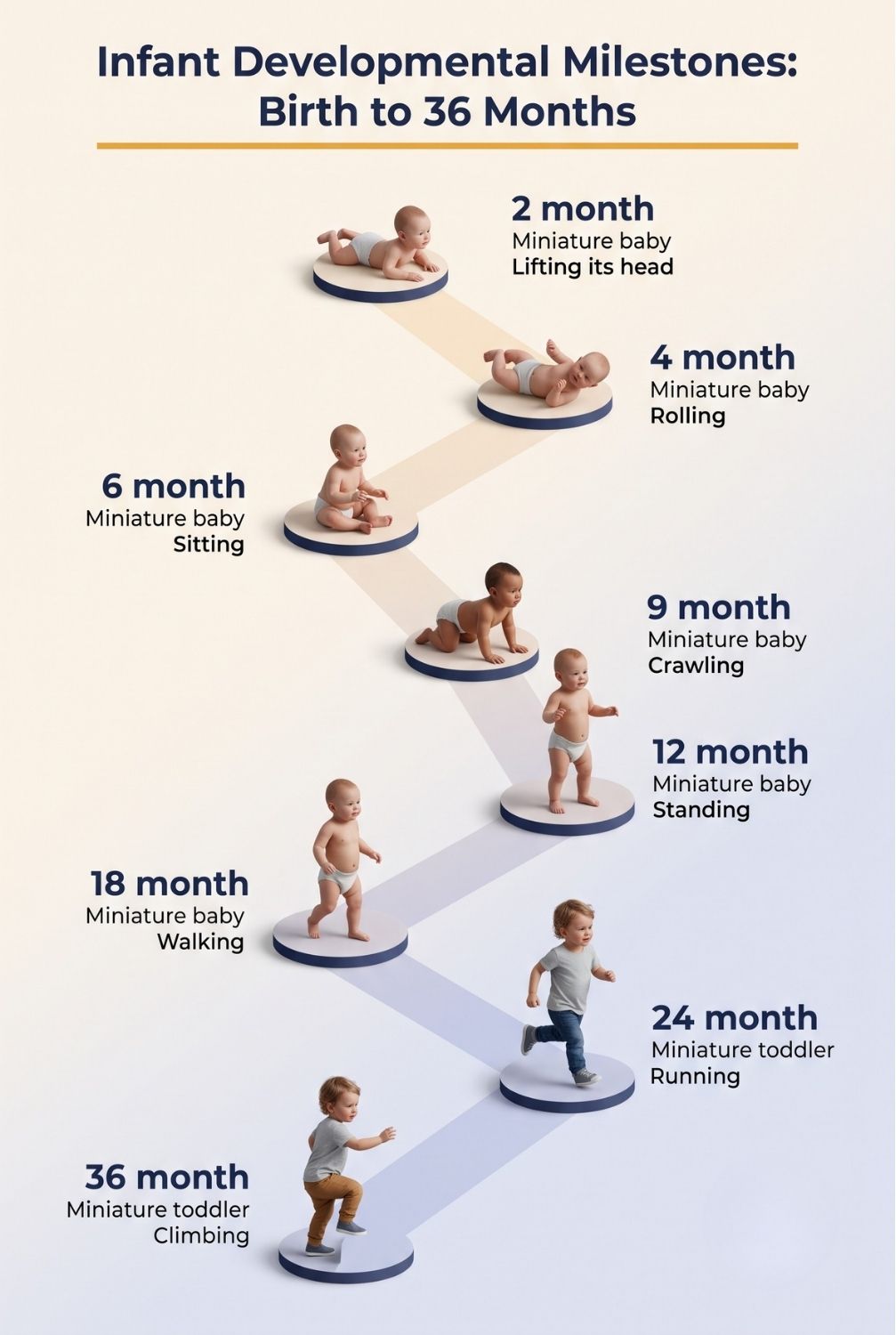
By 2 months, most babies can hold their head up briefly during tummy time, begin to follow objects with their eyes, make cooing sounds, and produce their first social smile — a smile in response to your voice or face, not just a reflex. By 3 months, the CDC’s revised checklist indicates that most babies can lift their head and chest during tummy time, open and close their hands, bring their hands to their mouth, and turn toward the sound of your voice.
This is also the stage where sleep patterns begin to emerge. If you’re navigating sleep in these early weeks, our guide on whether babies can sleep with a pacifier covers what the AAP recommends for safe sleep during this critical period.
What you can do: Tummy time is the single most important activity during this period — even a few minutes several times a day strengthens neck and shoulder muscles that your baby will need for every subsequent motor milestone. Talk to your baby often; narrating your day builds the neural pathways for language even before they understand words. Skin-to-skin contact continues to support bonding and regulation.
What Milestones Should a Baby Reach by 4 to 6 Months?
Between 4 and 6 months, your baby reaches several milestones that mark a shift from passive observer to active participant — including rolling over, reaching for objects, laughing out loud, and showing readiness for solid foods. This is the period Cleveland Clinic describes as a “motor revolution,” when babies gain the trunk control and hand coordination needed to interact meaningfully with their environment.
By 4 months, most babies can hold their head steady without support, push up on elbows during tummy time, grasp a toy placed in their hand, and babble with simple sounds like “ah” and “ooh.” They recognize familiar faces and may begin to laugh. By 6 months, according to the CDC’s revised milestones, most babies can roll in both directions, sit with support (and some without), reach for and transfer objects between hands, respond to their name, and show curiosity about things that are out of reach.
This period also introduces an important transition in feeding. The AAP’s HealthyChildren.org identifies signs of readiness for solid foods — sitting with support, showing interest in food, and good head control — that typically emerge around 6 months. For guidance on feeding during this transition, see our breastfeeding and feeding guide.
What you can do: Offer a variety of safe toys in different textures, shapes, and colors — your baby is learning cause and effect (shake a rattle, it makes noise). Read board books together; at this age, babies are fascinated by high-contrast images and the rhythm of your voice. Place toys just out of reach during tummy time to encourage reaching and, eventually, rolling.
What Should Your Baby Be Doing at 7 to 9 Months?
Between 7 and 9 months, most babies gain independent sitting, begin crawling or finding other ways to move across the floor, develop the pincer grasp, and show clear signs of object permanence — understanding that things still exist even when hidden. This period, according to Mayo Clinic, is when separation anxiety often appears as your baby forms stronger attachments.
By 9 months, the CDC’s revised milestone checklist indicates that most babies can sit without support, pull to stand, crawl or scoot, use a raking or early pincer grasp to pick up small objects, look where you point, and play interactive games like peek-a-boo. Babbling becomes more complex — you’ll hear consonant-vowel strings like “bababa” and “mamama,” though these aren’t yet used with specific meaning.
This is also the age when many babies develop strong preferences for comfort objects. If your baby is beginning to show attachment to a blanket or stuffed animal, our guide on when to introduce a lovey explains what’s safe and developmentally appropriate.
A note about crawling: Not every baby crawls in the traditional hands-and-knees pattern. Some babies army crawl (pulling with their arms), some scoot on their bottoms, and some skip crawling entirely and go straight to pulling up and cruising. The World Health Organization’s motor development study found wide variation in crawling patterns across cultures, and all of these variations are considered typical development.
What you can do: Create a safe space for exploration — baby-proof the areas your baby can reach and let them move freely. Play peek-a-boo and simple hiding games to reinforce object permanence. Offer finger foods (with close supervision) to practice the pincer grasp and support self-feeding skills.
What Are the Key Milestones From 10 to 12 Months?
Between 10 and 12 months, most babies begin cruising along furniture, may take their first independent steps, use gestures purposefully (waving, pointing, shaking head “no”), and say their first meaningful words. According to the AAP, the end of the first year is marked by a dramatic leap in intentional communication — your baby is learning that they can use sounds, gestures, and expressions to influence others.
By 12 months, the CDC’s revised milestones indicate that most babies can pull to stand, cruise along furniture, use a few words like “mama” or “dada” with meaning, follow simple one-step instructions (“give me the ball”), explore objects by shaking, banging, and throwing, and show strong preferences for familiar people. Some babies are walking independently at 12 months, though the typical range for first steps extends to 15 months.
Cognitive development takes a visible leap during this period. Your baby begins to understand cause and effect in more complex ways — pressing a button to make a toy play music, lifting a cup to find a hidden object, imitating actions they’ve seen you do. This is also when you’ll notice early problem-solving: using one object to reach another, figuring out how to open a container.
What you can do: Encourage walking by holding your baby’s hands while they practice stepping, or letting them push a sturdy push toy. Name everything — narrate your activities, label objects, describe what you see. Respond consistently to your baby’s gestures and sounds; this teaches them that communication works and motivates them to keep trying.
What Developmental Changes Happen From 12 to 18 Months?
Between 12 and 18 months, your child transitions from baby to toddler — walking independently, speaking their first words with meaning, using simple tools like a spoon, and beginning to demonstrate pretend play. Johns Hopkins Medicine describes this period as the “language explosion” phase, when receptive vocabulary (words your child understands) far outpaces expressive vocabulary (words they say).
By 15 months, most toddlers can walk independently (though some still prefer crawling as their primary mode of transport), stack two blocks, use 3 to 5 words, point to show you something interesting, and imitate simple household tasks like sweeping or talking on a phone. By 18 months, the CDC’s revised milestones indicate that most toddlers can walk without holding on, scribble with a crayon, say at least 10 words, point to at least one body part when asked, follow one-step verbal commands without gestures, and show clear attachment to a caregiver through separation anxiety.
This is the age when the American Academy of Pediatrics recommends the second formal developmental screening (the first being at 9 months). The 18-month screening is particularly important because it includes an autism-specific screening tool (the M-CHAT-R/F), which can identify early signs of autism spectrum disorder when intervention is most effective.
What you can do: Follow your toddler’s lead in play — if they’re stacking blocks, stack with them and narrate (“You put the red block on top!”). Offer choices between two things to build decision-making skills and vocabulary. Set consistent, simple boundaries while acknowledging their big emotions — tantrums are a normal part of this stage as your toddler learns to handle frustration.
What Should a Toddler Do Between 18 and 36 Months?
Between 18 and 36 months, toddlers develop the skills that define early childhood: running, climbing, speaking in sentences, imaginative play, and the beginnings of self-regulation. According to Stanford Medicine’s developmental milestone reference, this period sees the most dramatic language growth of the entire lifespan — vocabulary can expand from about 10 words at 18 months to 200 or more by age 2, and to over 1,000 by age 3.
By 24 months (2 years), the CDC’s revised milestones indicate that most toddlers can kick a ball, run, walk up stairs while holding on, use 2-word phrases (“want milk,” “daddy go”), follow two-step instructions (“pick up the toy and put it on the table”), and engage in simple pretend play (feeding a doll, talking on a toy phone). By 30 months, most children use about 50 words, speak in 2-3 word sentences, jump with both feet, and begin to show interest in playing alongside (and sometimes with) other children.
By 36 months (3 years), most children can pedal a tricycle, draw a circle, speak in 3-4 word sentences that strangers can mostly understand, play with other children cooperatively, take turns sometimes, show concern when others are upset, and dress themselves with help. This is also when many children become interested in toilet training, though readiness varies widely.
The AAP’s third recommended developmental screening occurs at 30 months — the last routine screening before kindergarten entry assessments. This screening focuses heavily on language development and social interaction, as delays in these areas at this age may indicate the need for speech therapy, occupational therapy, or further evaluation.
What you can do: Read together every day — toddlers who are read to regularly show stronger language skills and school readiness. Provide opportunities for unstructured play with other children. Be patient with the “I do it myself” phase; letting your toddler attempt tasks independently (even slowly) builds confidence and motor skills. Limit screen time to high-quality content with adult co-viewing, following the AAP’s media guidelines.
How Can You Help Your Baby Reach Developmental Milestones?
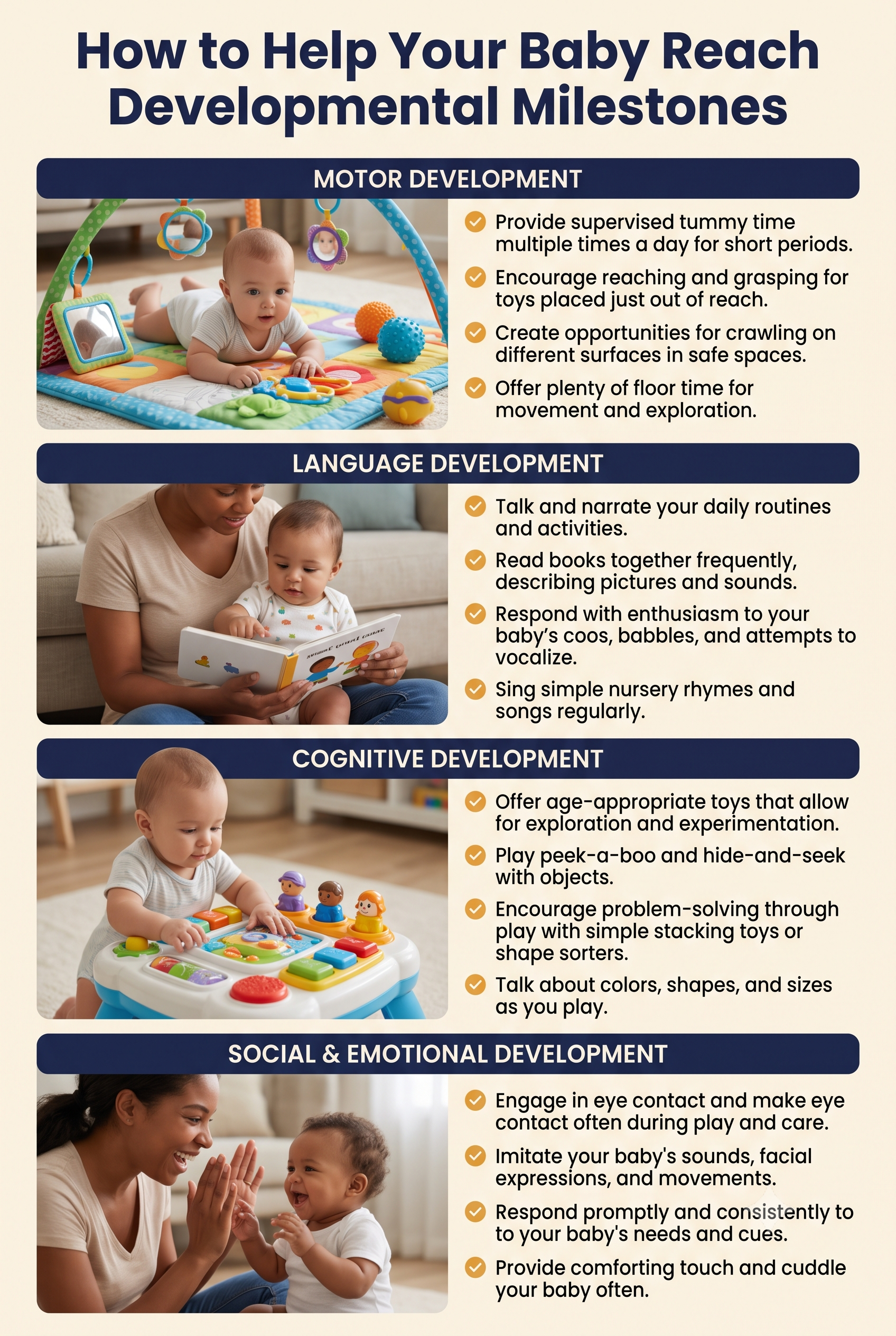
The most effective way to support your baby’s developmental milestones is through responsive, everyday interactions — talking, reading, playing, and providing a safe environment for exploration. According to the NICHD, the quality of parent-child interaction is the strongest predictor of developmental outcomes, more than any product, program, or app.
For motor development: Tummy time from day one (supervised, on a firm surface) builds the foundation for every gross motor milestone. As your baby grows, provide safe spaces for floor play, reaching, crawling, and pulling up. Resist the urge to “help” too much — when a baby works to reach a toy or pull to stand, the effort itself builds strength and neural connections. Packing for outings with mobility in mind helps too — see our diaper bag checklist for essentials that support active exploration outside the home.
For language development: Talk to your baby constantly — describe what you’re doing, name objects, ask questions (even before they can answer). Research consistently shows that the number of words a child hears in the first three years of life significantly predicts language ability at school entry. Read together daily from birth. Respond to your baby’s sounds and gestures as if they’re meaningful communication, because they are.
For cognitive and social-emotional development: Play is your child’s work. Simple, open-ended toys — blocks, balls, stacking cups, nesting boxes — offer more cognitive stimulation than electronic toys with buttons and lights. Follow your child’s interests rather than directing play. Comfort your baby when they’re distressed; secure attachment is the foundation of all healthy social-emotional development.
What Are the Red Flags in Baby Development?
Red flags in baby development are specific warning signs that suggest a child may benefit from developmental evaluation and early intervention services. According to the CDC’s Act Early campaign, the most critical red flag at any age is regression — losing skills that your child previously demonstrated consistently.
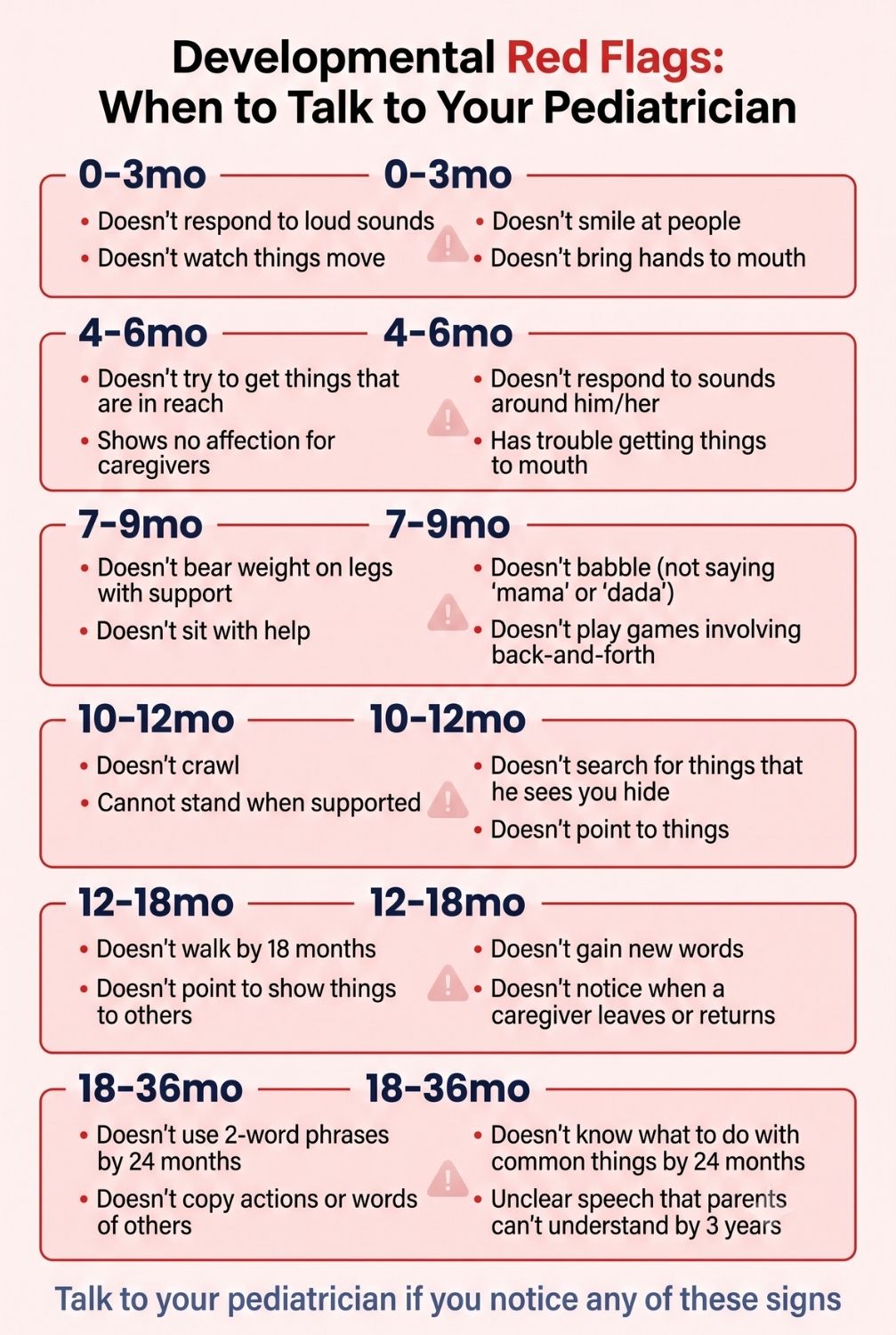
While every child develops at their own pace, certain patterns warrant a conversation with your pediatrician. The following red flags are age-specific and based on the CDC’s revised 2022 milestone guidelines and AAP Bright Futures screening recommendations:
By 2-3 months: Doesn’t respond to loud sounds. Doesn’t follow moving objects with eyes. Doesn’t smile at people. Doesn’t bring hands to mouth. Can’t hold head up when pushed up on tummy.
By 4-6 months: Doesn’t reach for objects. Shows no interest in surroundings. Doesn’t respond to sounds. Doesn’t make vowel sounds. Has difficulty getting objects to mouth. Seems very stiff or very floppy.
By 9-12 months: Doesn’t bear weight on legs when supported. Doesn’t sit with help. Doesn’t babble (“mama,” “baba”). Doesn’t play any back-and-forth games. Doesn’t respond to own name. Doesn’t seem to recognize familiar people. Doesn’t point to things.
By 18 months: Doesn’t walk. Doesn’t have at least 6 words. Doesn’t notice or mind when a caregiver leaves or returns. Doesn’t point to show you something. Doesn’t know what familiar things are for (cup, phone).
By 24-36 months: Doesn’t use 2-word phrases. Doesn’t follow simple instructions. Doesn’t copy actions or words. Doesn’t engage in pretend play. Loses skills they once had. Doesn’t show interest in other children.
If you notice any of these red flags, trust your instincts and bring your concerns to your child’s pediatrician. You know your child better than anyone. Early intervention services — available in every U.S. state for children from birth to age 3 through the Individuals with Disabilities Education Act (IDEA) Part C program — can make a significant difference. The NICHD emphasizes that earlier intervention consistently leads to better outcomes.
Frequently asked questions
What are the 5 main areas of child development?
The five main areas of child development are gross motor skills, fine motor skills, language and communication, cognitive development, and social-emotional development. The CDC tracks these through its Learn the Signs. Act Early. program, with milestone checklists at 11 age points from 2 months through 5 years.
At what age do babies start crawling?
Most babies begin crawling between 7 and 10 months of age, according to the CDC’s revised 2022 milestone guidelines. Some babies skip crawling entirely and move directly to pulling up, cruising along furniture, or walking. Crawling style also varies — some babies army crawl, scoot on their bottoms, or bear crawl on hands and feet.
When should I worry about my baby not reaching milestones?
Talk to your pediatrician if your baby consistently misses milestones across two or more developmental domains, loses skills they previously had, or shows no progress over several months. The American Academy of Pediatrics recommends formal developmental screening at 9, 18, and 30 months — these screenings catch delays that casual observation may miss.
What is the difference between a developmental delay and a disability?
A developmental delay means a child has not reached a milestone by the expected age but may still catch up with support. A developmental disability is a long-term condition that affects daily functioning and typically persists throughout life. Early intervention services, available in every U.S. state for children under 3, can significantly improve outcomes for both delays and disabilities.
When do babies say their first words?
Most babies say their first meaningful words between 12 and 18 months of age. Before that, babies typically babble with consonant-vowel combinations like “mama” and “dada” starting around 6 to 9 months — though these early sounds are not yet used with specific meaning. By 18 months, most toddlers can say at least 10 words.
How can I track my baby’s developmental milestones?
The CDC offers a free Milestone Tracker app that provides age-specific checklists and milestone photos. You can also use the CDC’s printable checklists at each well-child visit. Share your observations with your pediatrician at every appointment — your day-to-day insights are valuable clinical information that complements formal screening tools.
Do premature babies reach milestones later?
Premature babies often reach milestones later than full-term babies, and pediatricians typically use a corrected age (adjusted for prematurity) when assessing development for the first two years. For example, a baby born two months early would be assessed against the milestones of a baby two months younger. Most premature babies catch up to their peers by age 2 to 3.
When to contact your healthcare provider
Contact your child’s pediatrician or seek evaluation if you notice any of the following:
-
⚠️
Loss of previously acquired skills — regression at any age is the most critical red flag -
⚠️
No social smiling by 3 months — lack of responsive smiling may indicate a vision, hearing, or social development concern -
⚠️
No babbling by 9 months — absence of consonant sounds warrants a hearing evaluation -
⚠️
Not walking by 18 months — while the range is wide, independent walking should emerge by this age -
⚠️
No words by 16 months or no 2-word phrases by 24 months — language delays benefit from early speech therapy -
⚠️
Persistent lack of eye contact or response to name — discuss autism screening with your provider
This article is for educational purposes only and does not replace medical advice from a qualified healthcare provider. If you have concerns about your child’s development, contact your pediatrician.
Sources
- Centers for Disease Control and Prevention. (2022). CDC’s Developmental Milestones. CDC.gov.
- Centers for Disease Control and Prevention. (2025). Milestone Checklists by Age. CDC.gov.
- American Academy of Pediatrics. (2024). Developmental Milestones by Age. HealthyChildren.org.
- National Institute of Child Health and Human Development. (2024). Milestones — Child Development. NICHD.NIH.gov.
- Mayo Clinic. (2024). Infant Development: Birth to 3 Months. MayoClinic.org.
- Mayo Clinic. (2024). Infant Development: Milestones from 7 to 9 Months. MayoClinic.org.
- Cleveland Clinic. (2024). Baby Developmental Milestones By Month. ClevelandClinic.org.
- Johns Hopkins Medicine. (2024). Babies and Toddlers: Developmental Milestones. HopkinsMedicine.org.
- World Health Organization. (2006). WHO Motor Development Study — Windows of Achievement. WHO.int.
- Stanford Medicine. (2024). Developmental Milestones: Birth to 5 Years. Stanford.edu.
- Children’s Hospital of Philadelphia. (2024). Developmental Milestones. CHOP.edu.
- Zero to Three. (2022). Revised Developmental Milestones for Babies and Toddlers: Your Questions Answered. ZeroToThree.org.