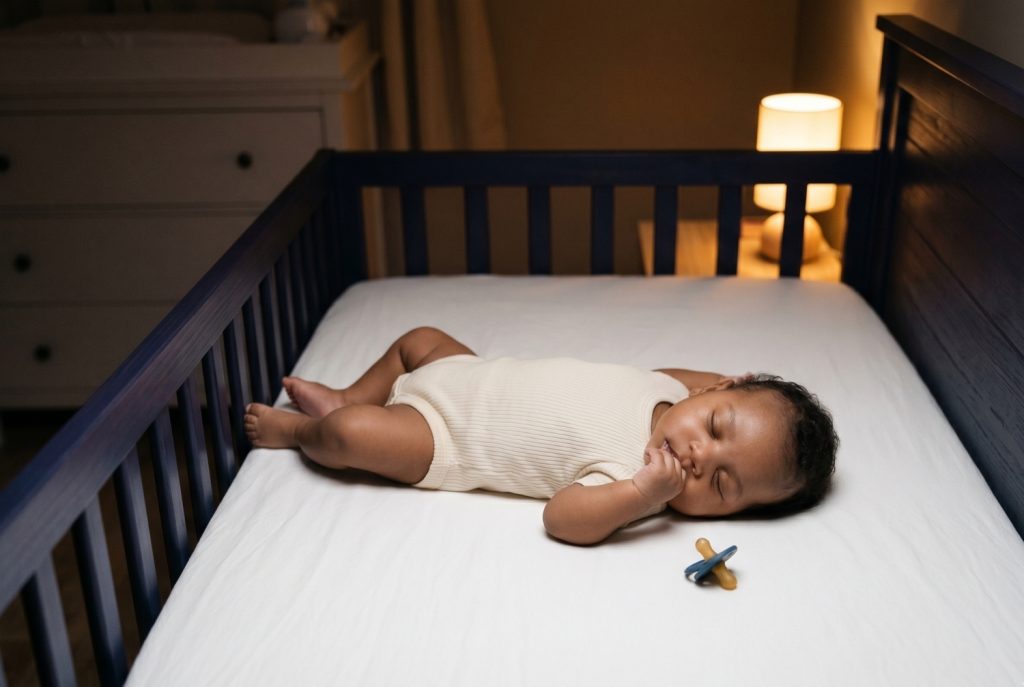
Can baby sleep with pacifier? Yes — a baby can safely sleep with a pacifier — and major medical authorities actively recommend it. According to the American Academy of Pediatrics (AAP), offering a pacifier at nap time and bedtime is associated with a reduced risk of sudden infant death syndrome (SIDS). Research published in the Journal of Pediatrics found that pacifier use during sleep may lower SIDS risk by up to 50–90 percent.
Key takeaways
- ✓Can baby sleep with pacifier? Yes — the AAP recommends offering one at every sleep to reduce SIDS risk.
- ✓Pacifiers may lower SIDS risk by keeping airways open and promoting lighter sleep.
- ✓Breastfed babies should wait until breastfeeding is established, typically 3–4 weeks.
- ✓If the pacifier falls out after your baby falls asleep, you do not need to replace it.
- ✓Never attach a pacifier to clothing, crib, or stuffed animals during sleep.
- ✓Begin weaning from the pacifier between 6 and 12 months, and fully by age 2–3.
Can baby sleep with pacifier safely? If you have ever found yourself tiptoeing into the nursery at 2 a.m. asking this question, you are far from alone. It is one of the most common questions new parents ask — and the answer is more reassuring than you might expect. Not only is sleeping with a pacifier safe for most babies, but the largest pediatric organizations in the world actively recommend it as part of a safe sleep environment.
This guide walks you through what the research says, when to introduce a pacifier, how it helps protect against SIDS, and the practical safety rules every parent should know. Everything here is based on current guidelines from the AAP, CDC, NIH, and peer-reviewed clinical research — no product pitches, no sponsored opinions, just sourced information you can trust.
Can baby sleep with pacifier safely?
Sleeping with a pacifier is a safe and recommended practice for infants when used correctly as part of the AAP’s evidence-based safe sleep guidelines. The AAP’s 2022 updated policy statement on sleep-related infant deaths — built on review of 159 scientific studies — specifically lists pacifier use among protective measures that reduce the risk of SIDS and other sudden unexpected infant deaths.
According to HealthyChildren.org (AAP), offering a pacifier at nap time and bedtime helps reduce SIDS risk — even if the pacifier falls out after your baby is asleep. The key is that your baby should be placed on their back, on a firm flat surface, in a bare crib or bassinet, with no loose bedding, blankets, or toys.
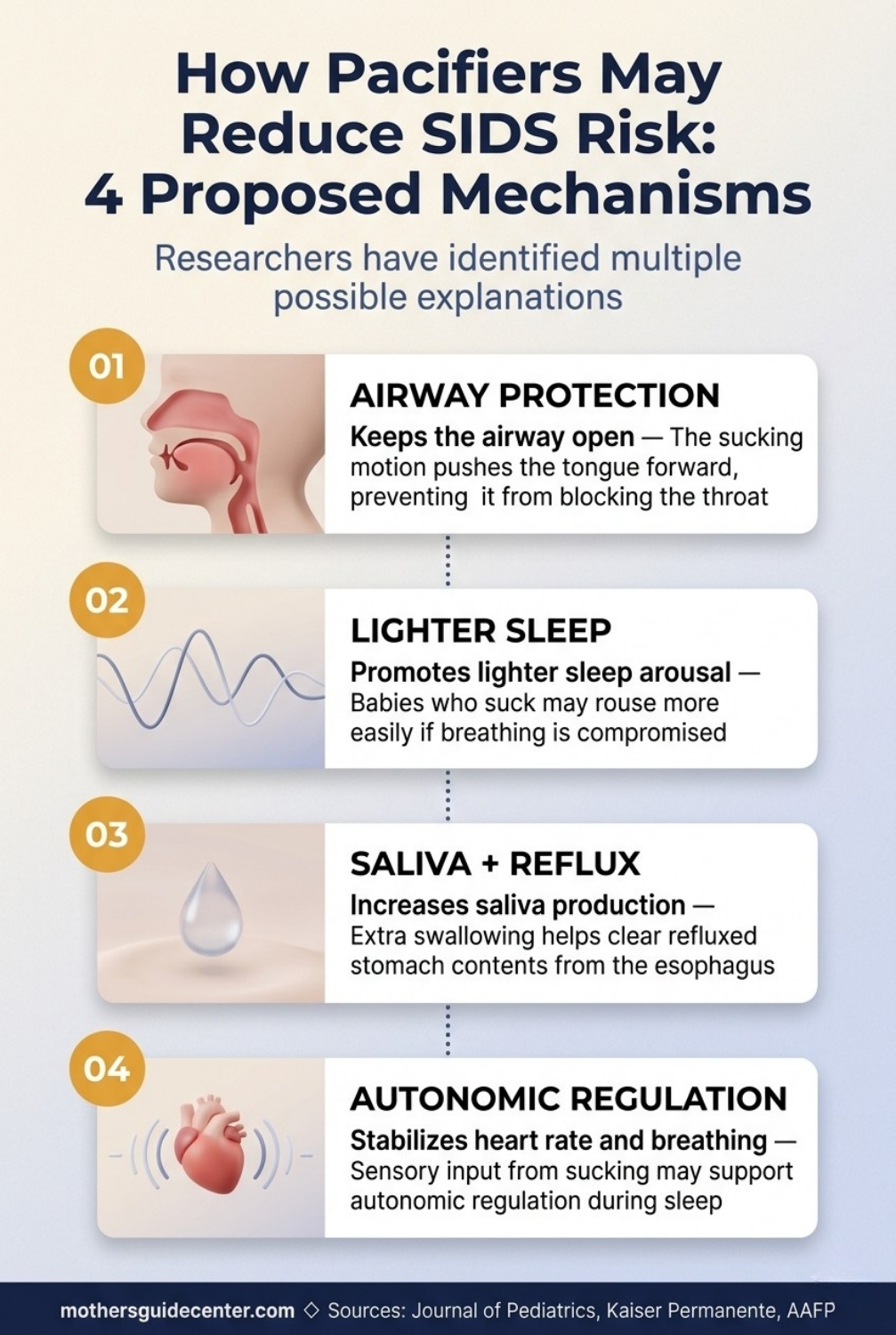
Formula-fed babies can use a pacifier from birth. Breastfed babies should wait until breastfeeding is firmly established — meaning milk supply is sufficient, latch is effective, and weight gain is on track. This typically happens around 3–4 weeks of age.
How do pacifiers reduce the risk of SIDS?
Pacifier use during sleep is associated with a significantly reduced risk of SIDS, although the exact biological mechanism is not fully understood. A meta-analysis published in the Journal of Pediatrics found that pacifier use at last sleep was associated with a summary odds ratio of 0.39 — meaning SIDS risk was reduced by roughly 61 percent.
A separate study by the Kaiser Permanente Division of Research reported up to a 90 percent reduction in SIDS risk. The protective effect held even in higher-risk situations — such as when babies were placed on their stomach, slept on soft bedding, or were exposed to secondhand smoke.
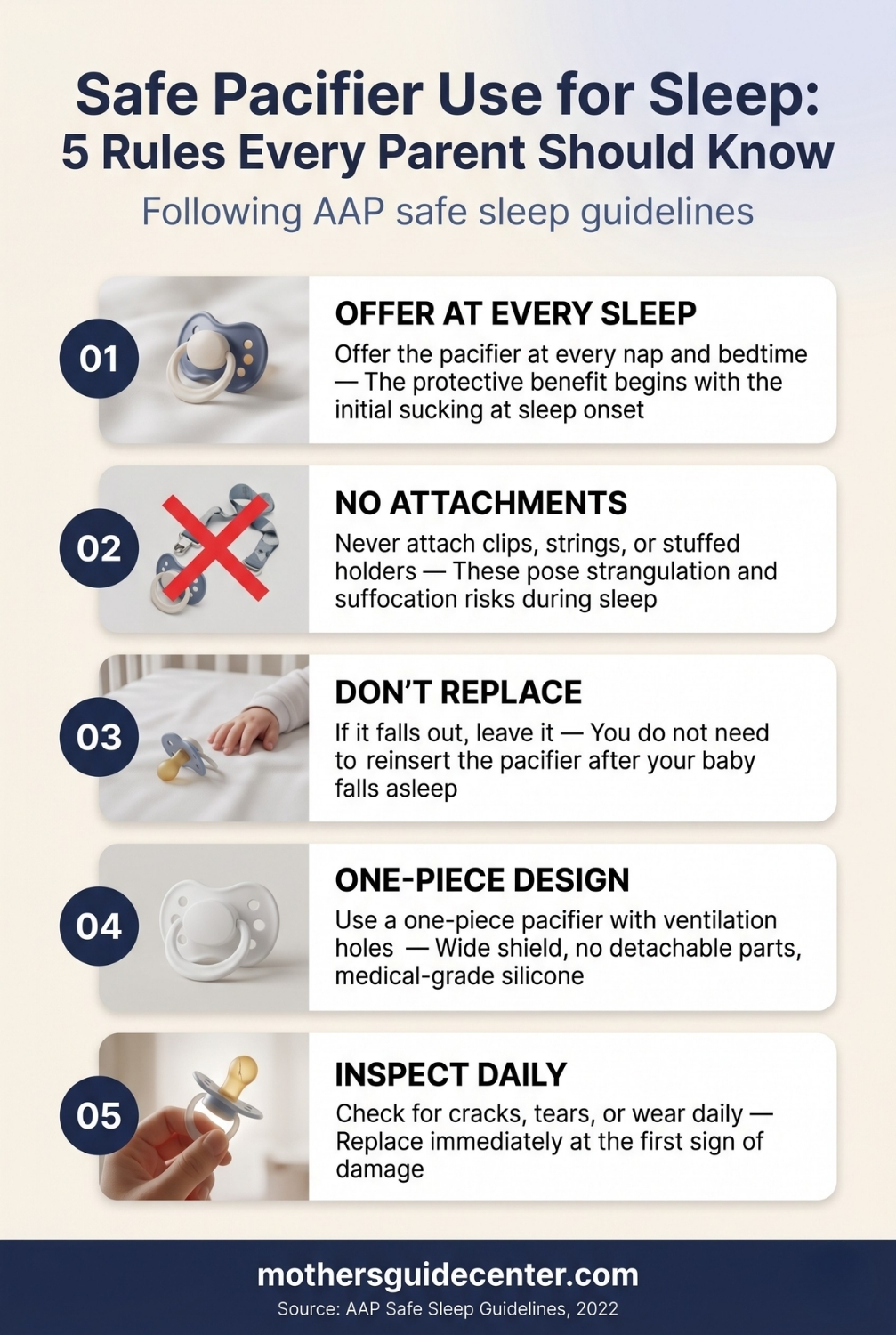
Researchers have proposed several possible explanations. The sucking motion may help keep the airway open by pushing the tongue forward. Pacifiers may also promote lighter sleep, making it easier for a baby to rouse if breathing is compromised. Additional theories include increased saliva production and possible stabilization of autonomic heart rate and breathing regulation during sleep.
Importantly, the protective effect appears to work even if the pacifier falls out. According to the AAFP, the initial sucking at sleep onset provides the benefit — the pacifier does not need to stay in the mouth all night.
When should you introduce a pacifier for sleep?
Parents often ask can baby sleep with pacifier from day one — the timing depends on whether your baby is breastfed or formula-fed. Formula-fed babies can start from birth. Breastfed babies should wait until breastfeeding is firmly established — typically around 3–4 weeks.
“Firmly established” means sufficient milk supply, effective latch, and appropriate weight gain. Some research suggests introduction as early as two weeks may be safe, but the AAP’s current recommendation remains approximately one month for breastfed babies.
If your baby refuses the pacifier, that is completely normal. The AAP emphasizes that pacifiers should never be forced on a resistant infant.
What should you do if the pacifier falls out at night?
If the pacifier falls out after your baby falls asleep, you do not need to put it back in. The protective benefit comes from the initial sucking at sleep onset, not from continuous use throughout the night.
For older babies (around 6–8 months), placing two or three pacifiers in the crib can help them find one independently during nighttime wakings.
If your younger baby wakes frequently because the pacifier has fallen out, this may be a sign that the pacifier is becoming more of a sleep association than a sleep aid. Speak with your pediatrician about strategies for gradual adjustment.
Does pacifier use affect breastfeeding?
Pacifier use can interfere with breastfeeding if introduced too early. Once breastfeeding is going well, current evidence does not show long-term breastfeeding problems from pacifier use. The important rule: never use a pacifier to delay or replace a feeding.
If you notice a painful latch, fewer wet diapers, prolonged sleepiness during feeds, or slow weight gain — pause pacifier use and consult your pediatrician or lactation consultant.
What are the safety rules for pacifiers during sleep?
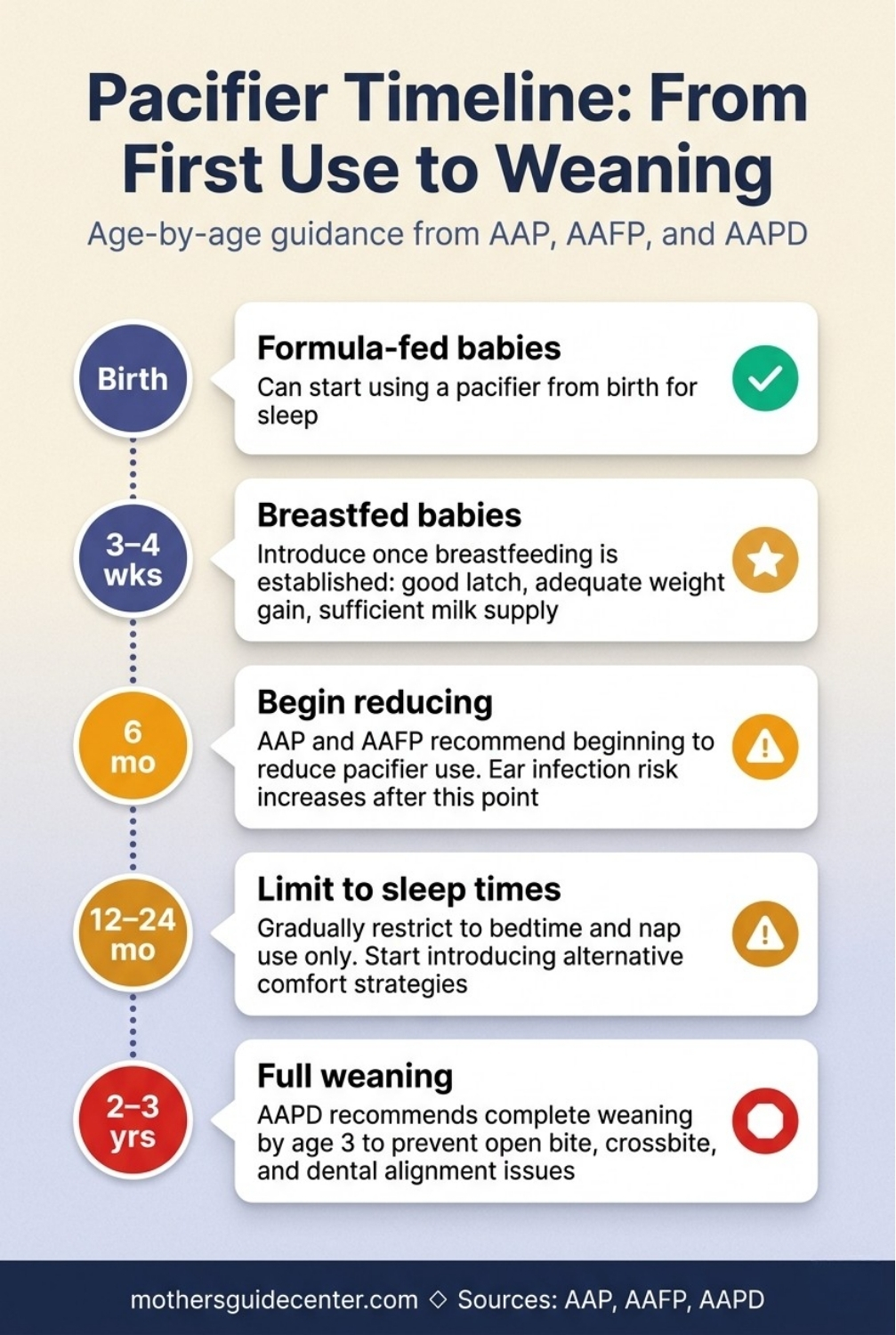
Never attach a pacifier to anything during sleep. Pacifier clips, strings, ribbons, or stuffed animal holders must never be used while a baby sleeps. According to HealthyChildren.org, these pose strangulation and suffocation hazards.
Use a one-piece pacifier with a wide mouth shield (at least 1.5 inches) and ventilation holes. Inspect and replace regularly. Check daily for cracks, tears, or sticky surfaces. Do not coat with honey or sweeteners — honey is dangerous for babies under 12 months due to botulism risk.
When should you stop offering a pacifier for sleep?
The AAP and AAFP recommend reducing pacifier use during the second six months of life. The AAPD notes that prolonged use beyond age 2 can lead to dental alignment issues. Full weaning is recommended by age 3.
A practical approach: limit to sleep times starting around 6 months, phase out between 12–24 months. Gradual weaning tends to be more effective than going cold turkey.
What type of pacifier is safest for sleeping?
The safest pacifier is a one-piece design made of medical-grade silicone with a wide, ventilated mouth shield and no detachable parts. The AAP does not endorse any specific brand. If your baby repeatedly refuses a pacifier, try a different shape — some babies simply do not take to them, and that is perfectly normal.
Frequently asked questions
Can a newborn sleep with a pacifier?
Can baby sleep with pacifier from birth? Yes, a newborn can sleep with a pacifier in most situations. Formula-fed newborns can use one from birth. Breastfed newborns should wait until breastfeeding is established — usually around 3–4 weeks. Always use the pacifier as part of a full safe sleep setup.
Do pacifiers prevent SIDS?
Pacifiers do not guarantee SIDS prevention, but they are strongly associated with reduced risk — lowering it by approximately 50–90 percent depending on the study. The AAP includes pacifier use in its official strategies to reduce sleep-related infant deaths.
Should I put the pacifier back in if it falls out?
No. The AAP states the protective benefit comes from offering the pacifier at sleep onset. There is no need to reinsert it during the night.
Can a pacifier cause ear infections?
Pacifier use is associated with a higher risk of ear infections after 6 months. The AAFP recommends reducing use in the second six months of life partly for this reason.
Is it safe to use a pacifier clip during sleep?
No — pacifier clips and tethered holders should never be used during sleep due to strangulation and suffocation risks. They are fine during supervised awake time only.
When should I wean my baby off the pacifier?
Begin reducing use after 6 months, limit to sleep by age 2, and fully wean by age 3 to prevent dental alignment issues. Gradual weaning is typically easier than abrupt removal.
When to contact your healthcare provider
Contact your pediatrician or seek immediate care if you notice:
- ⚠️Your baby stops breathing or turns blue — call 911 immediately
- ⚠️Repeated gagging or choking on the pacifier — wrong size
- ⚠️Difficulty latching after pacifier introduction — possible nipple confusion
- ⚠️Frequent ear infections — may need to reduce pacifier use
- ⚠️Oral thrush or persistent white patches — sterilize pacifiers properly
This article is for educational purposes only and does not replace medical advice from a qualified healthcare provider.
Sources
- American Academy of Pediatrics. (2022). Sleep-Related Infant Deaths: Updated 2022 Recommendations. Pediatrics, 150(1).
- Moon, R.Y., MD, FAAP. (2022). How to Keep Your Sleeping Baby Safe: AAP Policy Explained. HealthyChildren.org.
- Hauck, F.R. et al. (2005). Do pacifiers reduce the risk of SIDS? A meta-analysis. Pediatrics, 116(5).
- Li, D.K. et al. (2006). Use of a dummy during sleep and risk of SIDS. BMJ, 332(7532). Kaiser Permanente.
- Hauck, F.R. et al. (2011). Pacifier use and SIDS: evidence for a consistently reduced risk. Maternal and Child Health Journal.
- American Academy of Family Physicians. (2009). Risks and Benefits of Pacifiers. AFP, 79(8).
- American Academy of Pediatric Dentistry. (2024). Policy on Pacifiers (Revised 2024). AAPD.
- HealthyChildren.org. (2022). Safe Sleep: 9 Ways to Reduce SIDS Risk. AAP.
- Baby-Friendly USA. (2021). Pacifiers and Safe Sleep. BFUSA.
- Centers for Disease Control and Prevention. (2024). Helping Babies Sleep Safely. CDC.