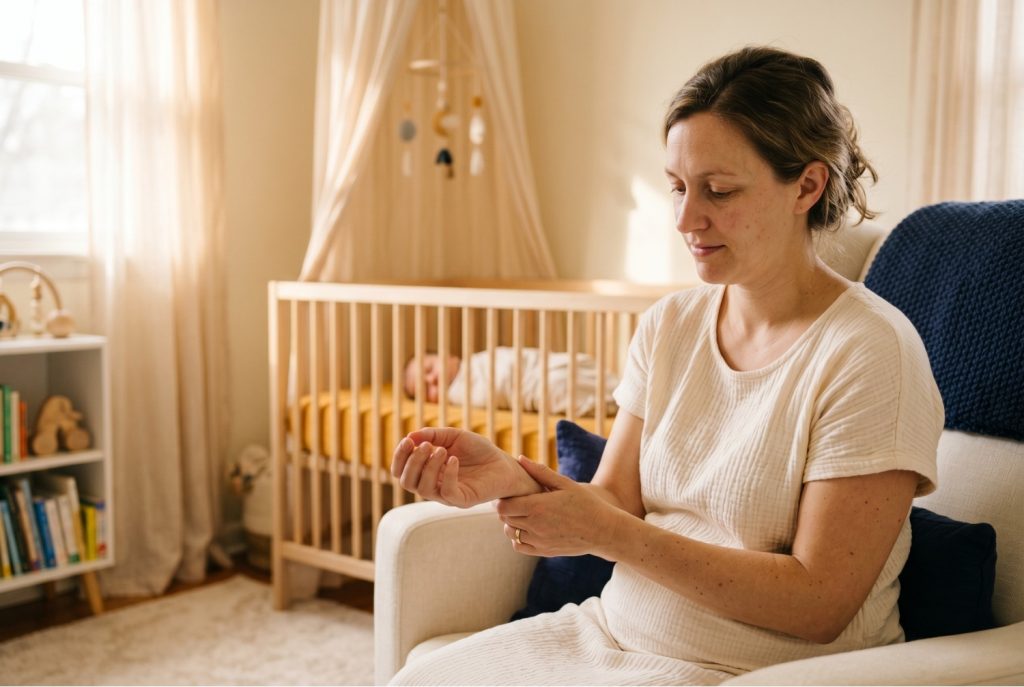
Postpartum carpal tunnel is a nerve compression condition in the wrist that causes numbness, tingling, and pain in the hand after childbirth. According to research published in the Journal of Hand Surgery, approximately 28 percent of women develop carpal tunnel symptoms during the third trimester, and about 15 percent still have symptoms one month after delivery. Most cases resolve within one to three months as pregnancy-related fluid retention decreases.
Key takeaways
- ✓ Carpal tunnel after pregnancy results from fluid retention compressing the median nerve in the wrist.
- ✓ Up to 28 percent of women develop symptoms in the third trimester; 85 percent resolve by six weeks postpartum.
- ✓ Postpartum carpal tunnel is different from de Quervain’s tenosynovitis, which affects the thumb-side tendons.
- ✓ Night wrist splinting reduces nighttime symptoms in approximately 60 to 70 percent of cases.
- ✓ Breastfeeding positions and repetitive baby-care motions can prolong wrist pain after birth.
- ✓ Symptoms persisting beyond 12 weeks postpartum warrant a formal medical evaluation.
- ✓ Contact your provider if you notice progressive numbness, grip weakness, or regularly drop objects.
You made it through pregnancy, labor, and delivery — and now your hands are numb at 3 a.m. while you try to hold your newborn. If you are waking up with tingling fingers, dropping bottles, or struggling to fasten tiny onesie snaps, you are not imagining it. Carpal tunnel syndrome after pregnancy is remarkably common, and it is one of the most underrecognized postpartum recovery challenges.
This guide explains exactly what causes postpartum carpal tunnel, how long it typically lasts, what you can do at home to find relief, and when to contact your healthcare provider. Every recommendation is sourced from Tier 1 medical authorities — including ACOG, the Mayo Clinic, and the Cleveland Clinic — so you can trust the information while caring for your baby.
What is postpartum carpal tunnel syndrome?
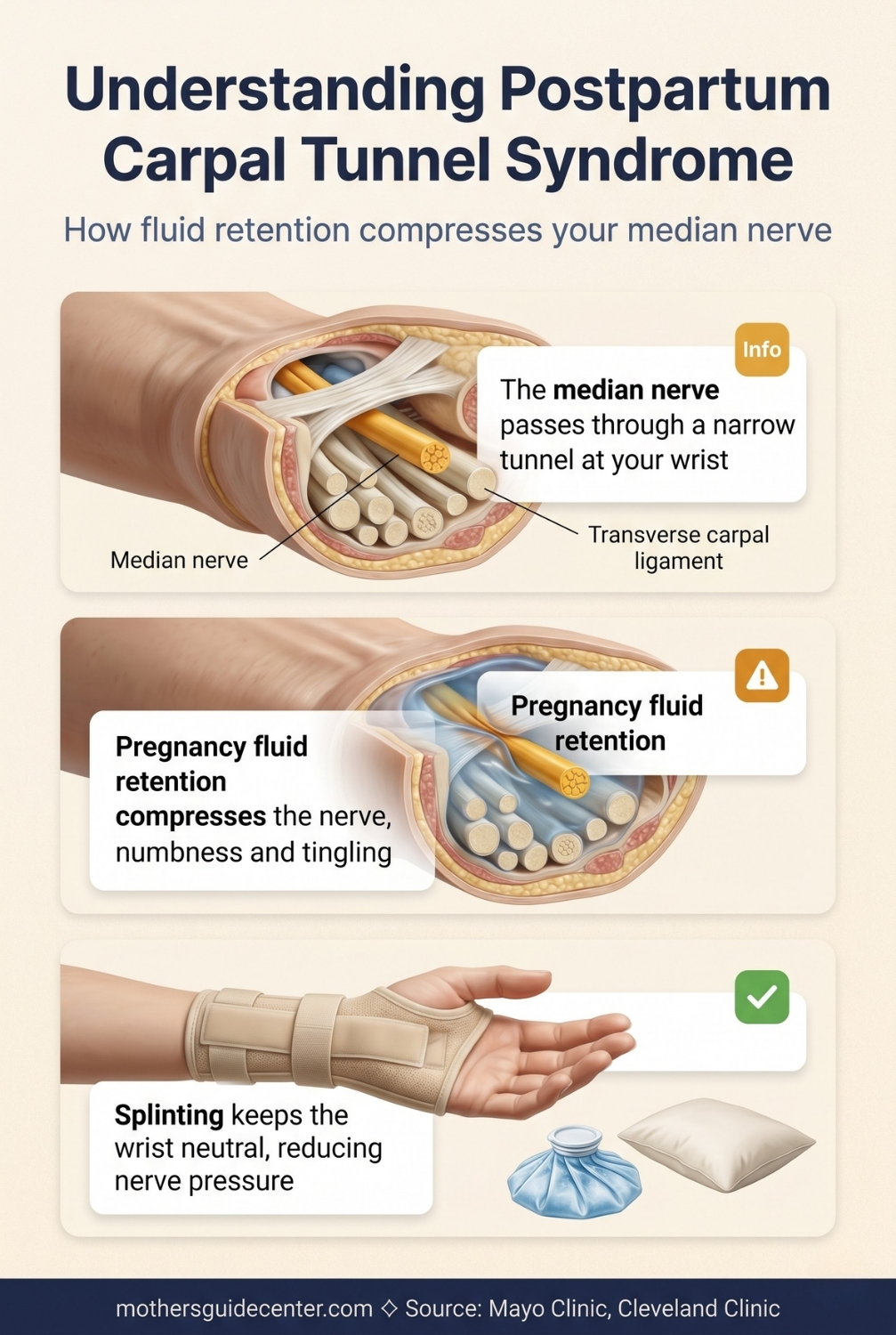
Postpartum carpal tunnel syndrome is a compression injury of the median nerve as it passes through the narrow carpal tunnel at the base of the wrist, causing numbness, tingling, and pain in the thumb, index, middle, and part of the ring finger. The carpal tunnel itself is a small passageway formed by wrist bones on three sides and a tough ligament — the transverse carpal ligament — on the fourth. When the tissues surrounding the median nerve swell, the nerve gets squeezed.
This condition is classified under ICD-10 code G56.0 (carpal tunnel syndrome) regardless of whether it develops during pregnancy or postpartum. According to the Mayo Clinic, carpal tunnel syndrome occurs when anything that irritates or compresses the median nerve in the carpal tunnel space produces symptoms — and the fluid retention and hormonal changes of pregnancy and the postpartum period are among the most common triggers in women of childbearing age.
What causes carpal tunnel syndrome after pregnancy?
Carpal tunnel after pregnancy is caused by a combination of retained fluid, hormonal changes, and the physical demands of newborn care — each compressing or irritating the median nerve through a different mechanism. Understanding these causes helps explain why some mothers recover quickly while others experience symptoms for months.
Fluid retention: During pregnancy, the body retains significantly more fluid. After delivery, this fluid does not disappear immediately — it can take weeks for the body to reabsorb and excrete the excess. The retained fluid increases pressure within the already tight carpal tunnel, compressing the median nerve. According to a 2024 narrative review published in Medicina, increased serum levels of estrogen, aldosterone, cortisol, and prolactin all contribute to fluid retention that directly affects the carpal tunnel.
Hormonal changes: Relaxin, a hormone that loosens ligaments to prepare for birth, also affects the transverse carpal ligament. When this ligament relaxes and shifts, it can create inflammation around the median nerve. Relaxin levels remain elevated for several weeks postpartum, particularly in breastfeeding mothers.
Repetitive baby-care motions: Postpartum carpal tunnel can begin or worsen after delivery due to the demands of newborn care — holding a baby’s head during breastfeeding, lifting and carrying, operating strollers and car seats, and pumping breast milk. These activities keep the wrist in flexed or extended positions for prolonged periods, increasing pressure on the median nerve.
Risk factors that increase the likelihood of developing carpal tunnel post pregnancy include gestational diabetes, preeclampsia, higher body weight, multiple pregnancies, and a history of carpal tunnel syndrome before pregnancy.
What symptoms should you watch for?
Postpartum carpal tunnel symptoms are the specific sensations caused by median nerve compression — they follow a recognizable pattern that distinguishes this condition from general wrist soreness or tendon injuries. Symptoms typically affect the thumb, index finger, middle finger, and the thumb-side half of the ring finger. The pinky finger is almost never affected because it is served by a different nerve.
According to the Cleveland Clinic, typical carpal tunnel symptoms include:
Numbness and tingling in the thumb, index, and middle fingers — often described as pins and needles or a feeling that the fingers have “fallen asleep.” This is frequently worse at night because many people sleep with their wrists flexed, which increases pressure on the median nerve.
Hand weakness and dropping objects — difficulty gripping bottles, clasping baby snaps, or holding a phone. This happens because the median nerve supplies muscles at the base of the thumb that control grip strength.
Pain that radiates up the forearm — sometimes extending to the elbow or shoulder, often worsened by sustained gripping or wrist flexion.
Morning stiffness — hands that feel swollen, clumsy, or difficult to use for the first 30 to 60 minutes after waking. This is especially noticeable when picking up your baby for early morning feeds.
How is postpartum carpal tunnel different from de Quervain’s tenosynovitis?
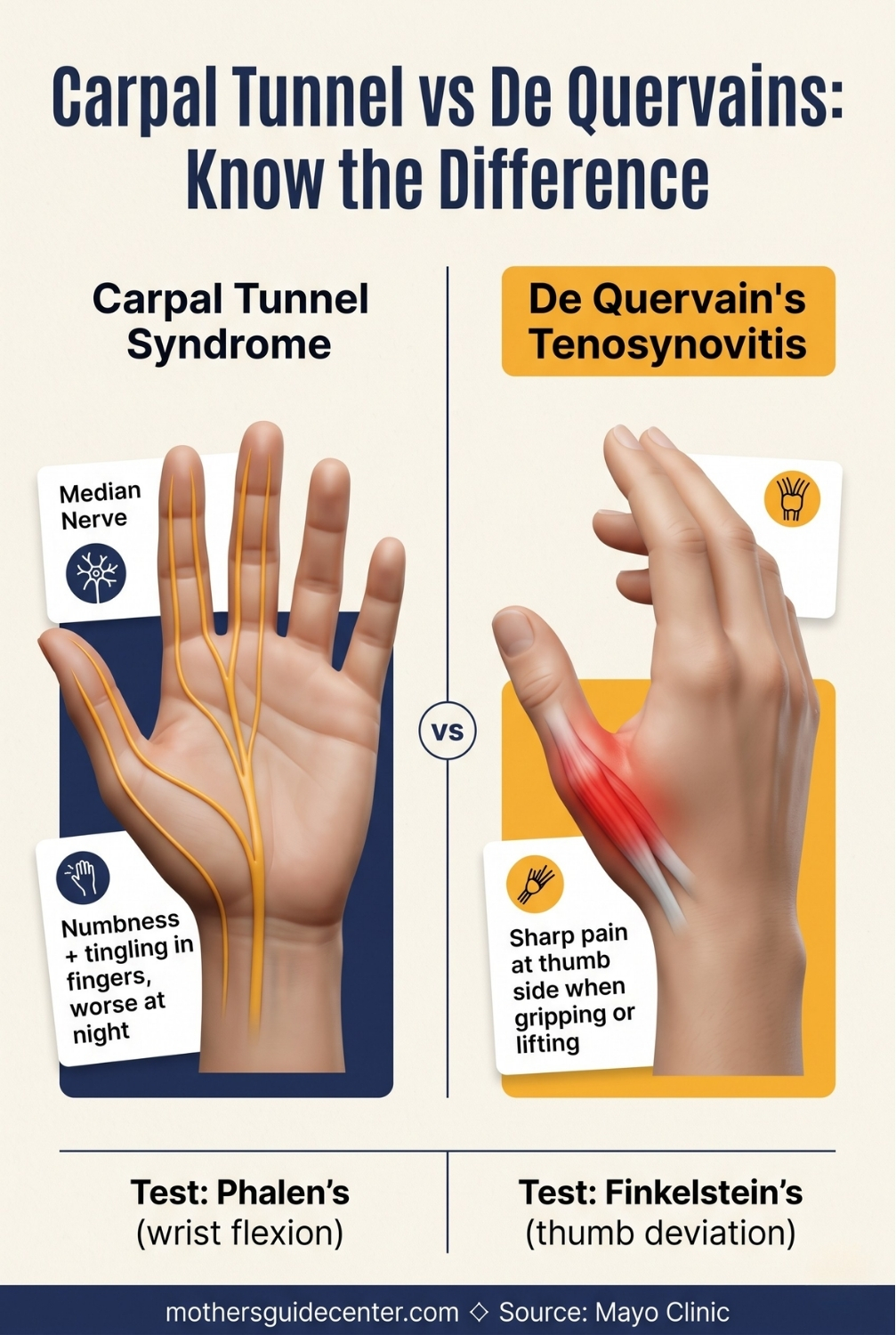
De Quervain’s tenosynovitis is a tendon inflammation on the thumb side of the wrist — a separate condition from carpal tunnel syndrome that is also very common in new mothers. Because both cause wrist pain postpartum, they are frequently confused, but they involve different structures, produce different symptoms, and respond to different treatments.
| Feature | Carpal tunnel syndrome | De Quervain’s tenosynovitis |
|---|---|---|
| Structure affected | Median nerve (palm side of wrist) | Thumb tendons (thumb side of wrist) |
| Primary symptoms | Numbness, tingling, pins and needles in fingers | Sharp pain at thumb-side of wrist with gripping |
| Fingers affected | Thumb, index, middle, half of ring finger | Thumb primarily |
| Worst timing | Night and early morning | During lifting and gripping activities |
| Typical onset | Third trimester or early postpartum | Usually postpartum (baby-care related) |
| Diagnostic test | Phalen’s test (wrist flexion) | Finkelstein’s test (thumb deviation) |
According to the Mayo Clinic, de Quervain’s is sometimes called “mommy thumb” because it is triggered by the repetitive thumb-wide-open motion used when lifting a baby under the arms. If your wrist pain is primarily on the thumb side and gets worse when you twist your wrist or make a fist around your thumb, you may have de Quervain’s rather than — or in addition to — carpal tunnel. Both conditions can occur simultaneously.
How long does carpal tunnel last after pregnancy?
Carpal tunnel after pregnancy typically lasts one to twelve weeks for the majority of women, with most experiencing complete resolution as postpartum fluid retention decreases. However, the timeline varies significantly depending on whether symptoms began during pregnancy or postpartum, whether you are breastfeeding, and how demanding baby-care activities are on your wrists.
A study led by Dr. Philip Blazar at Brigham and Women’s Hospital, published in the Journal of Hand Surgery, tracked 368 women with gestational carpal tunnel syndrome. The researchers found that 85 percent had complete resolution by six weeks postpartum. However, 15 percent still had persistent symptoms one month after delivery, and for women whose symptoms had not resolved by three months, the condition tended to persist and worsen over time.
If your symptoms started only after delivery — not during pregnancy — they are often related to the physical demands of baby care rather than fluid retention alone. In that case, symptoms may persist for as long as the triggering activities continue, particularly in breastfeeding mothers who maintain sustained wrist positions during feeding.
What treatments help postpartum carpal tunnel?
Postpartum carpal tunnel treatment is conservative in the vast majority of cases, meaning non-surgical approaches that reduce pressure on the median nerve while the body’s fluid levels return to normal. Surgery is rarely needed and is reserved for severe cases that do not respond to months of conservative care.
Wrist splinting is the first-line treatment. A neutral-position wrist splint — one that keeps the wrist straight, not bent up or down — reduces carpal tunnel pressure by preventing the wrist flexion that compresses the median nerve. Wearing a splint at night is especially effective because nighttime wrist flexion is a primary symptom trigger. A military hospital study published in the American Journal of Occupational Therapy found that splinting produced an average grip strength increase of 5.4 pounds and meaningful symptom improvement within one week.
Cold therapy applied to the wrist for 10 to 15 minutes at a time can reduce swelling. Wrap ice in a cloth — never apply directly to skin.
Activity modification means reducing the time your wrists spend in bent positions. Adjust how you hold your baby, use pillows for support during feeding, and take breaks from repetitive hand tasks like pumping.
Corticosteroid injection may be considered for moderate-to-severe symptoms that do not respond to splinting. According to the Cleveland Clinic, a single injection into the carpal tunnel can provide significant relief, and it is generally considered safe during breastfeeding. Discuss this option with your provider.
Physical therapy or occupational therapy can provide individualized nerve gliding exercises, ergonomic training for baby care, and manual therapy techniques to mobilize the carpal tunnel structures.
Carpal tunnel release surgery is reserved for cases with severe symptoms, electrophysiological evidence of significant nerve compression, and failure of conservative treatment over several months. Surgery is safe during breastfeeding and is typically performed as an outpatient procedure under local anesthesia.
What exercises relieve postpartum wrist pain?
Nerve gliding exercises are gentle movements designed to help the median nerve slide more freely through the carpal tunnel, reducing compression and easing symptoms. These exercises should produce a gentle pulling sensation but should never cause sharp pain. If they do, stop and consult your provider.
Median nerve glide: Start with your arm out in front of you, elbow straight, wrist bent forward and fingers curled into a fist. Slowly extend your wrist backward while opening your fingers. Hold for 5 seconds. Return to the starting position. Repeat 10 times, 1 to 2 times per day.
Tendon glide: Hold your hand up with fingers straight. Slowly curl your fingertips down to touch the top of your palm (making a hook shape), then straighten. Next, curl your fingers into a full fist, then straighten. Repeat each position 5 times.
Wrist flexion and extension stretch: Extend one arm with the palm facing up. Use the other hand to gently pull your fingers downward, stretching the inside of your wrist. Hold for 15 to 20 seconds. Then flip your hand palm-down and gently pull fingers toward you. Hold 15 to 20 seconds. Repeat on the other side.
Fist pumps: Make a tight fist, then spread your fingers wide. Repeat 10 times. This gentle pumping action promotes circulation and helps reduce fluid in the hand and wrist.
According to a 2025 review in Cureus, nerve-gliding exercises combined with wrist immobilization represent the most effective conservative approach for pregnancy-related carpal tunnel syndrome.
How can you adjust breastfeeding to protect your wrists?
Breastfeeding positioning adjustments are practical changes to how you hold and support your baby during feeds that reduce sustained wrist flexion — one of the primary triggers for postpartum carpal tunnel symptoms. The goal is to support your baby’s weight with pillows and your forearm rather than your hand and wrist.
Use a firm nursing pillow to bring your baby to breast height. This eliminates the need to hold your baby’s full weight with your arm and wrist. Place the pillow on your lap and position your baby on it so your hands are free or only lightly guiding.
Support baby’s head with your forearm, not your hand. In the cradle hold, rest your baby’s head in the crook of your elbow rather than cupping it with your palm. This keeps your wrist in a neutral position rather than flexed.
Try the side-lying position. Lying on your side with your baby beside you eliminates wrist involvement almost entirely. Place a rolled towel behind your baby for support. This position is especially helpful for nighttime feeds when carpal tunnel symptoms are worst.
Wear your wrist splint during feeds if symptoms are significant. A neutral-position splint prevents the wrist from bending while you support your baby.
Can carpal tunnel after pregnancy become permanent?
Permanent nerve damage from postpartum carpal tunnel is uncommon but possible if significant compression goes untreated for an extended period. The research shows a clear pattern: for the majority of women, symptoms resolve completely — but a subset requires long-term monitoring.
The Brigham and Women’s Hospital study found that for the 15 percent of women whose symptoms did not resolve by three months postpartum, the condition tended to persist and worsen rather than slowly improve. A separate long-term follow-up study published in the Journal of Hand Surgery tracked women with residual postpartum symptoms and found that some required surgical release 2 to 16 years after delivery, after initially responding to conservative treatment.
The key message: do not assume postpartum carpal tunnel will resolve on its own if symptoms persist beyond three months. Early evaluation allows your provider to determine whether the compression is still related to postpartum fluid retention or whether it has transitioned to true carpal tunnel syndrome requiring more aggressive treatment.
Frequently asked questions
Does breastfeeding make carpal tunnel worse?
Breastfeeding can prolong postpartum carpal tunnel symptoms through two mechanisms. First, prolactin and other breastfeeding hormones contribute to continued fluid retention. Second, the sustained wrist positions required for holding and supporting a baby during feeding increase mechanical pressure on the median nerve. Adjusting feeding positions and using pillow support can significantly reduce wrist strain while continuing to breastfeed.
Should I wear a wrist splint at night postpartum?
A neutral-position wrist splint worn at night is the single most effective conservative treatment for postpartum carpal tunnel. Most people sleep with their wrists flexed, which increases pressure on the median nerve and worsens symptoms. A splint keeps the wrist straight, and research shows this approach reduces nighttime symptoms in 60 to 70 percent of cases. Over-the-counter splints with a rigid metal bar are widely available at pharmacies.
Is postpartum carpal tunnel the same as regular carpal tunnel syndrome?
Postpartum carpal tunnel involves the same nerve (the median nerve) and the same anatomical structure (the carpal tunnel) as non-pregnancy-related carpal tunnel syndrome. The key difference is the cause: postpartum carpal tunnel is primarily triggered by hormonal fluid retention and typically resolves as hormone levels normalize. Regular carpal tunnel syndrome is usually caused by repetitive strain or anatomical factors and tends to be chronic without treatment. Both are classified under ICD-10 code G56.0.
Can carpal tunnel after a c-section be different?
Carpal tunnel after a cesarean birth can feel more challenging to manage because c-section recovery limits how you can position yourself and your baby. Lifting restrictions mean you may rely more heavily on your hands and wrists for tasks that would otherwise use your whole body. The intravenous fluids given during and after surgery can also temporarily increase fluid retention. The nerve compression itself is the same condition regardless of birth type.
When should I see a doctor for postpartum wrist pain?
Schedule an evaluation if your symptoms persist beyond 12 weeks postpartum, if they are worsening rather than improving, if you have constant numbness in your fingers, if you notice muscle wasting at the base of your thumb, or if you frequently drop objects. Seek same-day evaluation if your hand weakness is severe enough to interfere with safely holding your baby.
Will postpartum carpal tunnel go away on its own?
For the majority of women — approximately 85 percent — postpartum carpal tunnel resolves on its own within six weeks of delivery as fluid retention decreases and hormone levels stabilize. Conservative measures like splinting and activity modification can speed recovery. However, about 15 percent of women continue to have symptoms, and those whose symptoms persist beyond three months may need medical evaluation and potentially more targeted treatment to prevent long-term nerve damage.
When to contact your healthcare provider
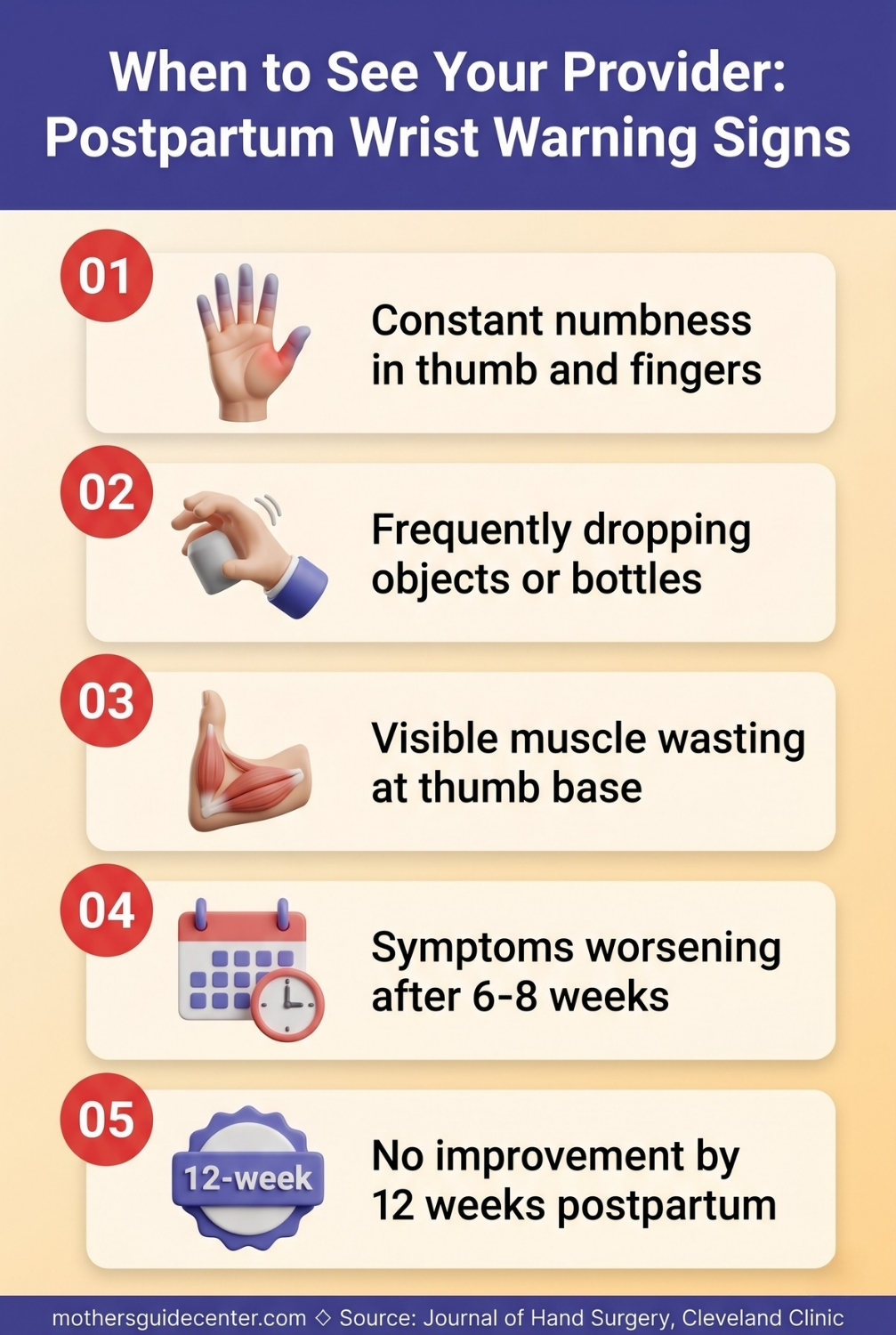
Contact your provider if you experience any of the following:
- ⚠️ Constant numbness in your thumb, index, or middle fingers that does not improve with rest or splinting
- ⚠️ Visible muscle wasting at the base of your thumb — the fleshy area appears flattened
- ⚠️ Frequently dropping objects or inability to grip items securely, especially your baby
- ⚠️ Symptoms worsening progressively rather than improving after 6 to 8 weeks postpartum
- ⚠️ Symptoms persisting beyond 12 weeks postpartum — formal evaluation recommended to prevent permanent nerve damage
This article is for educational purposes only and does not replace medical advice from a qualified healthcare provider.
Sources
- American College of Obstetricians and Gynecologists. (2018). Committee Opinion 736: Optimizing Postpartum Care. ACOG.org.
- Mayo Clinic. (2025). Carpal Tunnel Syndrome: Symptoms and Causes. MayoClinic.org.
- Cleveland Clinic. (2024). Carpal Tunnel Syndrome. ClevelandClinic.org.
- Blazar, P.E., et al. (2023). Carpal Tunnel Syndrome of Pregnancy May Persist Long After Delivery. The Rheumatologist. Journal of Hand Surgery findings.
- Tăbîrță, L., et al. (2024). Management of “De Novo” Carpal Tunnel Syndrome in Pregnancy: A Narrative Review. Medicina (Kaunas).
- Taş, S., et al. (2025). Pregnancy-Related Carpal Tunnel Syndrome. Cureus.
- Ekman-Ordeberg, G., et al. (1987). Carpal tunnel syndrome in pregnancy. Splinting for symptoms of carpal tunnel syndrome during pregnancy. American Journal of Occupational Therapy.
- Mayo Clinic. (2025). De Quervain’s Tenosynovitis. MayoClinic.org.
- Stolp-Smith, K.A., et al. (1998). Pregnancy-induced carpal tunnel syndrome requiring surgical release longer than 2 years after delivery. Journal of Hand Surgery.
- Goom, T., et al. (2019). Returning to Running Postnatal — Guidelines for Medical, Health and Fitness Professionals. British Journal of Sports Medicine.