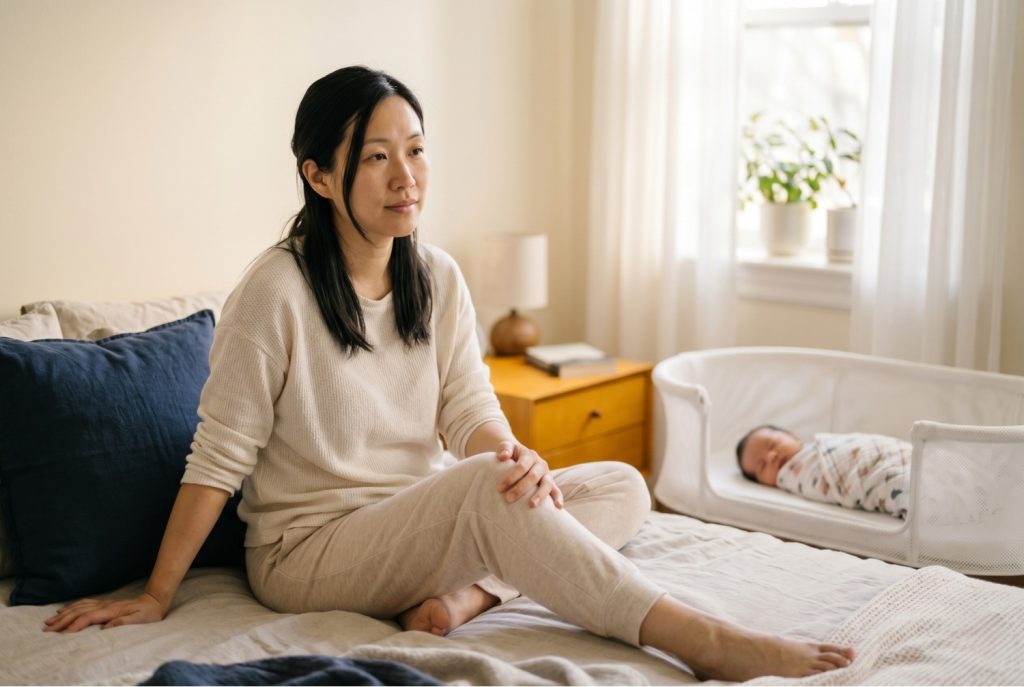
Joint pain after pregnancy is musculoskeletal discomfort caused by the hormone relaxin — produced during pregnancy to loosen ligaments for childbirth — which continues to affect joints after delivery. According to the Cleveland Clinic, it most commonly affects the hips, knees, fingers, and sacroiliac joint, and typically improves within three to six months as hormones normalize and joint stability is rebuilt.
Key takeaways
You have a new baby in your arms — but something feels wrong. Your hips ache when you stand up from the feeding chair. Your knees protest on the stairs. Your fingers are stiff every morning. You prepared for exhaustion. You did not prepare for joints that feel like they belong to someone two decades older.
Joint pain after pregnancy is one of the most common — and least discussed — aspects of postpartum recovery. It is not in your head, and in the vast majority of cases, it is not permanent. According to the American Physical Therapy Association, hormonal and biomechanical changes during pregnancy can affect every major joint in the body, and those effects do not simply stop at delivery. Understanding why your joints hurt, which areas are most vulnerable, and what actually helps is the first step toward feeling like yourself again.
Why do joints hurt after pregnancy?
Joint pain after pregnancy is a musculoskeletal response to a cascade of hormonal changes that begins the moment your baby is delivered. The primary driver is relaxin — a hormone produced throughout pregnancy to soften ligaments and widen the pelvis in preparation for childbirth. The problem is that relaxin does not selectively target pelvic joints. It acts on ligaments throughout the entire body, simultaneously loosening connective tissue in the hips, knees, ankles, fingers, and sacroiliac joint.
After delivery, relaxin levels begin to decline — but not immediately. Research shows that relaxin remains elevated for a full 12 weeks postpartum, as the liver requires at least that long to metabolize the circulating hormone. During that window, your joints remain more lax than usual, meaning the muscles around them have to work harder to provide stability. When those muscles are also weakened from nine months of altered posture, stretched abdominal muscles, and the physical demands of newborn care, the result is predictable: pain, stiffness, and an aching that tends to be worst in the morning or after periods of rest.
Relaxin is not the only factor. The rapid drop in estrogen and cortisol after delivery removes their natural anti-inflammatory protection. According to the Arthritis Foundation, this hormonal shift can trigger widespread joint inflammation. The immune system, which was deliberately suppressed during pregnancy to prevent rejection of the fetus, also “rebounds” after delivery — sometimes becoming hyperactive and further contributing to joint pain, particularly in women with a family history of autoimmune conditions.
Physical strain compounds the hormonal picture. Labor and delivery place enormous stress on the hips, pelvis, lower back, and knees. In the weeks that follow, repetitive newborn care tasks — lifting, feeding, bending, carrying — load the same joints that are already destabilized. A systematic review and meta-analysis published in the British Journal of Sports Medicine (2025) confirmed that these combined factors meaningfully contribute to postpartum musculoskeletal pain, and that targeted physical activity significantly reduces both pain severity and functional disability.
Which joints are most commonly affected after giving birth?
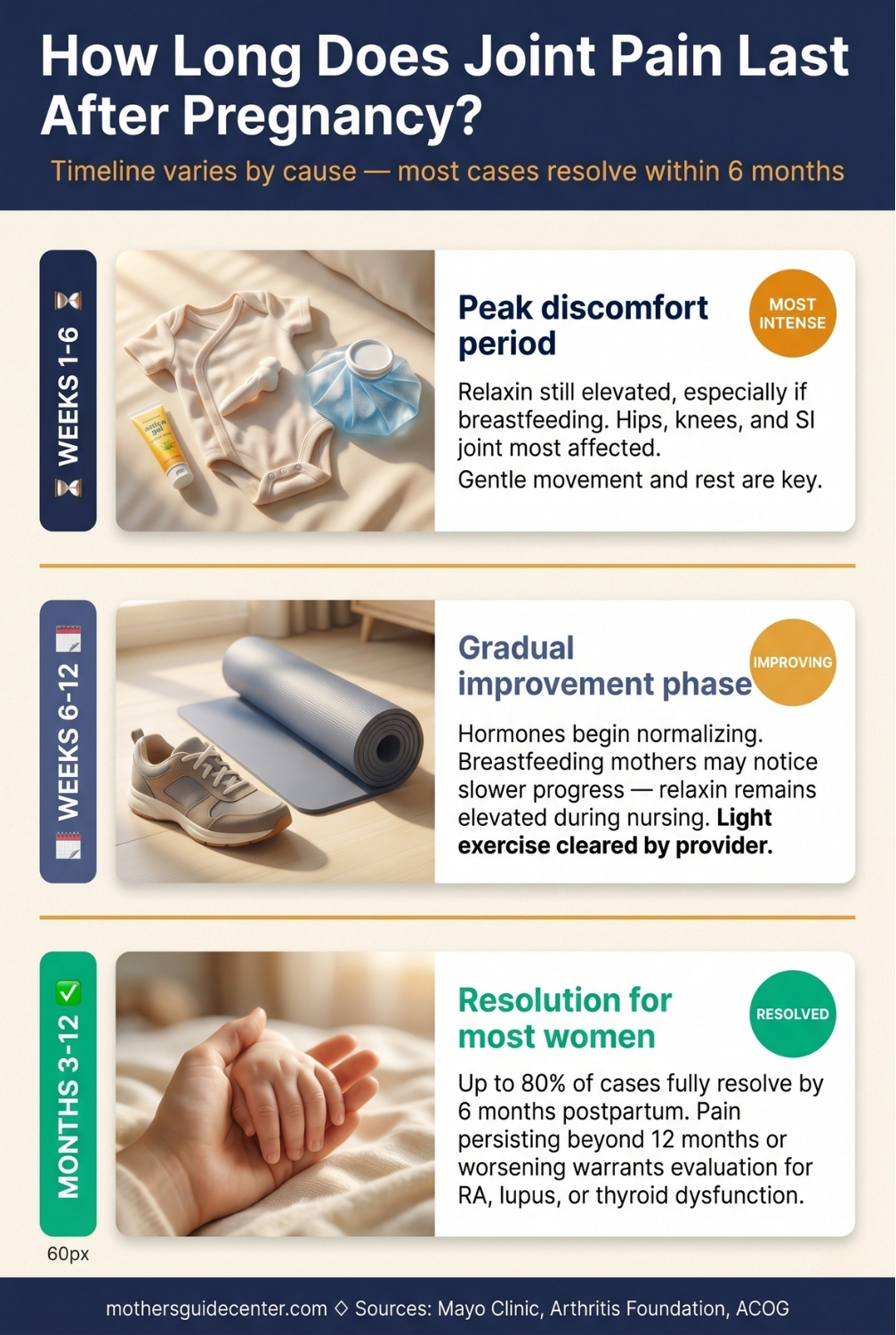
Postpartum joint pain is not confined to one area — relaxin affects ligaments throughout the body, and the physical demands of newborn care load joints that pregnancy itself may not have stressed. The most frequently reported problem areas are the hips and pelvis, knees, fingers and hands, and the sacroiliac joint in the lower back. The neck and shoulders join the list once breastfeeding and carrying positions become part of the daily routine.
The sections below examine each joint group in detail. If you are experiencing wrist pain specifically — numbness, tingling, or pain radiating from the wrist into the fingers — see our separate guide on postpartum carpal tunnel syndrome, which covers that distinct condition and its treatment.
Why do hips hurt after pregnancy?
Hip pain after pregnancy is the most widely reported postpartum joint complaint, and it stems directly from the pelvis’s central role in childbirth. The sacroiliac joints and the pubic symphysis — the joints that hold the pelvic ring together — are the primary targets of relaxin during pregnancy. They need to loosen significantly to allow the baby to pass through; after delivery, they gradually restabilize. That restabilization process takes weeks, and during it, the entire hip girdle is genuinely less mechanically stable than it was before pregnancy.
A specific condition called symphysis pubis dysfunction (SPD) — also known as pelvic girdle pain (PGP) — occurs when the pubic symphysis joint remains excessively mobile after delivery. According to the Cleveland Clinic, SPD pain typically eases after birth as hormone levels normalize, but residual discomfort is common in the first weeks postpartum. NHS research estimates that pelvic girdle pain affects approximately one in four pregnant women, and for many, it persists into early postpartum recovery.
Changed gait patterns during late pregnancy often persist for several weeks after delivery, altering hip mechanics and increasing load on the lateral hip structures. Hip bursitis can develop postpartum, particularly in women who spend long hours seated in one position while breastfeeding. Physical therapy focused on hip stabilizer muscles — specifically the glutes and hip abductors — is the most evidence-supported approach for lasting hip pain relief.
Why do knees ache after having a baby?
Knee pain after pregnancy is common because the knees absorb a disproportionate share of pregnancy’s mechanical load. During the third trimester, the average woman carries 25 to 35 additional pounds — all of which passes through the knee joint with every step. Relaxin compounds this by loosening the knee’s ligament structures, creating a joint that is simultaneously overloaded and under-supported.
A peer-reviewed study found that women at 12 weeks postpartum had significantly altered knee joint proprioception — the ability to sense joint position and movement accurately. This impairment was directly linked to relaxin’s effect on the proprioceptive receptors embedded in the knee ligaments. In practical terms, this means the knee is not only looser, but less able to detect its own position — increasing the risk of pain and minor injury during everyday movements like climbing stairs or rising from a chair.
Sore knees postpartum are frequently worse in women who resume walking or light exercise before the supporting musculature has been adequately rebuilt. The key principle is to strengthen the quadriceps, hamstrings, and glutes gradually before increasing joint-loading activity. Swimming and cycling tend to be better tolerated than walking or running in early recovery because they provide cardiovascular benefit without the full ground-reaction force through the knee.
Why do finger and hand joints hurt postpartum?
Finger and knuckle joint pain after pregnancy surprises many new mothers who expect joint discomfort to stay in the lower body. Relaxin loosens the small ligaments of the fingers and knuckles with the same mechanism it uses on the pelvis, leaving them vulnerable to the repetitive micro-stress of lifting, holding, and supporting a newborn throughout the day. Morning stiffness in the fingers that eases within 30 minutes is a common and typically benign finding in the early postpartum weeks.
Postpartum fluid retention also contributes. Swelling in the finger joints reduces range of motion and makes gripping uncomfortable. As postpartum edema resolves — typically within the first two to four weeks — many women find their finger symptoms improve significantly on their own.
It is important to distinguish general finger joint aching from two specific conditions: De Quervain’s tenosynovitis (inflammation of the thumb-side tendons, often called “mommy thumb”) and carpal tunnel syndrome (median nerve compression causing wrist and hand numbness or tingling). Both are common postpartum and are covered in our dedicated guide on postpartum wrist and carpal tunnel pain. If your hand symptoms include numbness, tingling, or pain radiating up the forearm, that guide is the more relevant starting point.
What is postpartum arthritis — and how is it different from normal joint pain?
Postpartum arthritis describes joint inflammation that develops or worsens in the weeks following childbirth, and it is clinically distinct from the normal hormonal joint discomfort described above. While the majority of postpartum joint pain is temporary and hormone-driven, a subset of women experience the onset or flare of a true autoimmune condition — most commonly rheumatoid arthritis (RA) — in the postpartum period.
The mechanism is well-established: during pregnancy, the immune system is intentionally suppressed to prevent the mother’s body from attacking the fetus as foreign tissue. Estrogen and progesterone play a central role in this suppression. After delivery, both hormones plummet within days, and the immune system rebounds — in some women becoming hyperactive and triggering inflammation in joint tissues. Researchers have documented that this rebound makes the first six months postpartum a window of significantly elevated autoimmune risk. RA and lupus flares are both substantially more common in this window than at any comparable stage in a woman’s life.
The key clinical distinction between normal postpartum joint pain and inflammatory arthritis lies in the pattern of symptoms:
If your joint pain follows the autoimmune pattern, contact your provider promptly. Early diagnosis and treatment of RA significantly improves long-term joint outcomes and quality of life.
How long does joint pain last after pregnancy?
How long postpartum joint pain lasts depends primarily on whether you are breastfeeding and whether your pain is hormonal or autoimmune in origin. For women with typical hormonal joint pain who are not breastfeeding, the recovery arc follows relaxin’s decline closely. Peak discomfort usually falls in the first four to six weeks postpartum — when hormone levels remain high, muscles are still weakened, and newborn care demands are at their most physically intensive.
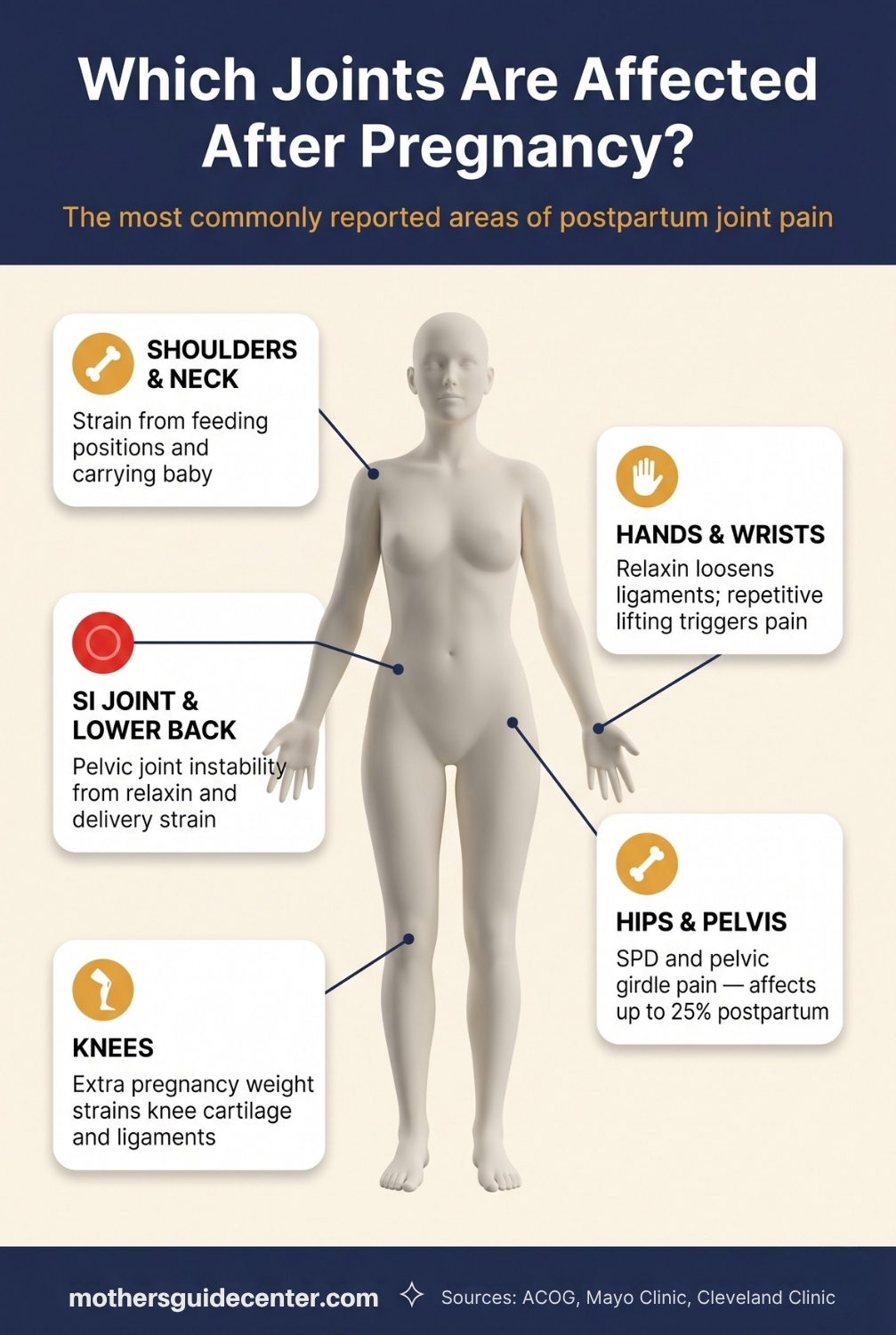
If you are breastfeeding, expect a longer timeline. Relaxin continues to be produced during lactation and remains in the body for approximately six weeks after weaning. If you breastfeed for six months, your joints may not reach full hormonal stability until around eight months postpartum. This is normal physiology — but it does mean breastfeeding mothers should be thoughtful about high-impact activities that load the hips and knees before ligament stability is fully restored. Ligaments can take up to 300 days to fully remodel after pregnancy’s hormonal changes.
For most women, joint pain after pregnancy substantially improves by three months and resolves by six months postpartum. Pain that is still worsening after six months — rather than on a gradual improving trajectory — warrants a provider evaluation to rule out an underlying condition such as rheumatoid arthritis or thyroid dysfunction.
What helps joint pain after pregnancy?
The most effective approach to postpartum joint pain combines gentle movement, targeted strengthening, and practical self-care — not complete rest. Resting completely allows muscles to weaken further and increases joint instability. A 2025 systematic review and meta-analysis in the British Journal of Sports Medicine found that exercise targeting the trunk and joint-stabilizing musculature significantly reduced pain severity and disability in women with postpartum musculoskeletal pain.
Evidence-based relief options
For a broader view of postpartum physical recovery, see our complete postpartum recovery guide.
Frequently asked questions
Is joint pain after pregnancy normal?
Yes, joint pain after pregnancy is very common and expected. During pregnancy, your body produces relaxin and other hormones that loosen ligaments and joints throughout the body to prepare for childbirth. After delivery, these hormones gradually normalize — but the process takes weeks to months. Most new mothers experience some degree of joint stiffness or discomfort in the hips, knees, or hands, particularly in the first six weeks postpartum.
How long does postpartum joint pain last?
For most women, postpartum joint pain improves significantly within three to six months as hormones normalize. Relaxin typically remains elevated for up to 12 weeks after delivery, and longer during breastfeeding. Joint pain that persists beyond six months, worsens over time, or affects joints symmetrically on both sides of the body should be evaluated by a healthcare provider for conditions such as rheumatoid arthritis.
Can breastfeeding cause joint pain?
Breastfeeding can prolong joint pain after pregnancy because the hormone relaxin remains elevated during nursing, and for approximately six weeks after you stop. Relaxin loosens ligaments throughout your body — including your hips, knees, and hands — which extends joint instability and discomfort. Breastfeeding mothers are advised to take extra care with high-impact exercise and joint-loading activities until after weaning.
What joints hurt most after having a baby?
The joints most commonly affected after pregnancy are the hips and pelvis (from relaxin and labor strain), knees (from pregnancy weight gain and gait changes), fingers and knuckles (from repetitive lifting and hormonal effects), and the sacroiliac joint in the lower back. The neck and shoulders are also frequently affected from breastfeeding and carrying positions.
When should I see a doctor about joint pain after pregnancy?
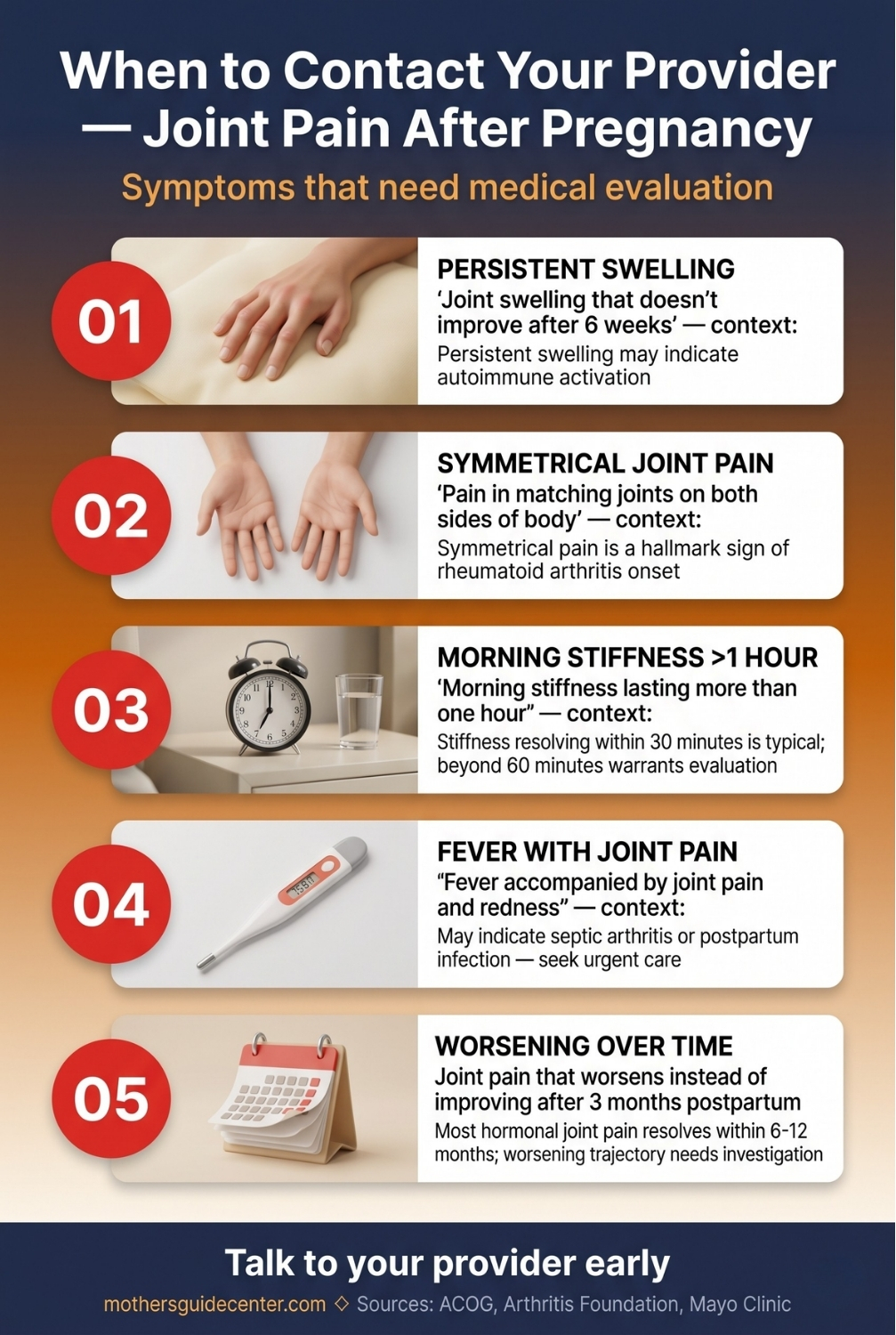
Contact your healthcare provider if you have joint swelling that does not improve after six weeks, pain that affects the same joints on both sides of your body, morning stiffness lasting more than one hour, fever alongside joint pain, or pain that worsens rather than gradually improving. These symptoms can indicate rheumatoid arthritis, lupus, or another autoimmune condition that benefits from early treatment.
Is postpartum joint pain the same as rheumatoid arthritis?
Postpartum joint pain and rheumatoid arthritis are different conditions, but the postpartum period is a known trigger for new-onset RA in susceptible women. Normal postpartum joint pain is caused by hormonal changes, is temporary, and improves over months. RA involves an overactive immune system attacking joint tissue, produces symmetrical joint involvement and prolonged morning stiffness, and requires medical management. If your symptoms fit the RA pattern, ask your provider about testing.
When to contact your healthcare provider
Contact your provider or seek same-day care if you experience:
This article is for educational purposes only and does not replace medical advice from a qualified healthcare provider.
Sources
- American College of Obstetricians and Gynecologists. (2024). Exercise After Pregnancy. ACOG.org.
- Cleveland Clinic. (2024). Symphysis Pubis Dysfunction (SPD). ClevelandClinic.org.
- Cleveland Clinic. (2023). Joint Pain: Causes and Treatment. ClevelandClinic.org.
- American Physical Therapy Association — Pelvic Health. (2025). Pregnancy and Postpartum Physical Therapy. aptapelvichealth.org.
- Ruchat, S.-M., Beamish, N., Pellerin, S., et al. (2025). Impact of exercise on musculoskeletal pain and disability in the postpartum period: a systematic review and meta-analysis. British Journal of Sports Medicine, bjsports-2024-108488.
- National Health Service UK. (2023). Pelvic pain in pregnancy. NHS.uk.
- Autoimmune Institute. (2026). Why Autoimmunity Emerges Postpartum and How to Recognize It. autoimmuneinstitute.org.
- Al-Eisa, E., et al. (2021). Sacroiliac Joint and Pelvic Dysfunction in Postpartum Women. PMC/NIH.
- Karaaslan, O., et al. (2023). Knee Joint Proprioception in 12-Week Postpartum Women. PMC/NIH.
- Dar a Luz Birth and Health Center. (2024). Relaxing Into the Hormone RELAXIN. daraluzbirthcenter.org.