
Postpartum brain fog is a temporary period of forgetfulness, difficulty concentrating, and mental haziness that many women experience after childbirth. According to research cited by the Smithsonian, up to 80% of new mothers report cognitive changes during the postpartum period. These shifts are driven by hormonal fluctuations, sleep deprivation, and structural brain changes that support your transition into caregiving.
Key takeaways
You walked into the kitchen and forgot why. You lost your phone — it was in the fridge. You started a sentence and the words just vanished. If this sounds familiar, you are far from alone. That frustrating haze that settles over your thinking after childbirth has a name: postpartum brain fog.
Often called “mom brain” or “baby brain,” these cognitive changes affect the vast majority of new mothers and are now backed by a rapidly growing body of neuroscience research. Far from being a sign that something is wrong with you, postpartum brain fog reflects your brain adapting to the enormous demands of caring for a newborn — though understanding that does not make it any less frustrating in the moment. This guide explains what causes postpartum brain fog, how long it typically lasts, what the latest brain research reveals, and when the fog might signal something that warrants a conversation with your healthcare provider.
What is postpartum brain fog?
Postpartum brain fog is a collection of temporary cognitive changes — including forgetfulness, difficulty concentrating, slower processing speed, and a general sense of mental cloudiness — that many women experience in the weeks and months following childbirth. While “mom brain” is not a formal medical diagnosis, the underlying experience is well-documented in scientific literature and supported by brain imaging studies.
According to research covered by the Smithsonian, up to 80% of pregnant and postpartum women report memory and focus changes. These changes are not random. They reflect a complex interplay of hormonal shifts, sleep disruption, increased mental load, and actual structural reorganization within your brain — all of which serve the purpose of helping you attune to your baby’s needs.
The important thing to understand is that postpartum brain fog is not cognitive decline. Your brain is not breaking down. It is remodeling — and that distinction matters, both for your peace of mind and for knowing when to seek help.
What causes postpartum brain fog?
The causes of postpartum brain fog are multifactorial, meaning no single factor is responsible. Instead, several biological and environmental forces converge during the postpartum period to create the conditions for cognitive fogginess.
Hormonal shifts. During pregnancy, estrogen and progesterone levels rise dramatically — in some cases 100 to 1,000 times above baseline. After delivery, these hormones plummet within days. According to the National Institutes of Health (NIH), these hormonal fluctuations directly affect brain structure and function, including regions involved in memory, attention, and emotional regulation.
Sleep deprivation. Fragmented sleep is one of the most powerful contributors to brain fog. Newborns typically wake every 2 to 3 hours, and chronic sleep disruption impairs attention, response time, learning, and memory consolidation. As psychiatrist Dr. Sogand Ghassemi of PrairieCare has noted, fragmented sleep is now recognized as an independent risk factor for postpartum mood disorders — not merely a consequence of caregiving.
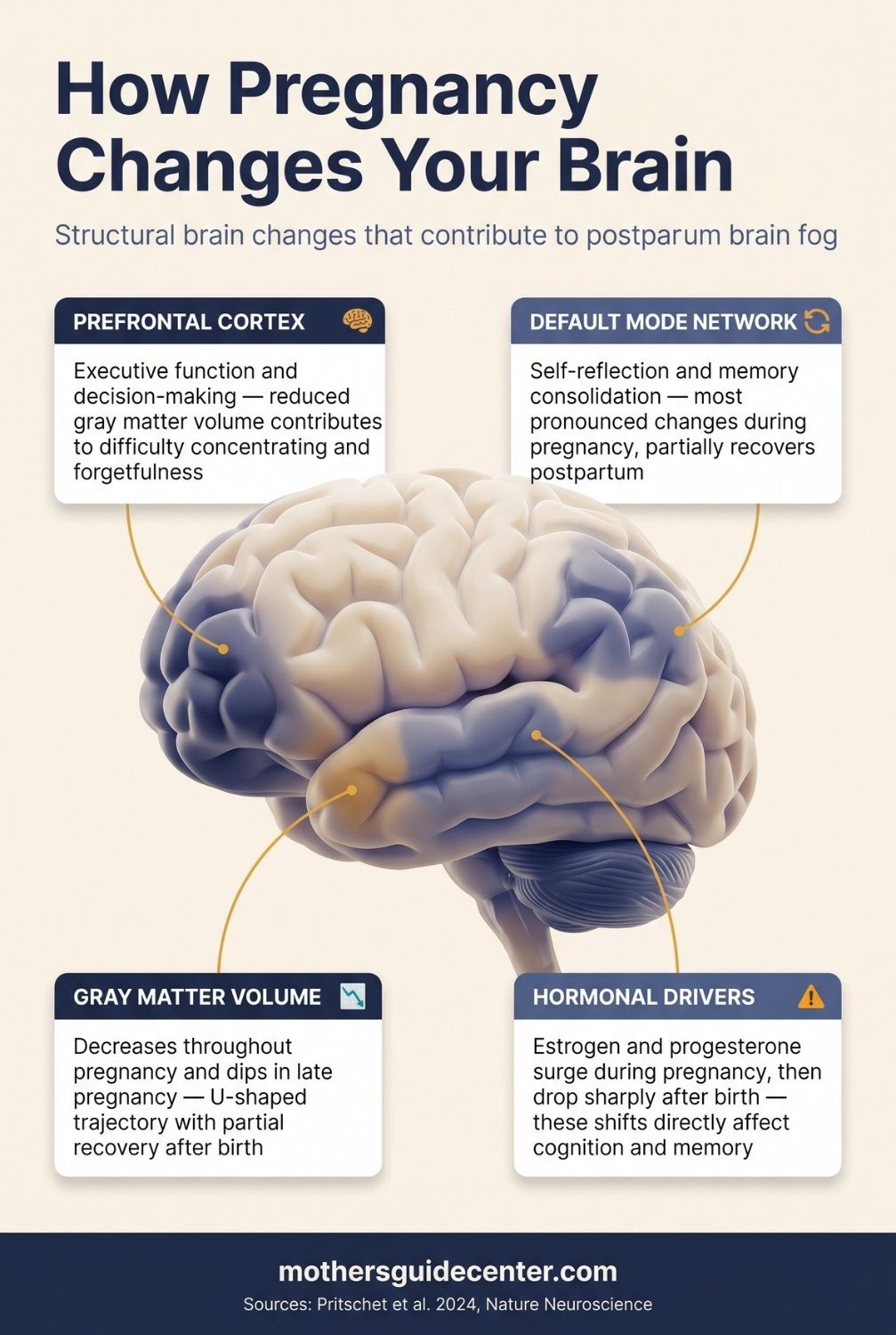
Structural brain changes. Landmark research published in Nature Neuroscience has demonstrated that pregnancy causes measurable reductions in gray matter volume across multiple brain regions. These changes are not damage — they appear to reflect a pruning process similar to what occurs during adolescence, fine-tuning neural circuits for the demands of parenthood.
Mental load and stress. The cognitive demands of caring for a newborn are enormous. Tracking feeding schedules, monitoring sleep patterns, managing medical appointments, and maintaining awareness of safety — all while recovering physically from birth — places extraordinary strain on working memory and executive function.
How does pregnancy change your brain?
Pregnancy triggers widespread structural changes in the brain that researchers are only beginning to map in detail. A groundbreaking 2024 study funded by the NIH and published in Nature Neuroscience collected 26 MRI brain scans from a single first-time mother — from three weeks before conception through two years after giving birth. The results revealed pronounced decreases in cortical gray matter volume and cortical thickness throughout pregnancy, with partial recovery after birth.
An earlier study by Hoekzema and colleagues (2017) at Amsterdam University Medical Center found that these gray matter reductions were concentrated in regions involved in social cognition — the brain networks responsible for reading other people’s emotions, detecting danger, and understanding nonverbal cues. Crucially, the degree of change predicted stronger maternal attachment to the baby. The brain was not deteriorating. It was specializing.
A 2025 follow-up study published in Nature Communications revealed that gray matter volume follows a U-shaped trajectory: it dips during late pregnancy, reaches its lowest point around delivery, and then partially rebounds during the postpartum months. This recovery pattern aligns with what most mothers experience — peak brain fog in the early weeks, followed by gradual improvement.
What are the symptoms of postpartum brain fog?
The most common symptoms of postpartum brain fog include forgetfulness, difficulty concentrating, word-finding problems, slower mental processing, and a persistent sense of being “one step behind.” This experience — sometimes described as postpartum memory loss — tends to be most noticeable in the first six weeks after birth and gradually improves as hormones stabilize and sleep quality increases.
Specific experiences mothers commonly report include misplacing everyday items like keys or phones, walking into a room and forgetting the reason, losing your train of thought mid-conversation, struggling to recall names or words that were previously automatic, difficulty switching between tasks, and feeling mentally exhausted even after rest.
It is important to recognize that these symptoms can vary significantly from day to day. You may feel sharper on days when you slept better or had more support, and foggier during periods of high stress or poor rest. This variability is normal and expected — your brain is navigating an enormous transition, and some days will feel harder than others.
How long does postpartum brain fog last?
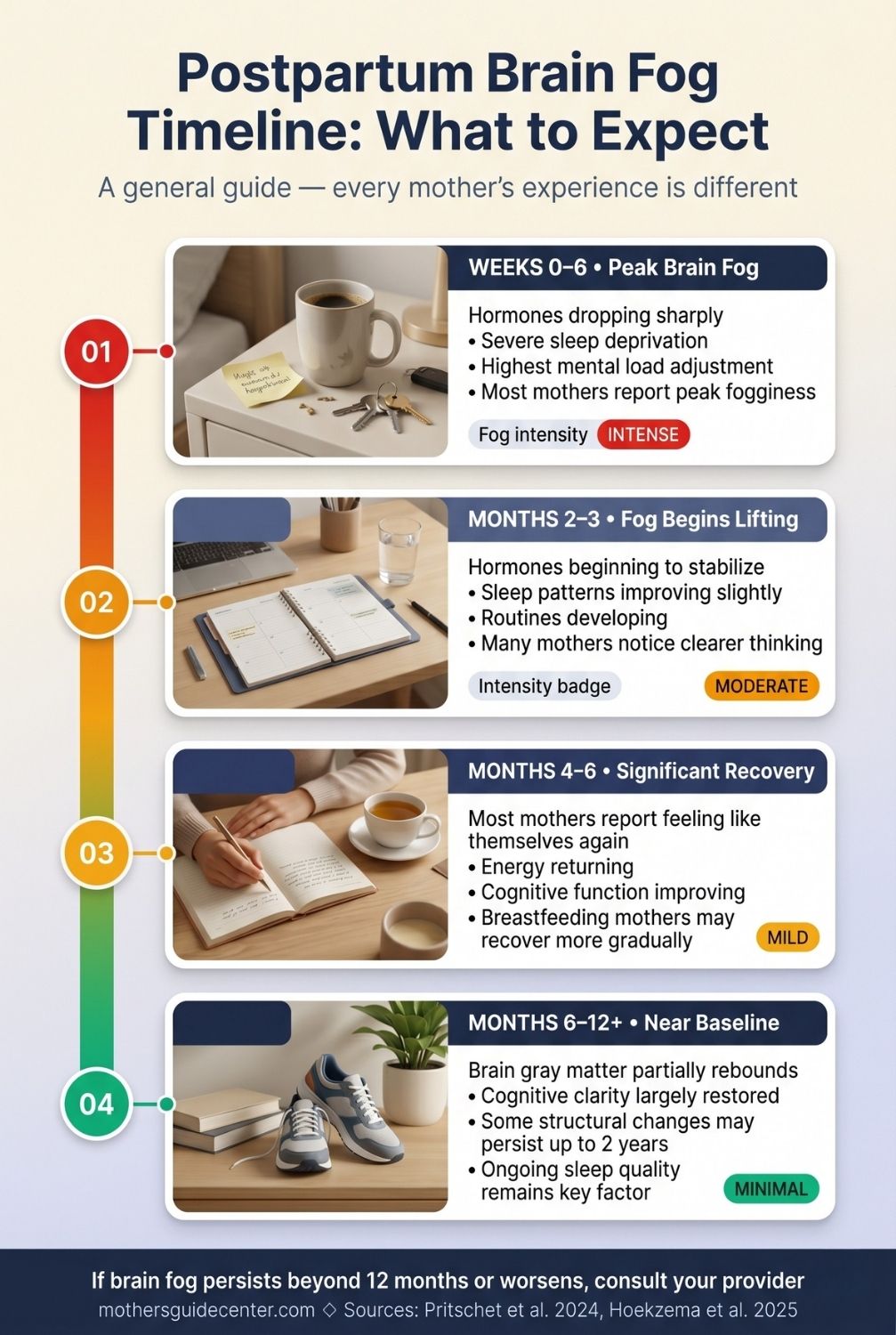
Postpartum brain fog typically follows a general timeline, though every mother’s experience is different. Most experts and current research suggest the following pattern: the fog is at its most intense during the first 6 weeks postpartum, when hormonal shifts are steepest and sleep deprivation is greatest. Around 2 to 3 months, many mothers begin noticing improvement as hormones start to stabilize and daily routines develop.
By 4 to 6 months postpartum, most mothers report feeling significantly more like themselves. According to Henry Ford Health, the fuzzy thinking typically eases by the time a baby is six months old. However, the 2017 Nature Neuroscience study found that some structural brain changes can persist for at least two years after giving birth, and the 2025 Nature Communications study confirmed that gray matter recovery follows a gradual U-shaped trajectory rather than a sudden return to baseline.
Several factors influence how long the fog lasts for you: the quality and quantity of sleep you are getting, your nutritional status (particularly iron, B12, and omega-3 levels), whether you have adequate practical support, your stress levels, and whether you are breastfeeding. If brain fog is not improving by 6 months postpartum — or is getting worse — talk to your healthcare provider, as this may warrant evaluation for underlying conditions.
Does breastfeeding make brain fog worse?
Breastfeeding does not directly cause brain fog, but it does increase your body’s demand for nutrients that are critical for brain function. During lactation, your body prioritizes your baby’s nutritional needs — sometimes at your expense. Key nutrients drawn upon at higher rates during breastfeeding include omega-3 fatty acids (particularly DHA), iron, vitamin B12, iodine, choline, and vitamin D.
If your diet does not adequately replenish these stores, the resulting deficiencies can contribute to fatigue, difficulty concentrating, and worsened brain fog. According to the Cleveland Clinic, postpartum thyroiditis — which affects approximately 5 to 10% of new mothers — can also cause symptoms that closely mimic brain fog, including fatigue, difficulty concentrating, and memory problems. A simple blood test can check thyroid function and rule out this treatable condition.
If you are breastfeeding and experiencing persistent brain fog, discuss nutritional screening with your provider. Addressing deficiencies through diet or guided supplementation can make a meaningful difference in how clear your thinking feels.
How can you manage postpartum brain fog?
Managing postpartum brain fog involves addressing its root causes — sleep, nutrition, stress, and support — rather than trying to willpower your way through it. While no single strategy eliminates the fog overnight, a combination of small, practical changes can meaningfully improve your cognitive clarity over time.
Protect your sleep. Sleep is the single most powerful tool available to you. Even short naps of 20 to 30 minutes can improve attention and working memory. Share nighttime feeding duties with a partner when possible, and try to rest when your baby sleeps — even if it means letting other tasks wait. As Dr. Ghassemi of PrairieCare has emphasized, reframing sleep as a clinical intervention rather than a luxury is an essential shift in postpartum care.
Eat for your brain. Focus on nutrient-dense meals rich in protein, healthy fats, and iron-rich foods. Foods high in omega-3 fatty acids — such as salmon, sardines, walnuts, and flaxseed — support brain health. If you suspect nutritional deficiencies, ask your provider about blood work to check iron, B12, vitamin D, and thyroid function.
Externalize your memory. Use lists, reminders, phone alarms, and a shared family calendar to reduce the burden on your working memory. This is not a crutch — it is a practical strategy that frees mental resources for the decisions that actually require your full attention.
Move your body. Even gentle exercise — a 15-minute walk with the stroller — increases blood flow to the brain, boosts endorphins, and improves mood and focus. Exercise does not need to be intense to be beneficial.
Ask for help directly. Mental load sharing matters. Be specific when asking for support: “I need you to handle bedtime tonight” is more effective than “I need help.” Reducing the invisible labor of planning and tracking creates mental space for your own cognitive recovery.
Is postpartum brain fog the same as postpartum depression?
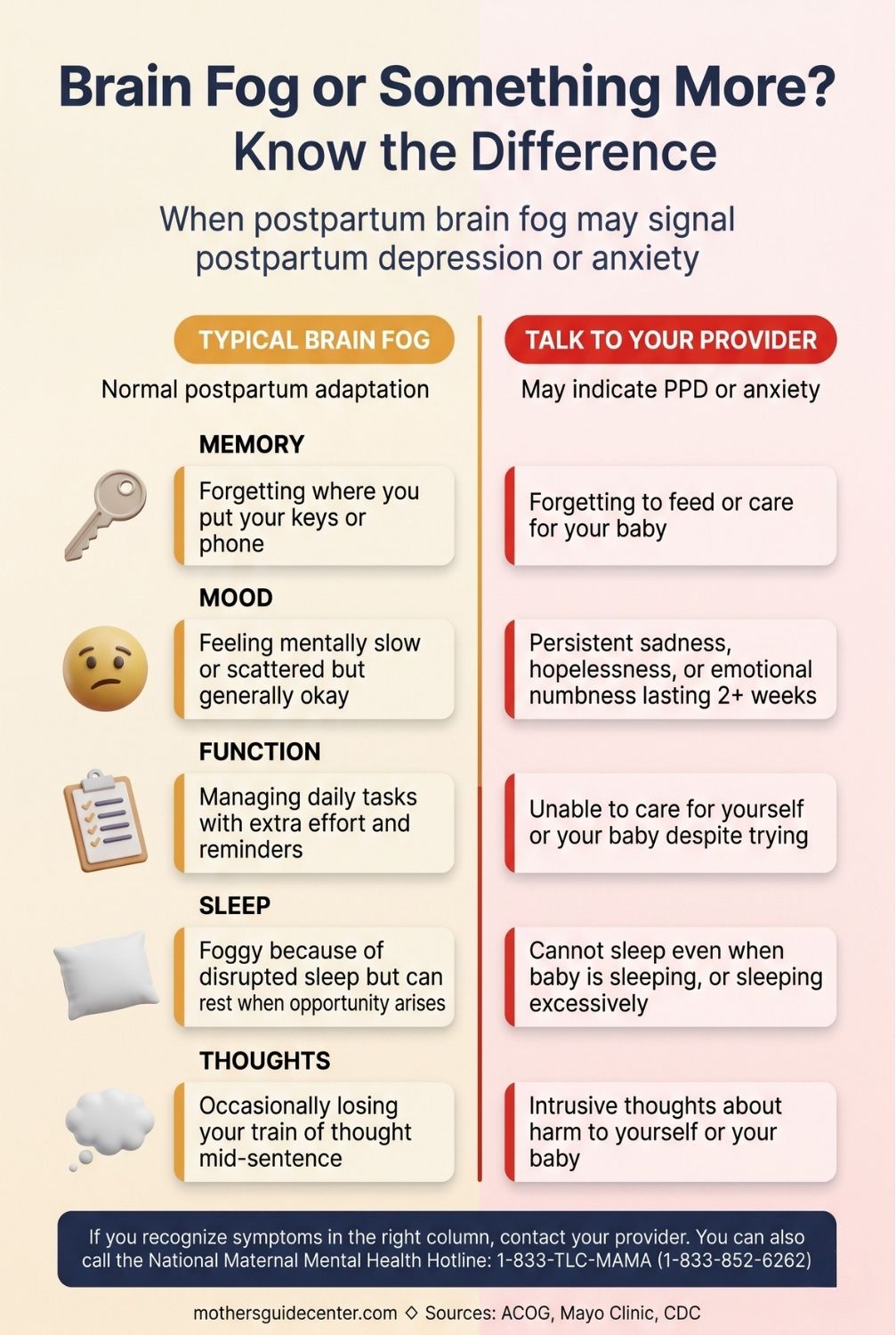
Postpartum brain fog and postpartum depression (PPD) are not the same thing, but they can overlap in ways that make them difficult to distinguish. Brain fog on its own — forgetfulness, difficulty concentrating, feeling mentally slow — is a normal part of the postpartum transition for most mothers. Postpartum depression, by contrast, is a clinical mood disorder that affects approximately 1 in 8 women who have recently given birth, according to the CDC.
The key distinction lies in what accompanies the fog. According to the Mayo Clinic, PPD includes symptoms that go beyond cognitive changes: persistent sadness or emptiness, loss of interest in activities you once enjoyed, difficulty bonding with your baby, excessive guilt or feelings of worthlessness, changes in appetite, withdrawal from family and friends, and in severe cases, thoughts of harming yourself or your baby.
| Feature | Typical Brain Fog | May Indicate PPD |
|---|---|---|
| Memory | Forgetting where you put your keys | Forgetting to feed or care for your baby |
| Mood | Feeling scattered but generally okay | Persistent sadness, hopelessness, or numbness for 2+ weeks |
| Function | Managing tasks with extra effort | Unable to care for yourself or baby despite trying |
| Sleep | Foggy from broken sleep, can rest when possible | Cannot sleep even when baby sleeps, or sleeping excessively |
| Thoughts | Losing your train of thought mid-sentence | Intrusive thoughts about harm to yourself or your baby |
If you recognize yourself in the right column, please reach out to your healthcare provider. PPD is common, treatable, and not your fault. Early support — whether through therapy, medication, or both — can make a significant difference within weeks.
Frequently asked questions
Is postpartum brain fog real?
Yes, postpartum brain fog is a well-documented experience supported by neuroscience research. A 2024 study published in Nature Neuroscience mapped widespread structural brain changes during pregnancy using MRI scans, and a 2017 study confirmed that pregnancy causes long-lasting gray matter reductions in regions involved in social cognition. While not a formal diagnosis, the cognitive changes are real and measurable.
How long does mom brain last?
Mom brain typically begins to improve around 2 to 3 months postpartum, with most mothers feeling significantly better by 4 to 6 months. However, some structural brain changes may persist for up to two years after delivery, and factors like sleep quality, nutritional status, and ongoing stress levels all influence how quickly cognitive clarity returns.
Can postpartum brain fog be permanent?
Postpartum brain fog is not considered a permanent condition. Research shows that gray matter volume follows a U-shaped pattern, dipping during late pregnancy and gradually recovering postpartum. While some brain changes may linger for years, they do not represent cognitive decline — they reflect neural adaptation. If fog persists beyond 12 months or worsens, consult your provider to rule out other causes.
Does postpartum brain fog affect fathers too?
Fathers and non-birthing partners can experience cognitive fog related to sleep deprivation, stress, and the mental load of new parenthood — though they do not undergo the same hormonal shifts or structural brain changes as birthing mothers. Research from the Maternal Brain Project suggests that paternal brains also undergo some remodeling in response to caregiving, though the mechanisms differ from those in mothers.
Can thyroid problems cause brain fog after pregnancy?
Postpartum thyroiditis is an inflammation of the thyroid gland that affects approximately 5 to 10% of new mothers, according to the Cleveland Clinic. It can cause symptoms that closely resemble brain fog, including fatigue, difficulty concentrating, memory problems, and mood changes. Because it is treatable, thyroid function testing is worth discussing with your provider if brain fog feels disproportionately severe or is not improving.
What foods help with postpartum brain fog?
Foods rich in omega-3 fatty acids (salmon, sardines, walnuts, flaxseed), iron (lean red meat, spinach, lentils), and B vitamins (eggs, dairy, fortified cereals) support brain health during the postpartum period. Adequate hydration also matters — even mild dehydration can impair concentration. Talk to your provider before starting any supplements, especially if you are breastfeeding.
Does brain fog get worse with each pregnancy?
A 2026 study from Amsterdam UMC found that the brain changes occurring during a second pregnancy differ from those in a first pregnancy — rather than repeating the same pattern, the brain appears to shift its remodeling strategy, affecting different neural networks. This does not necessarily mean the fog is worse, but the experience may feel different. Added sleep deprivation and caring for older children alongside a newborn can intensify the practical impact.
You are not alone
If you are struggling with your mental health, free and confidential support is available 24/7. The National Maternal Mental Health Hotline offers help in English and Spanish.
📞 1-833-TLC-MAMA
(1-833-852-6262)
When to contact your healthcare provider
Contact your provider or seek immediate care if you experience:
This article is for educational purposes only and does not replace medical advice from a qualified healthcare provider.
Sources
- Pritschet, L., Taylor, C. M., Cossio, D., et al. (2024). Neuroanatomical changes observed over the course of a human pregnancy. Nature Neuroscience.
- Hoekzema, E., Barba-Müller, E., Pozzobon, C., et al. (2017). Pregnancy leads to long-lasting changes in human brain structure. Nature Neuroscience, 19(2), 287–296.
- Paternina-Die, M., Martinez-Garcia, M., Martin de Blas, D., et al. (2025). Pregnancy entails a U-shaped trajectory in human brain structure linked to hormones and maternal attachment. Nature Communications.
- National Institutes of Health. (2024). Brain changes observed during pregnancy. NIH Research Matters.
- American College of Obstetricians and Gynecologists. (2024). Postpartum Depression. ACOG.org.
- Mayo Clinic. (2024). Postpartum depression — Symptoms and causes. MayoClinic.org.
- Cleveland Clinic. (2024). Postpartum Thyroiditis. ClevelandClinic.org.
- Centers for Disease Control and Prevention. (2024). Depression Among Women. CDC.gov.
- Health Resources & Services Administration. (2024). National Maternal Mental Health Hotline. HRSA.gov.
- Henry Ford Health. (2025). Mom Brain Is Real. Here’s How to Deal With It. HenryFord.com.
Last updated: June 2026
Reviewed: Sources verified against 10 Tier 1 medical authorities and peer-reviewed studies (NIH, ACOG, Mayo Clinic, Cleveland Clinic, CDC, Nature Neuroscience, Nature Communications, HRSA) on June 2026.
Written by: Mother’s Guide Editorial Team — independent maternal health editorial team. Our process: Editorial Standards.
Mother’s Guide Center is ad-free and independent. We do not accept sponsorships, affiliate partnerships, or product placements. Medical Disclaimer.