
Feeling sick during ovulation — am I pregnant? Almost certainly not. Ovulation nausea is caused by a surge in estrogen and luteinizing hormone (LH), not pregnancy. According to the Cleveland Clinic, ovulation triggers hormonal shifts that can cause nausea, cramping, and bloating in some women. Pregnancy-related nausea doesn’t begin until after implantation, which happens at least 6–12 days after ovulation — so feeling sick on ovulation day itself is almost certainly hormonal.
Key takeaways
- ✓ Nausea during ovulation is driven by estrogen and LH surges, not hCG.
- ✓ Feeling sick during ovulation, am I pregnant? No — the timing is too early for pregnancy symptoms.
- ✓ Pregnancy symptoms begin after implantation (6–12 DPO), not during ovulation.
- ✓ Ovulation nausea is usually short-lived — lasting one to two days at most.
- ✓ Wait until at least 14 DPO (the day of your expected period) for a reliable pregnancy test.
Feeling sick during ovulation — am I pregnant? If you’re trying to conceive and suddenly feel nauseous around the middle of your cycle, your first thought is probably: could this be an early sign of pregnancy? It’s a completely natural reaction — especially when you’re hyperaware of every twinge and shift in your body during the fertile window. But here’s the reassuring truth: the nausea you feel during ovulation is almost always caused by normal hormonal fluctuations, not a newly forming pregnancy.
This guide breaks down exactly why you may feel sick around ovulation, how those symptoms differ from actual early pregnancy signs, and when it’s truly time to take a test. We’ve sourced every claim from Tier 1 medical authorities — ACOG, the Cleveland Clinic, the Mayo Clinic, and NIH — so you can trust what you read at 2 AM when the two-week wait feels endless.
Can you feel sick during ovulation?
Feeling sick during ovulation is a recognized — though less common — symptom of the hormonal changes that accompany egg release. According to the Cleveland Clinic, ovulation is triggered by a surge in luteinizing hormone (LH) that causes an ovary to release a mature egg, and this process involves rapid shifts in estrogen and progesterone that can affect the entire body, not just the reproductive organs.
The more commonly recognized symptoms of ovulation include mild pelvic cramping on one side (called mittelschmerz), changes in cervical mucus, light spotting, breast tenderness, and a slight rise in basal body temperature. The Mayo Clinic notes that mittelschmerz affects roughly 1 in 5 women and typically lasts from a few minutes to a day or two.
Nausea, bloating, and fatigue can also occur during ovulation, though these symptoms tend to be milder and shorter-lived than those experienced in pregnancy. If you’ve noticed a pattern of feeling queasy around the same time each month — roughly mid-cycle — that’s a strong clue your body is responding to ovulation rather than signaling something else.
Why does ovulation make you feel nauseous?
Ovulation-related nausea is a side effect of the hormonal cascade that triggers egg release, not a standalone condition. In the days leading up to ovulation, estrogen levels climb steadily, peaking just before the LH surge. According to the Office on Women’s Health, this estrogen peak is the body’s way of preparing the uterine lining and triggering the release of the egg — but it can also stimulate the gastrointestinal tract, leading to nausea and bloating.
Several factors can amplify ovulation nausea. Prostaglandins — inflammatory compounds that help the follicle rupture and release the egg — can irritate surrounding tissue and trigger GI symptoms in sensitive individuals. Pain itself plays a role: when mittelschmerz is more pronounced, the nervous system’s response to that pelvic discomfort can produce nausea as a secondary symptom.
Other amplifying factors include stress, sleep deprivation, skipped meals, dehydration, and pre-existing conditions such as endometriosis or ovarian cysts, which can intensify ovulation-related discomfort. If you’re taking fertility medications like clomiphene (Clomid) or letrozole, nausea may also be a medication side effect rather than a direct ovulation symptom.
The key hormone to understand here is estrogen, not hCG. Pregnancy nausea is driven by rising human chorionic gonadotropin (hCG) — a hormone that only appears after a fertilized egg implants in the uterine lining. At ovulation, implantation hasn’t happened yet, so hCG is at zero. Any nausea you feel at this point is estrogen- and prostaglandin-driven.
Does feeling sick during ovulation mean you’re pregnant?
If you’re feeling sick during ovulation and wondering am I pregnant, the answer is no — the biological timeline makes it impossible at that point. According to ACOG, pregnancy begins when a fertilized egg successfully implants in the uterine wall, a process that takes at least 6 to 12 days after ovulation. On the day of ovulation itself, fertilization may or may not have occurred, and even if a sperm has met the egg, implantation — and therefore pregnancy — is still days away.
The confusion is understandable. Many ovulation symptoms — nausea, bloating, breast tenderness, fatigue, mild cramping, mood changes — overlap closely with early pregnancy symptoms. Both are driven by hormonal changes, which is why the two-week wait (TWW) between ovulation and a missed period can feel so uncertain. But the underlying hormones are different: ovulation nausea comes from estrogen and LH, while pregnancy nausea comes from hCG, which doesn’t begin rising until after implantation.
If you’re trying to conceive, the nausea you feel at ovulation is your body signaling that it’s doing its job — releasing an egg and creating the conditions for a potential pregnancy. That’s encouraging, but it’s not a confirmation of pregnancy itself. A reliable answer requires waiting until at least 14 days past ovulation (DPO) and taking a home pregnancy test.
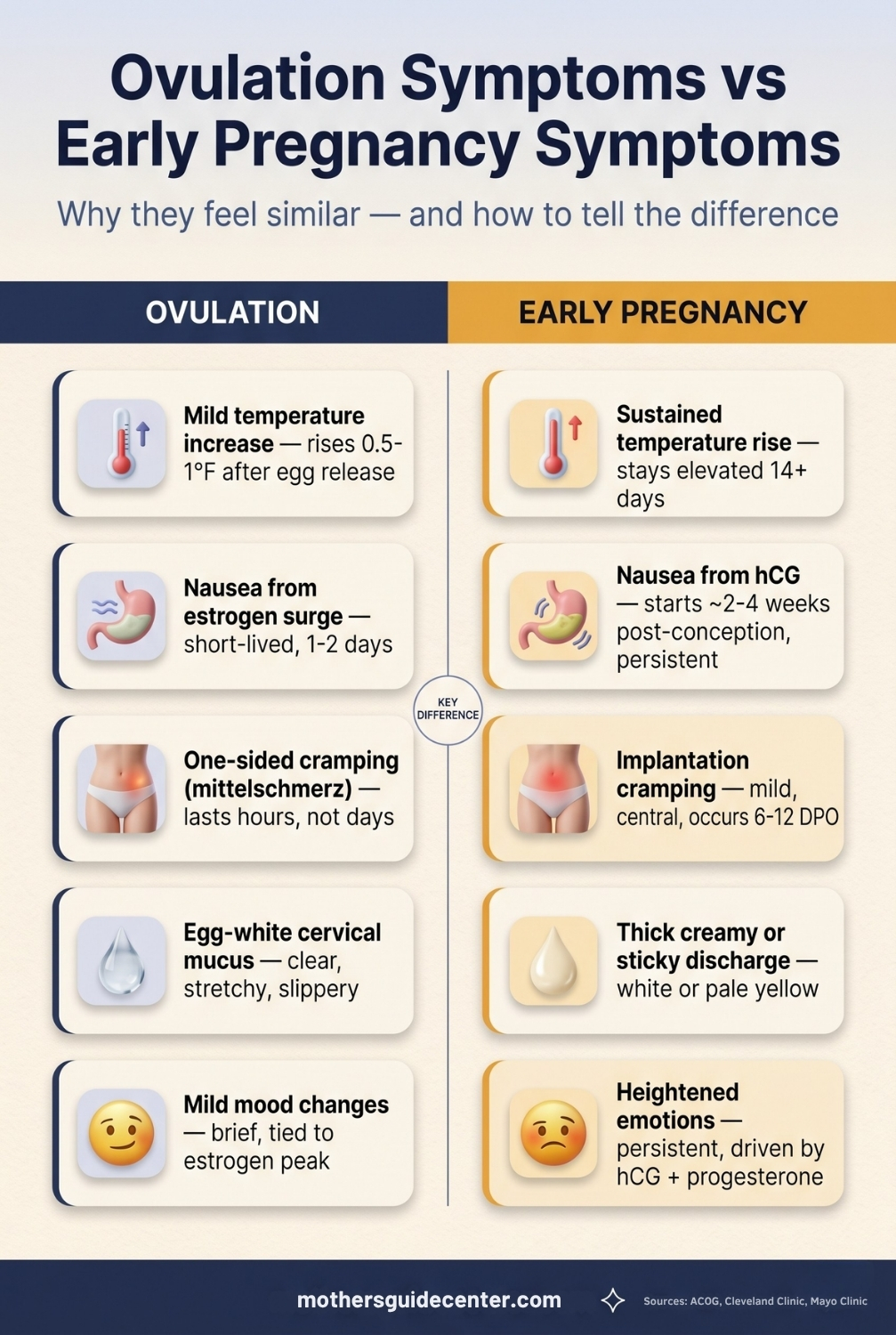
How are ovulation symptoms different from early pregnancy symptoms?
Ovulation symptoms and early pregnancy symptoms are caused by different hormones acting on similar body systems, which is why they feel nearly identical in the moment. The most reliable way to distinguish them is timing, not the sensation itself.
During ovulation, estrogen peaks sharply and then drops, while progesterone begins to rise. These shifts cause short-lived symptoms — typically lasting 24 to 48 hours. In early pregnancy, the hormone hCG enters the picture after implantation and continues to double roughly every 48 to 72 hours, producing symptoms that are more persistent and tend to intensify over days and weeks.
| Symptom | At ovulation | In early pregnancy |
|---|---|---|
| Nausea | Mild, lasts 1–2 days, driven by estrogen surge | Persistent, worsens over weeks, driven by hCG |
| Cramping | One-sided (mittelschmerz), hours to 1 day | Mild, central, occurs 6–12 DPO (implantation) |
| Discharge | Clear, stretchy, egg-white texture | Thick, creamy, white or pale yellow |
| Temperature | Rises ~0.5–1°F after ovulation, then drops before period | Stays elevated beyond 14 days |
| Timing | Mid-cycle (day ~14 of 28-day cycle) | After missed period (~14+ DPO) |
The single most telling difference is duration. Ovulation symptoms resolve within a day or two as hormone levels stabilize. Early pregnancy symptoms, particularly nausea and breast tenderness, persist and worsen because hCG levels keep climbing. If your symptoms started at mid-cycle and disappeared within 48 hours, ovulation is the far more likely explanation.
How soon after ovulation can pregnancy symptoms actually start?
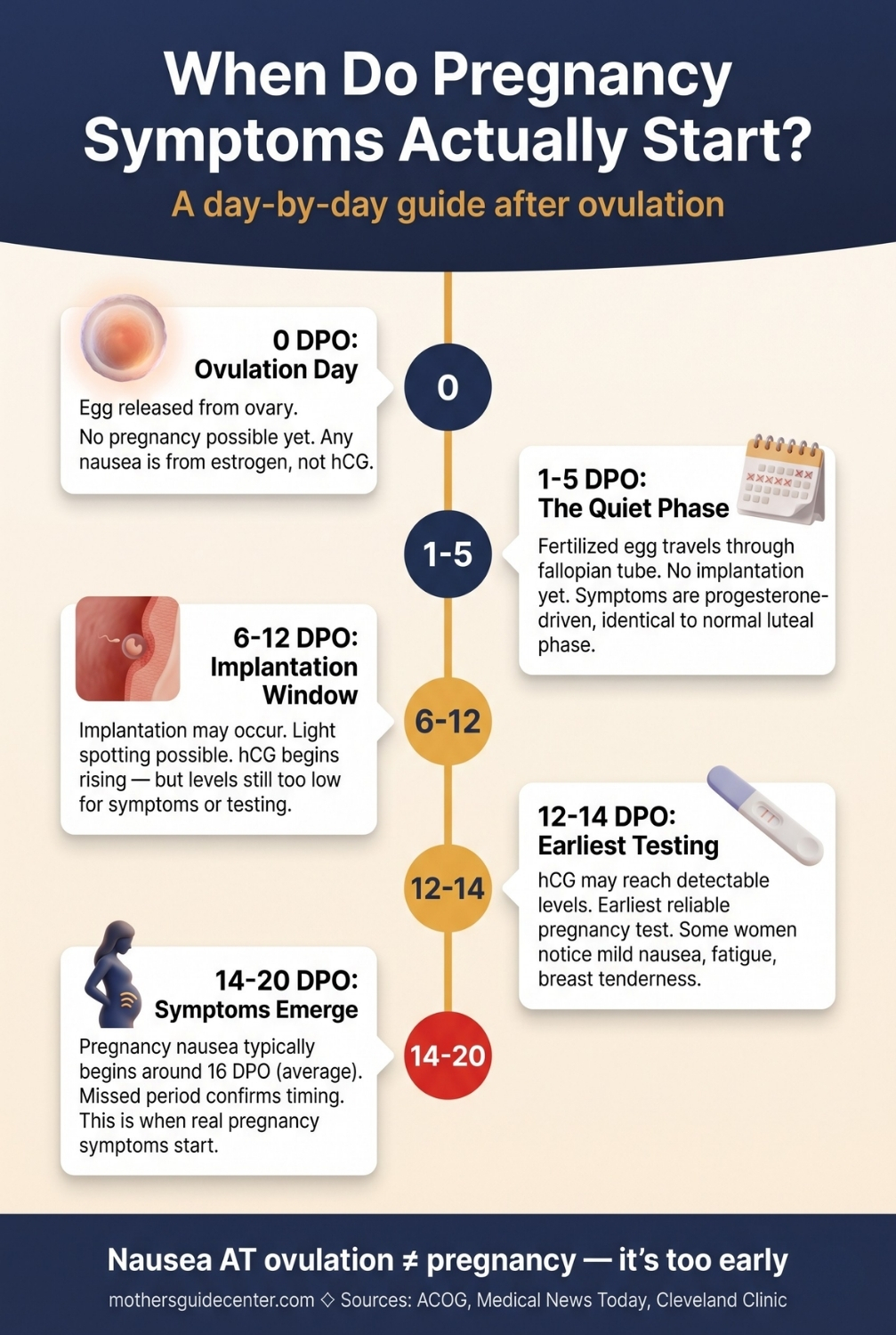
Pregnancy symptoms can only begin after implantation — the point at which a fertilized egg embeds into the uterine lining and the body starts producing hCG. According to the NIH (MedlinePlus), implantation typically occurs between 6 and 12 days past ovulation (DPO), with most implantation events happening around 8–10 DPO.
Even after implantation, hCG levels start very low and need time to build. This is why the Mayo Clinic recommends waiting until the first day of a missed period — roughly 14 DPO — before taking a home pregnancy test. Testing too early, even if you’re technically pregnant, often produces a false negative because hCG hasn’t risen enough to be detected.
Pregnancy nausea specifically — what most people call “morning sickness” — tends to start around 2 to 8 weeks after conception, with the average onset at roughly 16 DPO (about 2 days after the missed period). Some women notice very mild nausea or fatigue as early as 10–12 DPO, but these symptoms are indistinguishable from normal luteal phase progesterone effects, which is why they’re unreliable indicators on their own.
The bottom line: if you feel nauseous on the day of ovulation or within the first 5 days after, pregnancy is not the cause. If nausea appears around 10–14 DPO and persists, that’s when a pregnancy test becomes worthwhile.
How can you relieve nausea during ovulation?
Ovulation nausea is a self-limiting symptom that typically resolves within one to two days as hormone levels stabilize after egg release. While it usually doesn’t require medical treatment, several strategies can help you feel more comfortable during that window.
Stay hydrated. Dehydration intensifies nausea. Sipping water, herbal teas (ginger or peppermint are commonly used), or diluted broth throughout the day can help settle the stomach. Eating smaller, more frequent meals rather than large ones can also prevent the empty-stomach queasiness that compounds hormonal nausea.
Apply warmth. A heating pad on a low setting placed on the lower abdomen can ease mittelschmerz, and when the pain component decreases, the accompanying nausea often subsides too. Gentle movement — a short walk or light stretching — can help reduce bloating and improve digestion.
Consider OTC options carefully. Over-the-counter antacids or anti-nausea medications can provide relief, but if you’re actively trying to conceive, talk to your healthcare provider before taking any new medication during the luteal phase. Some women find that tracking their cycles helps them anticipate ovulation nausea and plan ahead with preventive measures like adjusting meal timing.
If nausea consistently disrupts your daily life each cycle or is accompanied by severe pain, vomiting, or other intense symptoms, speak with your provider. Persistent or worsening mid-cycle symptoms may warrant investigation for conditions like endometriosis or ovarian cysts.
Frequently asked questions
Can ovulation make you throw up?
Vomiting during ovulation is uncommon but possible. Ovulation nausea is typically mild and rarely progresses to actual vomiting. If you experience severe nausea with vomiting at ovulation, the cause may be intense mittelschmerz pain triggering a vagal response, a pre-existing condition like endometriosis, or a side effect of fertility medication. Consult your provider if it happens regularly.
Is nausea at ovulation a sign of good fertility?
Nausea at ovulation is not a direct indicator of fertility quality. It reflects hormonal sensitivity, which varies between individuals. Some women with perfectly healthy fertility never experience ovulation nausea, while others with fertility challenges do. According to the Cleveland Clinic, what matters is whether ovulation is occurring regularly — not the intensity of the symptoms accompanying it.
How many days does ovulation nausea last?
Ovulation nausea is a short-lived symptom that typically lasts one to two days — roughly the same duration as ovulation itself. The nausea usually peaks on the day of or day after egg release, then resolves as estrogen drops and progesterone rises to dominate the luteal phase. If nausea persists beyond three days, other causes should be considered.
Can you get a positive pregnancy test during ovulation?
A pregnancy test cannot be positive during ovulation. Home pregnancy tests detect hCG, which only appears after implantation — at least 6 to 12 days after ovulation. According to the Mayo Clinic, the earliest reliable time to test is around 14 DPO, ideally on the first day of a missed period. Testing at ovulation will always return a negative result regardless of whether conception occurs.
Does ovulation pain always mean you released an egg?
Ovulation pain (mittelschmerz) is a common sign of ovulation, but it does not guarantee egg release. According to the Mayo Clinic, the pain may come from follicular growth or fluid released when the follicle ruptures. Some women experience similar mid-cycle sensations during anovulatory cycles. The most reliable confirmation of ovulation is a sustained rise in basal body temperature or a positive LH test followed by a temperature shift.
When should I take a pregnancy test if I feel sick after ovulation?
If you feel sick after ovulation and suspect pregnancy, wait until at least 14 days past ovulation (DPO) before testing — ideally the day of your expected period. Testing earlier often produces false negatives because hCG levels haven’t risen enough for detection. Use a first-morning urine sample for the most concentrated hCG reading. If the test is negative but your period hasn’t arrived, retest in two to three days.
When to contact your healthcare provider
Contact your provider or seek medical evaluation if you experience:
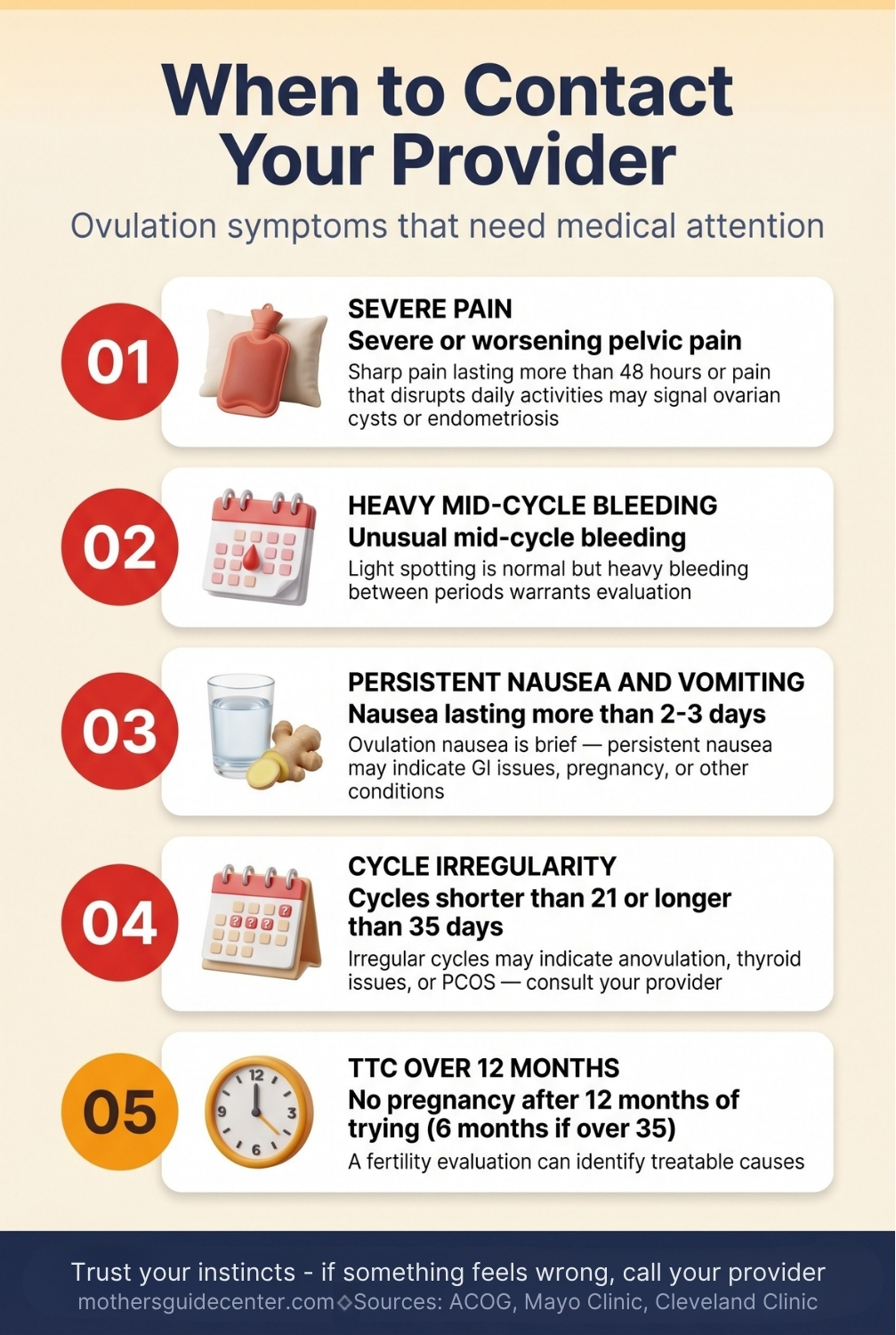
- ⚠️ Severe or worsening pelvic pain — sharp pain lasting more than 48 hours or pain that disrupts daily activities
- ⚠️ Persistent nausea or vomiting — lasting beyond 2–3 days or preventing you from keeping fluids down
- ⚠️ Heavy mid-cycle bleeding — more than light spotting between periods
- ⚠️ Cycles shorter than 21 or longer than 35 days — may indicate anovulation, thyroid issues, or PCOS
- ⚠️ No pregnancy after 12 months of trying (or 6 months if you are 35 or older) — a fertility evaluation can identify treatable causes
This article is for educational purposes only and does not replace medical advice from a qualified healthcare provider.
Sources
- Cleveland Clinic. (2026). Ovulation: Calculating, Process, Pain & Other Symptoms. my.clevelandclinic.org. Retrieved June 2026.
- Mayo Clinic. (2024). Mittelschmerz. mayoclinic.org. Retrieved June 2026.
- Office on Women’s Health. (2025). Your Menstrual Cycle. womenshealth.gov. Retrieved June 2026.
- American College of Obstetricians and Gynecologists. (2019). Fertility Awareness-Based Methods of Family Planning. ACOG.org. Retrieved June 2026.
- National Institutes of Health (MedlinePlus). (2024). HCG Blood Test — Quantitative. medlineplus.gov. Retrieved June 2026.
- Mayo Clinic. (2024). Home Pregnancy Tests: Can You Trust the Results?. mayoclinic.org. Retrieved June 2026.
- American College of Obstetricians and Gynecologists. (2024). Evaluating Infertility. ACOG.org. Retrieved June 2026.
- American Society for Reproductive Medicine. (2022). Optimizing Natural Fertility. reproductivefacts.org. Retrieved June 2026.
- Cleveland Clinic. (2024). Implantation. my.clevelandclinic.org. Retrieved June 2026.