
Most providers recommend waiting at least 24 hours after a vaginal delivery before a tub bath, and 3 to 6 weeks after a C-section, until the incision is fully healed. Sitz baths — shallow warm-water soaks covering only the perineum — are typically safe within 24 hours of vaginal birth, per Mayo Clinic and Cleveland Clinic guidance.
Key takeaways
After delivery, the desire for a warm, calm bath can feel almost as important as sleep. The simple act of soaking — for muscles that have worked for nine months, for tender tissues healing from birth, for a mind processing everything that just happened — is genuinely restorative. But this is also the period when your body is most vulnerable to infection, when cervical, vaginal, or surgical tissues are still actively repairing, and when “what’s normal?” carries real medical weight.
This guide walks you through the evidence-based timeline for postpartum baths based on your delivery type: vaginal birth, C-section, and the sitz bath that nearly every provider recommends for perineal healing. You’ll find specific guidance on bath additives, hot tubs, and how to bathe safely during recovery — plus the warning signs that mean it’s time to call your provider, not run the bath. Recommendations are drawn from ACOG, Mayo Clinic, Cleveland Clinic, the Merck Manual, and institutional hospital guidance, with one consistent principle: your provider’s clearance always trumps a generic timeline.
When can you take a bath postpartum?
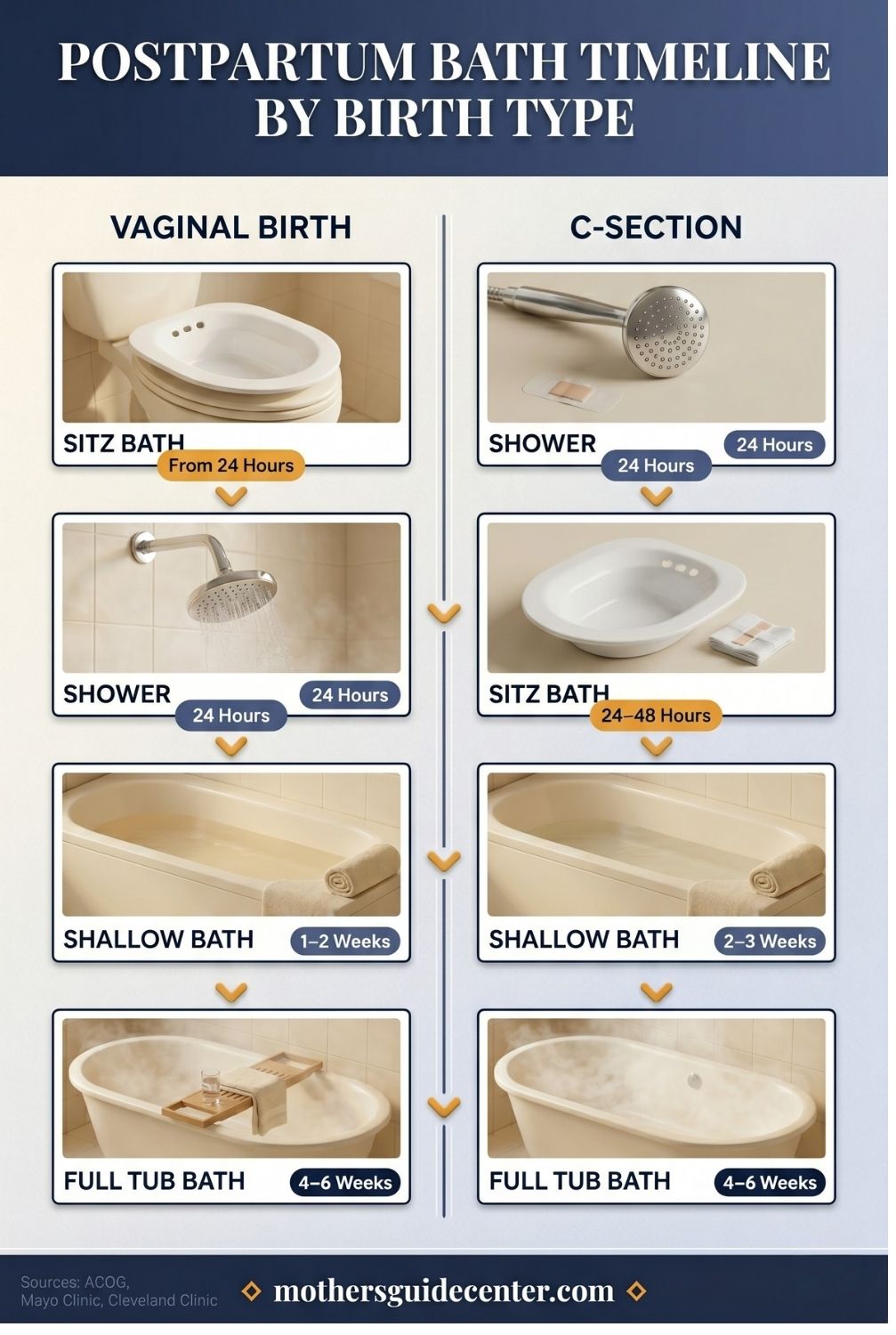
Bath timing after birth depends on your delivery method, incision healing, and provider clearance. For most mothers, a shallow sitz bath that covers only the perineum is safe within 24 hours of a vaginal delivery, while a full tub bath typically waits 1 to 2 weeks (with provider clearance) to 4 to 6 weeks (traditional guidance), depending on stitches, perineal tears, and individual healing. After a C-section, providers generally advise against submerging the incision in a tub until it has fully healed — usually 3 to 6 weeks postpartum.
The often-repeated “6-week rule” has roots in the traditional postpartum check-up timing rather than strict scientific evidence. As midwifery educators reviewing postpartum bathing literature have noted, controlled studies on home-bath infection rates after vaginal birth are limited. What’s well-supported is the underlying caution: the cervix remains partially open in the days after delivery, perineal stitches need time to seal, and any C-section incision is a surgical wound that can re-open or develop infection if exposed to standing water too soon.
The American College of Obstetricians and Gynecologists (ACOG) Committee Opinion 736 reframes postpartum care as an ongoing 12-week process rather than a single 6-week visit. That means bath clearance can come gradually — sitz baths first, shallow tub baths next, full tub immersion later — rather than waiting for one calendar date. Always check with your provider about your specific healing before transitioning from one bath type to the next.
How long after a vaginal delivery can you take a bath?
After a vaginal birth without complications, most providers permit a tub bath within the first 1 to 2 weeks postpartum, though guidance varies by institution. The Mayo Clinic recommends shallow sitz baths from the first day for perineal soreness — sitting in a warm bath “just deep enough to cover your buttocks and hips for five minutes” eases pain, reduces swelling, and supports tissue healing.
The picture becomes more cautious for fuller tub baths. Traditional guidance — common at many hospitals — recommends waiting until the postpartum check-up around 4 to 6 weeks. The reasoning: the cervix is still partially dilated for several weeks after delivery, and theoretically, bath water containing bacteria could enter the uterus through the open cervix and cause infection. Modern research, however, has not strongly confirmed this risk in the home-bath setting. Many OB/GYNs now allow earlier tub bathing with appropriate caution and patient-specific clearance.
Practical guidance for vaginal-birth baths:
If you had a significant tear, an episiotomy, or required stitches that haven’t dissolved, your provider may recommend a longer wait. The general rule: if you’re still experiencing heavy lochia (postpartum bleeding) or have visible perineal stitches, stick to sitz baths and showers until your follow-up appointment confirms healing.
How long after a C-section can you take a bath?
After a cesarean section, current Mayo Clinic and clinical hospital guidance recommends waiting 3 to 6 weeks before submerging the incision in a tub bath, depending on how the wound is healing. The first priority post-surgery is incision care, not bath access.
Most hospitals discharge C-section patients with clear guidance: showering is allowed within 24 hours of the outer dressing being removed, typically 1 to 2 days postoperatively. The Mayo Clinic Health System Mankato campus encourages mothers to shower the day after surgery and daily thereafter — but reserves tub baths for the post-healing window. The Merck Manual Professional Edition reinforces this: patients may shower after the dressing is removed, but they are usually advised to defer immersing in a bath until the wound is fully healed.
Why the longer wait for C-section baths?
Per Cleveland Clinic guidance on physical changes after delivery, once your incision has closed and is dry, you can bathe or shower as usual. Practically, that healing process usually completes between weeks 3 and 6. Universal markers that suggest your incision is bath-ready include no drainage, no surrounding redness or swelling, no opening or gapping along the suture line, and provider clearance at follow-up.
What is a sitz bath and how do you take one?
A sitz bath is a warm, shallow bath that covers only the hips and perineum, designed to ease soreness, support stitch healing, and clean the perineal area gently during postpartum recovery. The Cleveland Clinic describes a sitz bath as soaking your perineum — the area between the anus and the external genitals — to reduce muscle spasms and improve blood circulation, which promotes healing and reduces pain.
You can take a sitz bath two ways:
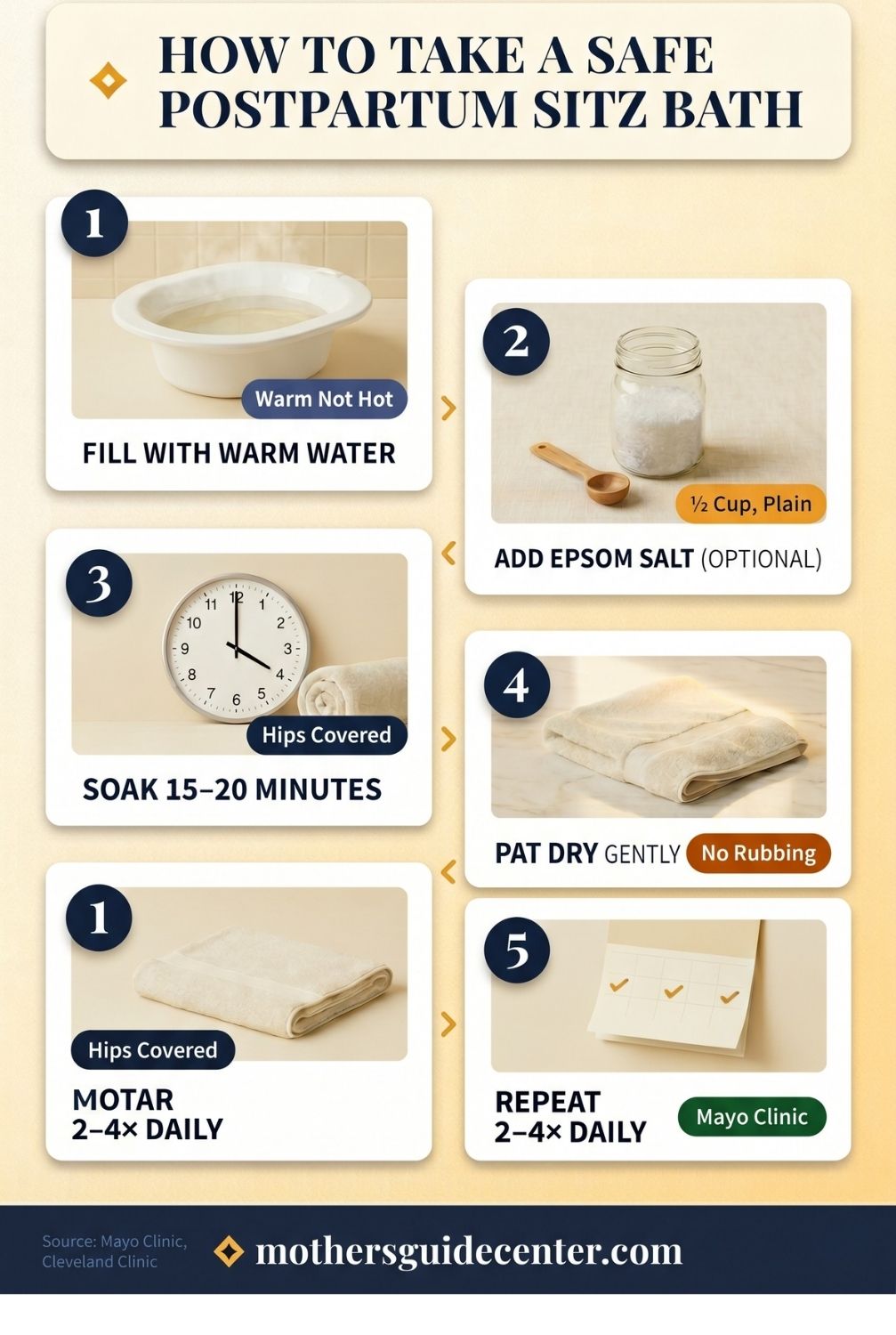
The Cleveland Clinic and Mayo Clinic Health System Mankato outline a consistent protocol:
Plain warm water is enough — the Cleveland Clinic explicitly states no additive is required. Some mothers find cool sitz baths more soothing for swelling; Mayo Clinic notes cool water may feel better than warm for some women after vaginal birth. If you have hemorrhoids, perineal tears, or an episiotomy, sitz baths are usually recommended starting within 24 to 48 hours of birth, on your provider’s go-ahead. Stand up slowly after a sitz bath — postpartum dizziness is common and the warm water can briefly lower blood pressure.
Can you take a bubble bath, Epsom salt bath, or hot tub postpartum?
Most hospitals advise against bubble baths, bath bombs, and scented bath products during the early postpartum weeks because these can irritate healing perineal tissue or C-section incisions. Newton-Wellesley Hospital’s direct postpartum guidance is explicit: avoid use of bubble bath or other bath soaking preparations, as these can irritate and dry the perineum or cesarean incisions.
Here’s how the most common additives and heated baths break down for postpartum:
What should you avoid in a postpartum bath?
Beyond bath additives and hot tubs covered in the previous section, several behavioral habits stay on the avoid list during the first 6 weeks postpartum to protect healing tissue:
How do you take a postpartum bath safely?
A safe postpartum bath uses warm (not hot) water, lasts 15 to 20 minutes maximum, includes no fragranced additives, and is followed by gently patting the perineum or incision dry. Here’s the protocol that works for both sitz baths and full tub baths once cleared:
Before the bath:
During and after the bath:
This protocol holds for both vaginal and C-section recovery. The main differences are timing (when you’re first cleared) and intensity (depth, duration). When in doubt, sit-bath first, soak later.
When should you call your provider after a postpartum bath?
Stop the bath and contact your provider the same day if you notice signs of infection or wound complications. AWHONN’s POST-BIRTH warning signs curriculum identifies fever above 100.4°F (38°C), wound redness or drainage, heavy bleeding, foul-smelling discharge, and severe abdominal pain as primary postpartum red flags requiring same-day evaluation. Per Merck Manual Professional Edition, signs of incision infection include erythema (redness), induration (firmness), purulent discharge, and dehiscence (wound separation).
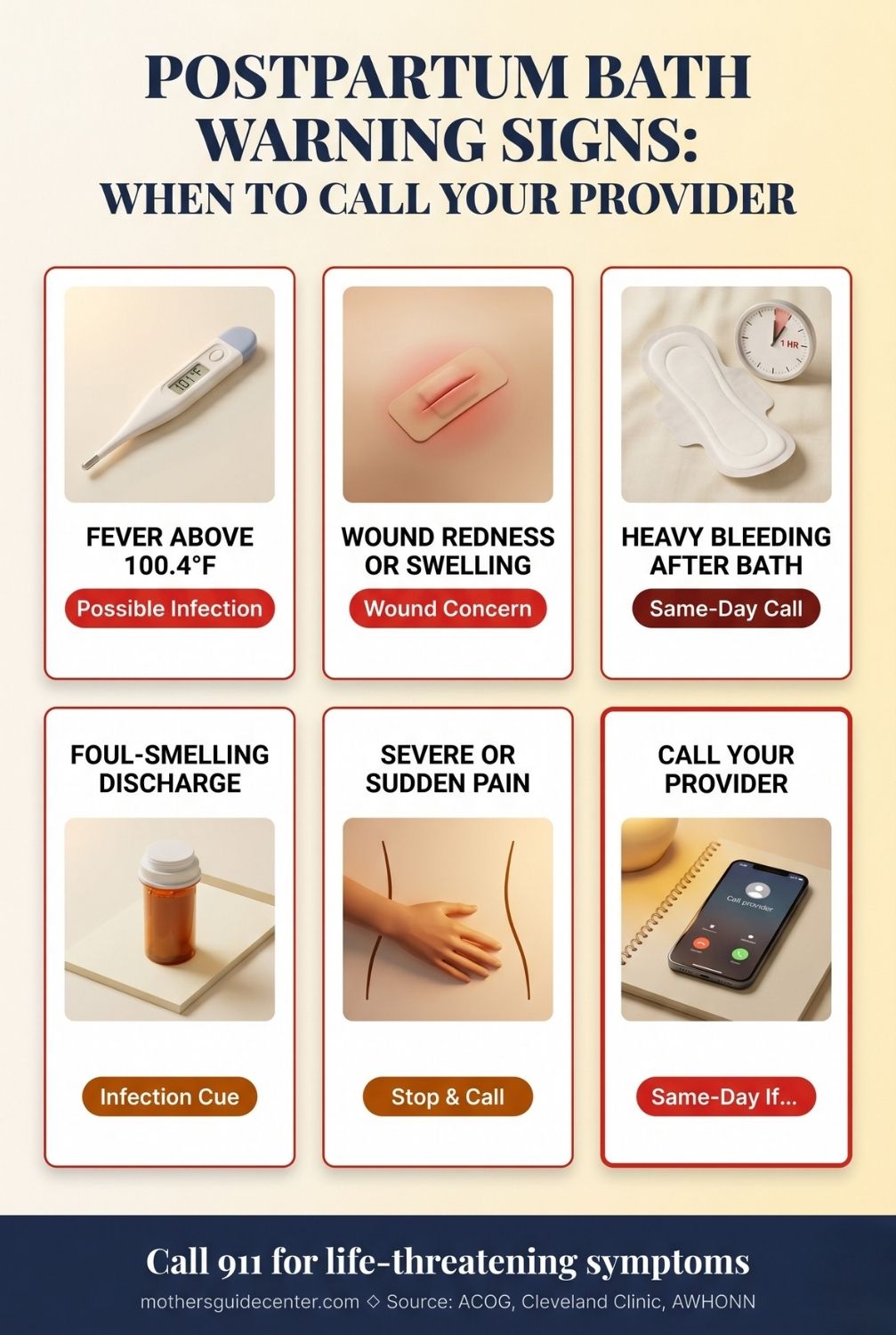
If symptoms include heavy uncontrolled bleeding, severe abdominal pain with fever, signs of stroke (sudden weakness, vision changes, severe headache), or chest pain and difficulty breathing, call 911 — these can indicate life-threatening complications including sepsis, postpartum hemorrhage, or pulmonary embolism. The specific warning signs and emergency triggers are summarized in the boxes below.
Frequently asked questions
Can I take a bath 2 weeks postpartum?
Whether a tub bath is safe at 2 weeks postpartum depends on your delivery type and incision status. After an uncomplicated vaginal birth with no significant tears or stitches, many providers permit a shallow tub bath at 2 weeks. After a C-section, most providers prefer waiting until 3 to 6 weeks until the incision is fully closed and dry. Sitz baths remain safe throughout. Confirm with your provider before transitioning bath types.
How often should I take a sitz bath after birth?
Mayo Clinic Health System Mankato recommends sitz baths 2 to 4 times per day for 15 to 20 minutes during the early postpartum weeks. Some women only need sitz baths for the first week or so after birth; others use them for several weeks while perineal tears or hemorrhoids heal. Use them as long as they feel soothing and your provider has cleared you to continue.
Is Epsom salt safe in a postpartum bath?
Plain Epsom salt is generally considered safe for sitz baths during postpartum recovery. The magnesium sulfate may help reduce swelling and soothe sore tissue, though Cleveland Clinic states plain warm water alone is sufficient. Use about ½ cup per sitz basin or 2 cups per full bathtub of warm water. Avoid scented or flavored Epsom salt blends, which can irritate healing tissue.
Why can’t you take a bath after giving birth?
The traditional 6-week wait is rooted in concern that an open cervix could allow bath water to introduce bacteria into the uterus, and that any perineal or C-section wound needs sealed-tissue time before submersion. Modern research on home-bath infection rates is limited, and many providers now allow earlier tub bathing with appropriate caution. The underlying logic — protecting healing tissue from immersion — remains valid.
Can I take a bath with stitches?
Sitz baths are generally safe with perineal stitches after 24 hours, and may actually support healing by gently cleaning the area. Full tub baths typically require provider clearance based on healing status. If your stitches are dissolvable, they usually do not need to be kept fully dry — but if you have non-dissolvable stitches or staples, your provider may recommend showers only until removal.
When can I take a bath after a C-section incision heals?
Once your C-section incision is fully closed, dry, and free of drainage or surrounding redness — usually between 3 and 6 weeks postpartum — Cleveland Clinic indicates you can bathe or shower as usual. Confirm with your provider at follow-up. After that point, normal bathing resumes, though hot tubs and jacuzzis typically wait until 6 weeks plus provider clearance.
When to contact your healthcare provider
Contact your provider the same day, or seek immediate care, if you experience any of these after a postpartum bath:
This article is for educational purposes only and does not replace medical advice from a qualified healthcare provider.
Sources
- American College of Obstetricians and Gynecologists. (2018, reaffirmed 2021). Optimizing Postpartum Care. Committee Opinion Number 736. ACOG.org.
- Mayo Clinic Staff. (2023). Postpartum care: What to expect after a vaginal birth. MayoClinic.org.
- Mayo Clinic Staff. (2024). C-section recovery: What to expect. MayoClinic.org.
- Mayo Clinic Health System. (n.d.). Postpartum routines for mom. Mankato campus, MayoClinicHealthSystem.org.
- Cleveland Clinic. (2018, reviewed 2024). Pregnancy: Physical Changes After Delivery. ClevelandClinic.org.
- Cleveland Clinic. (2025). Sitz Bath: Uses, How to Take One, and Benefits. ClevelandClinic.org.
- Merck Manual Professional Edition. (2024). Postpartum Care. Gynecology and Obstetrics section, MerckManuals.com.
- Newton-Wellesley Hospital. (n.d.). Daily Adjustments for Postpartum Care. NWH.org.
- Association of Women’s Health, Obstetric and Neonatal Nurses (AWHONN). (2025). Postpartum Care Resources: POST-BIRTH Warning Signs. AWHONN.org.
- NHS. (2023). You and your body just after birth. NHS.uk.